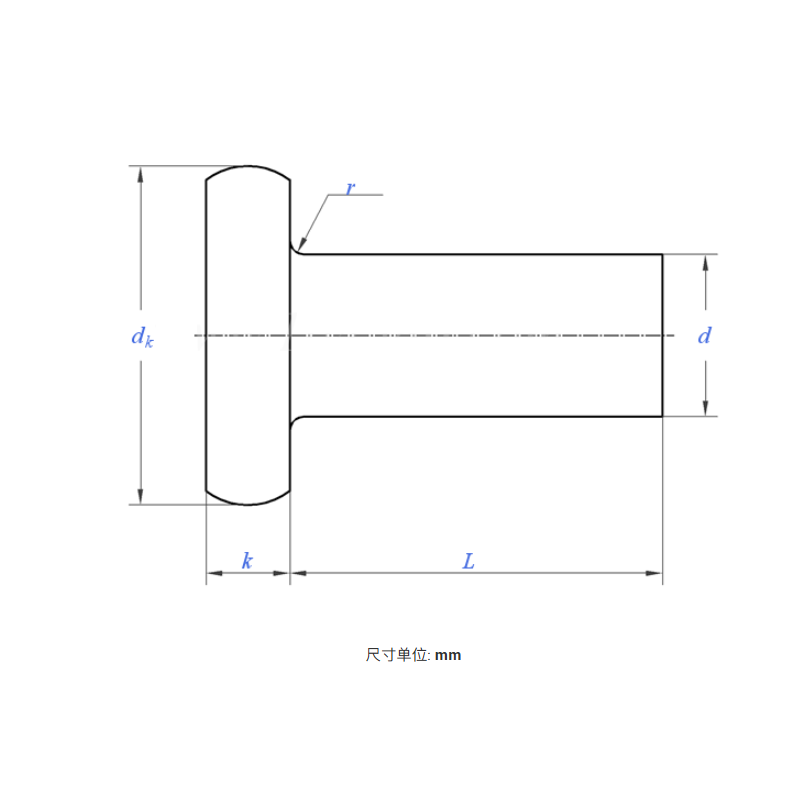
Product Specifications
| Model / Specification | M2 - M10 |
| Material | Aluminum |
| Nom. Dia. d |
Φ2 | Φ2.5 | Φ3 | (Φ3.5) | Φ4 | Φ5 | Φ6 | Φ8 | Φ10 | |
| d | Max. | 2.06 | 2.56 | 3.06 | 3.58 | 4.08 | 5.08 | 6.08 | 8.1 | 10.1 |
| Min. | 1.94 | 2.44 | 2.94 | 3.42 | 3.92 | 4.92 | 5.92 | 7.9 | 9.9 | |
| dk | Max. | 4.24 | 5.24 | 6.24 | 7.29 | 8.29 | 10.29 | 12.35 | 16.35 | 20.42 |
| Min. | 3.76 | 4.76 | 5.76 | 6.71 | 7.71 | 9.71 | 11.65 | 15.65 | 19.58 | |
| k | Max. | 1.2 | 1.4 | 1.6 | 1.8 | 2 | 2.2 | 2.6 | 3 | 3.44 |
| Min. | 0.8 | 1 | 1.2 | 1.4 | 1.6 | 1.8 | 2.2 | 2.6 | 2.96 | |
| r | Max. | 0.1 | 0.1 | 0.1 | 0.3 | 0.3 | 0.3 | 0.3 | 0.5 | 0.5 |
| Wt./1,000 pcs (steel) | - | - | - | - | - | - | - | - | - | |
Flat Head Rivet — Product Introduction
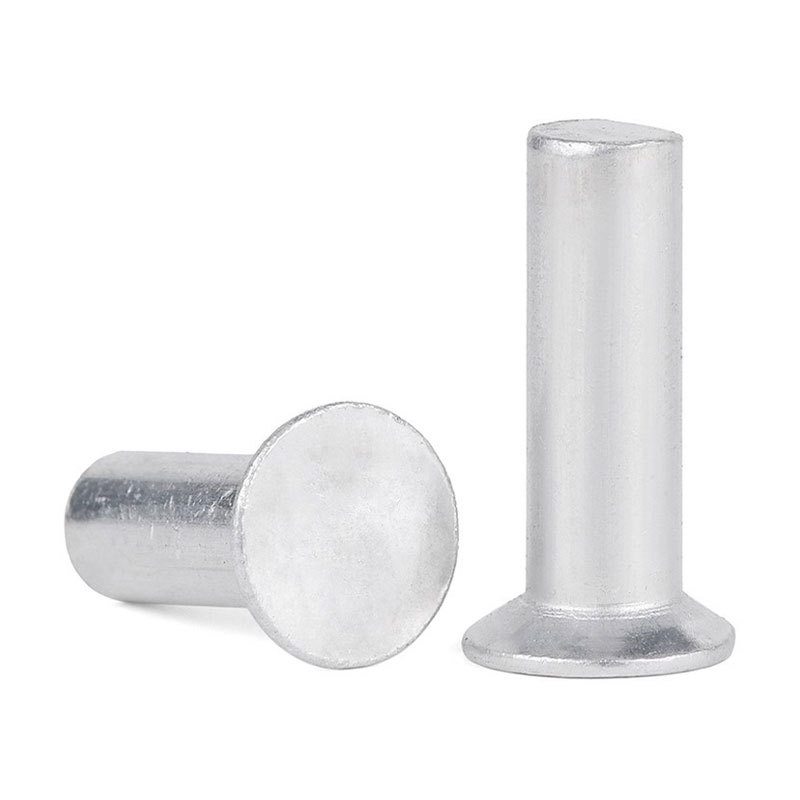
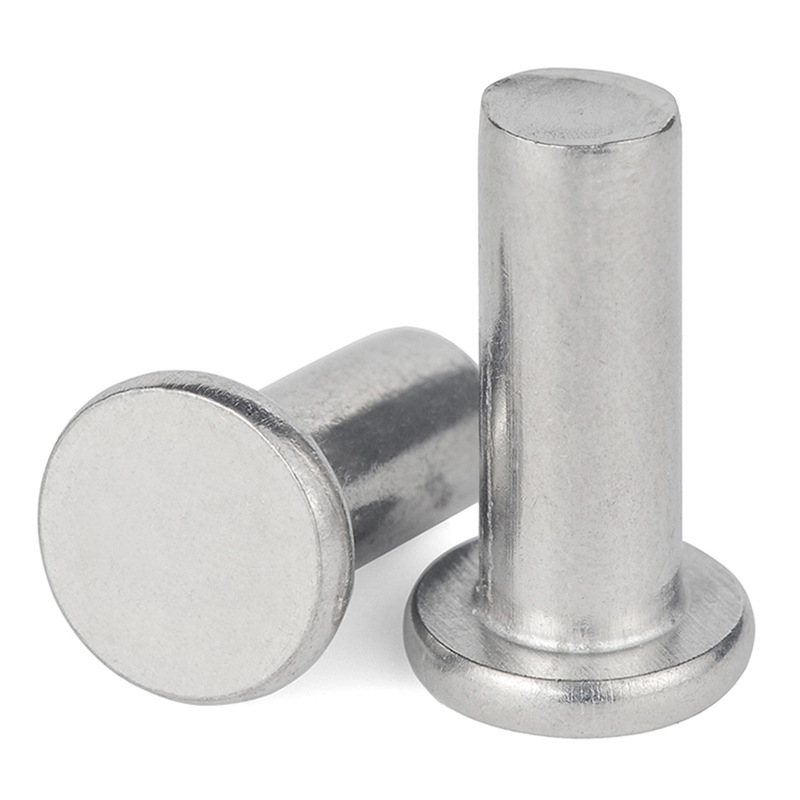
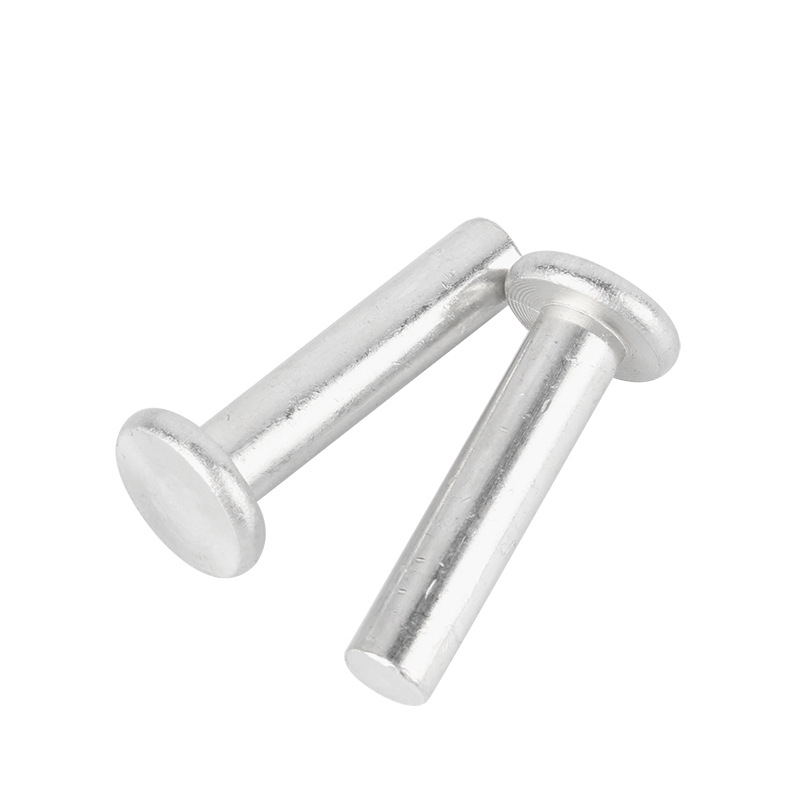
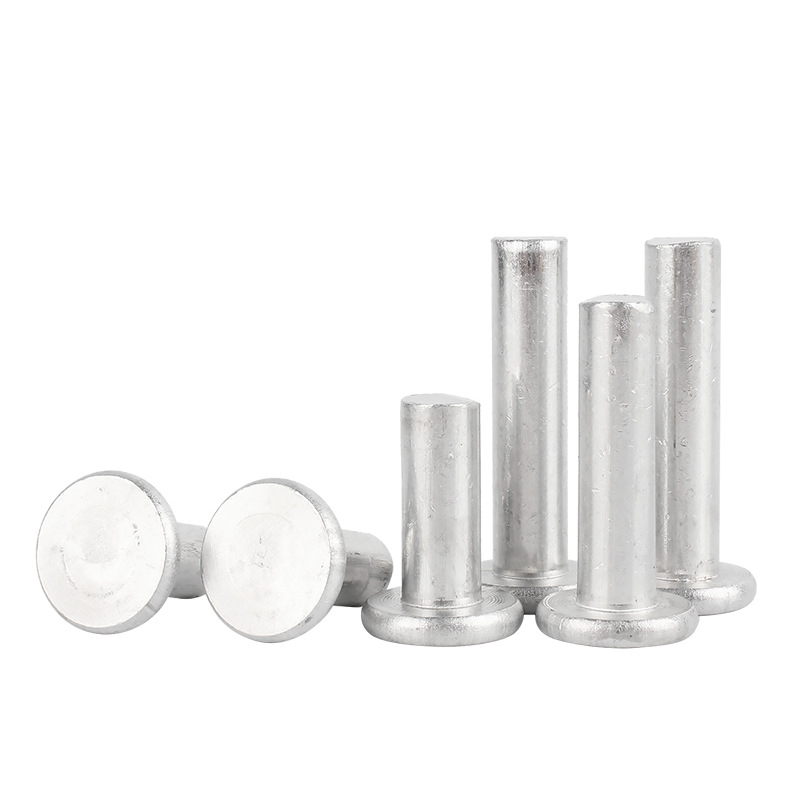
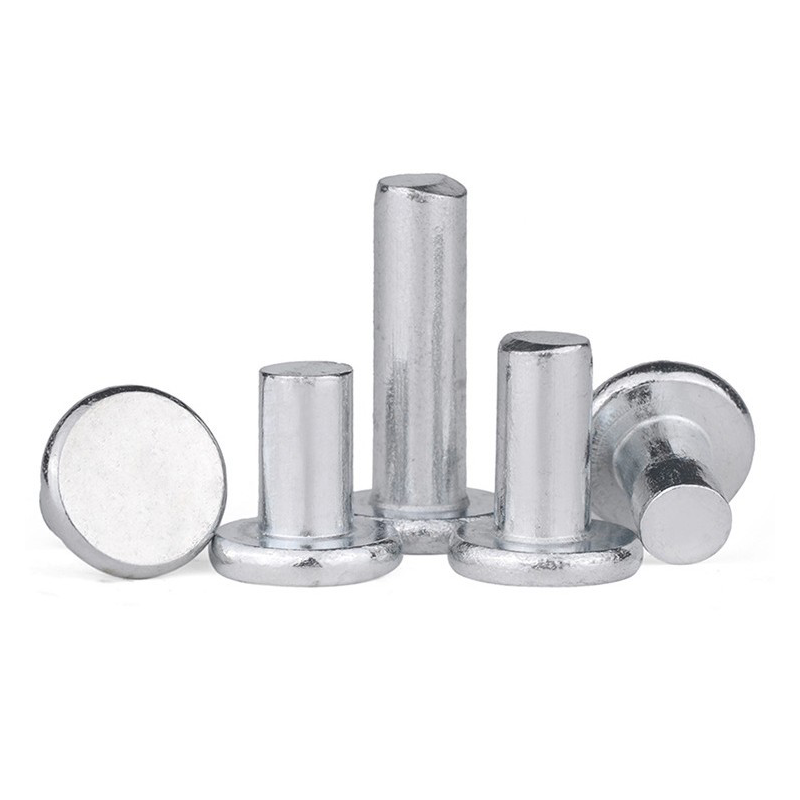
Flat head rivets are manufactured according to GB/T 109—1986. They are solid rivets with a flat round head and a cylindrical shank. During use, the rivet is inserted into a pre-drilled hole in the parts to be joined, and the shank end is hammered or pressed to upset it and form a driven head, thereby permanently joining two or more parts together. The flat head rivet has a relatively thin head, and after riveting the surface is flat, making it suitable for applications requiring a smooth exposed surface at the joint.
1. Product Features
• Standard structure: Dimensions conform to GB/T 109—1986, fit well with standard rivet holes, and offer good interchangeability.
• Flat head design: The head is flat and, after riveting, is essentially flush with the surface of the connected parts, giving a flat appearance.
• Solid shank: The shank is a solid cylinder, deforms uniformly during riveting, and provides a firm connection.
• Various materials: Carbon steel, copper, aluminum, stainless steel, etc., are available to suit different environments and strength requirements.
• Simple process: The riveting process is mature and does not require complex equipment, making it suitable for batch assembly.
2. Product Advantages
• Reliable connection: Forms a permanent connection after riveting, resistant to vibration and impact, and not easily loosened.
• Flat surface: The flat head design makes the outer surface at the joint smooth and reduces protrusions, suitable for parts with appearance requirements.
• Strong load-bearing capacity: After upsetting, the rivet shank fits tightly against the hole wall and can withstand large shear forces.
• Low cost: The rivet itself is low in price, and the riveting process is highly efficient, resulting in an economical overall cost.
• Wide applicability: Can be used for connecting plates of different materials and thicknesses, especially suitable for non-detachable structures.
3. Scope of Application
Flat head rivets are widely used in applications requiring permanent connections and a flat outer surface, including:
• Construction and steel structures: Connections of metal plates, supports, frames, etc.
• Vehicle manufacturing: Automobile bodies, carriages, motorcycle frames, etc.
• Ships and containers: Hull plates, container side panels, etc.
• General machinery: Chassis, guards, supports, etc.
• Furniture and hardware: Metal furniture, toolboxes, hardware products, etc.
• Electronic equipment: Cabinets, instrument housings and other connections requiring a smooth surface.