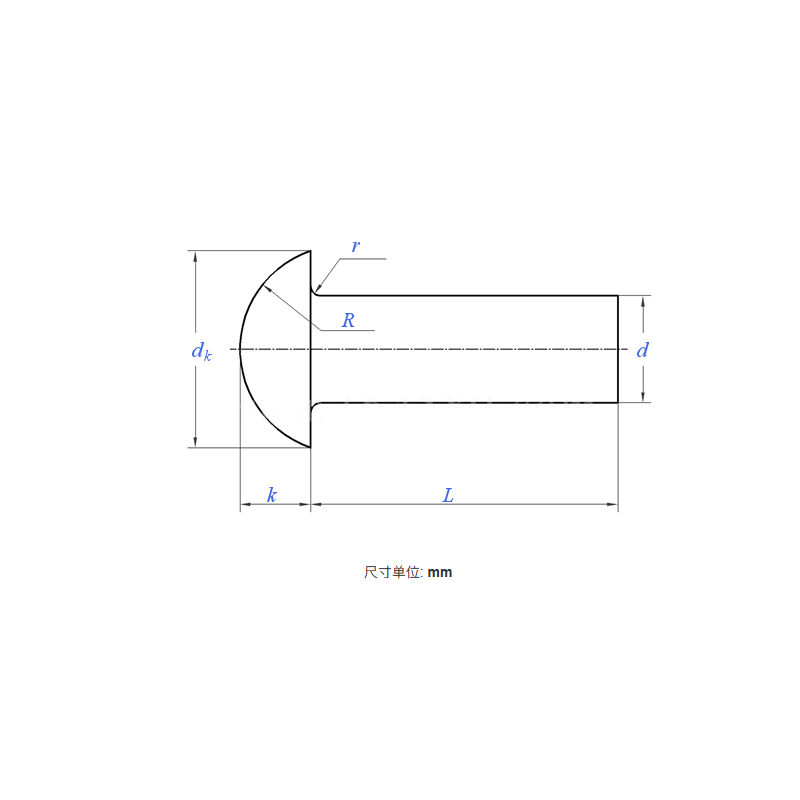
Product Specifications
| Model / Specification | M0.6-M16 |
| Material | Carbon Steel |
| Nom. Dia. d |
Φ0.6 | Φ0.8 | Φ1 | (Φ1.2) | Φ1.4 | (Φ1.6) | Φ2 | Φ2.5 | Φ3 | |
| d | Max. | 0.64 | 0.84 | 1.06 | 1.26 | 1.46 | 1.66 | 2.06 | 2.56 | 3.06 |
| Min. | 0.56 | 0.76 | 0.94 | 1.14 | 1.34 | 1.54 | 1.94 | 2.44 | 2.94 | |
| dk | Max. | 1.3 | 16 | 2 | 2.3 | 2.7 | 3.2 | 3.74 | 4.84 | 5.54 |
| Min. | 0.9 | 1.2 | 1.6 | 1.9 | 2.3 | 2.8 | 3.26 | 4.36 | 5.06 | |
| k | Max. | 0.5 | 0.6 | 0.7 | 0.8 | 0.9 | 1.2 | 1.4 | 1.8 | 2 |
| Min. | 0.3 | 0.4 | 0.5 | 0.6 | 0.7 | 0.8 | 1 | 1.4 | 1.6 | |
| R | 0.58 | 0.74 | 1 | 1.2 | 1.4 | 1.6 | 1.9 | 2.5 | 2.9 | |
| r | Max. | 0.05 | 0.05 | 0.1 | 0.1 | 0.1 | 0.1 | 0.1 | 0.1 | 0.1 |
| Steel Wt. ≈ kg/1000 pcs | - | - | - | - | - | - | - | - | - | |
| Nom. Dia. d |
(Φ3.5) | Φ4 | Φ5 | Φ6 | Φ8 | Φ10 | Φ12 | (Φ14) | Φ16 | |
| d | Max. | 3.58 | 4.08 | 5.08 | 6.08 | 8.1 | 10.1 | 12.12 | 14.12 | 16.12 |
| Min. | 3.42 | 3.92 | 4.92 | 5.92 | 7.9 | 9.9 | 11.88 | 13.88 | 15.88 | |
| dk | Max. | 6.59 | 7.39 | 9.09 | 11.35 | 14.35 | 17.35 | 21.42 | 24.42 | 29.42 |
| Max. | 6.01 | 6.81 | 8.51 | 10.65 | 13.65 | 16.65 | 20.58 | 23.58 | 28.58 | |
| k | Min. | 2.3 | 2.6 | 3.2 | 3.84 | 5.04 | 6.25 | 8.29 | 9.29 | 10.29 |
| Max. | 1.9 | 2.2 | 2.8 | 3.36 | 4.56 | 5.76 | 7.71 | 8.71 | 9.71 | |
| R | 3.4 | 3.8 | 4.7 | 6 | 8 | 9 | 11 | 12.5 | 15.5 | |
| r | Min. | 0.3 | 0.3 | 0.3 | 0.3 | 0.3 | 0.3 | 0.4 | 0.4 | 0.4 |
| Steel Wt. ≈ kg/1000 pcs | - | - | - | - | - | - | - | - | - | |
Solid Rivet – Product Introduction
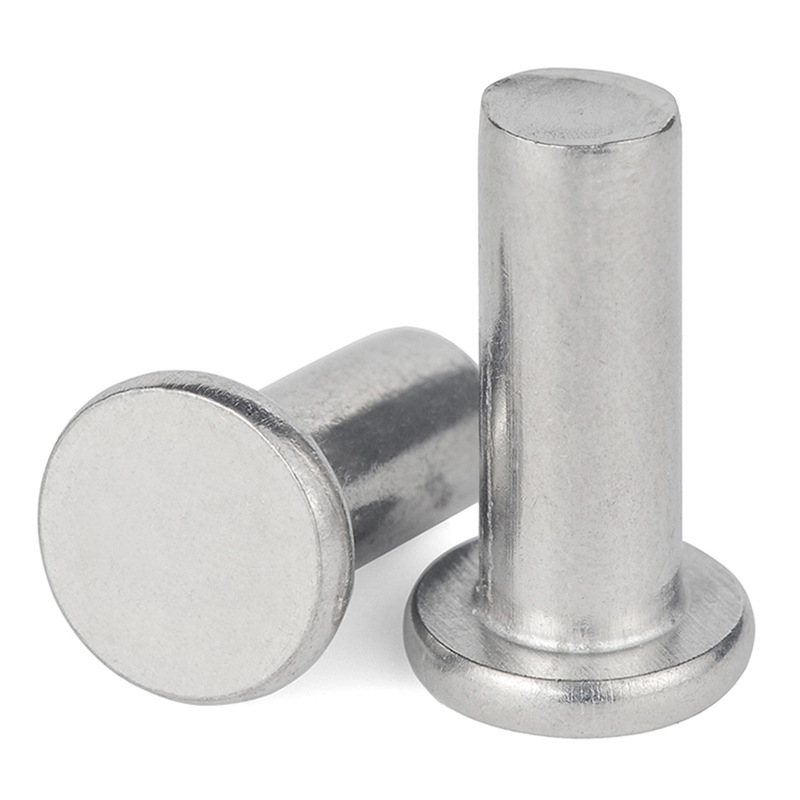
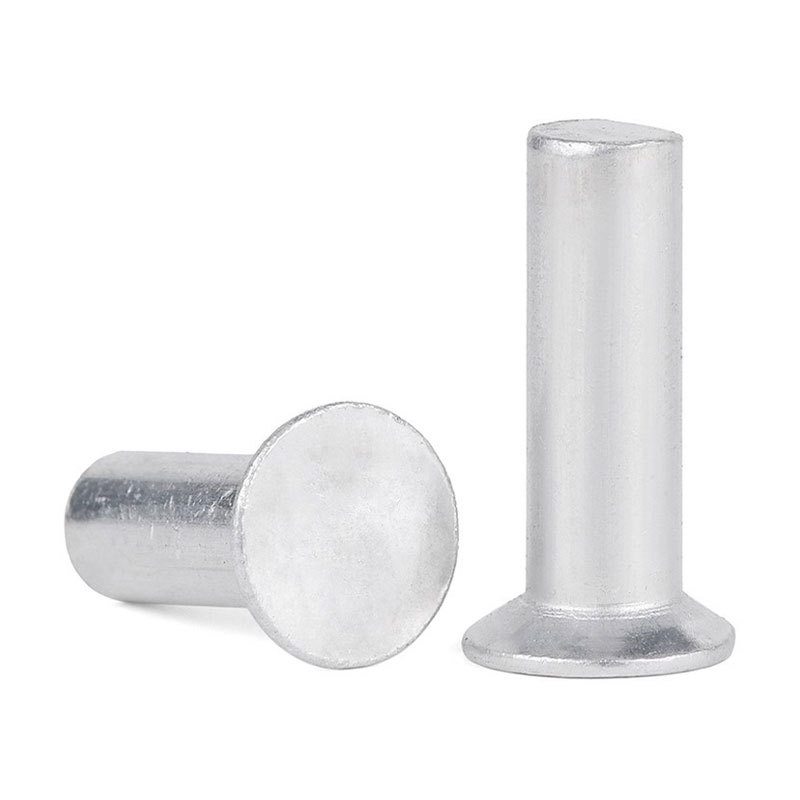
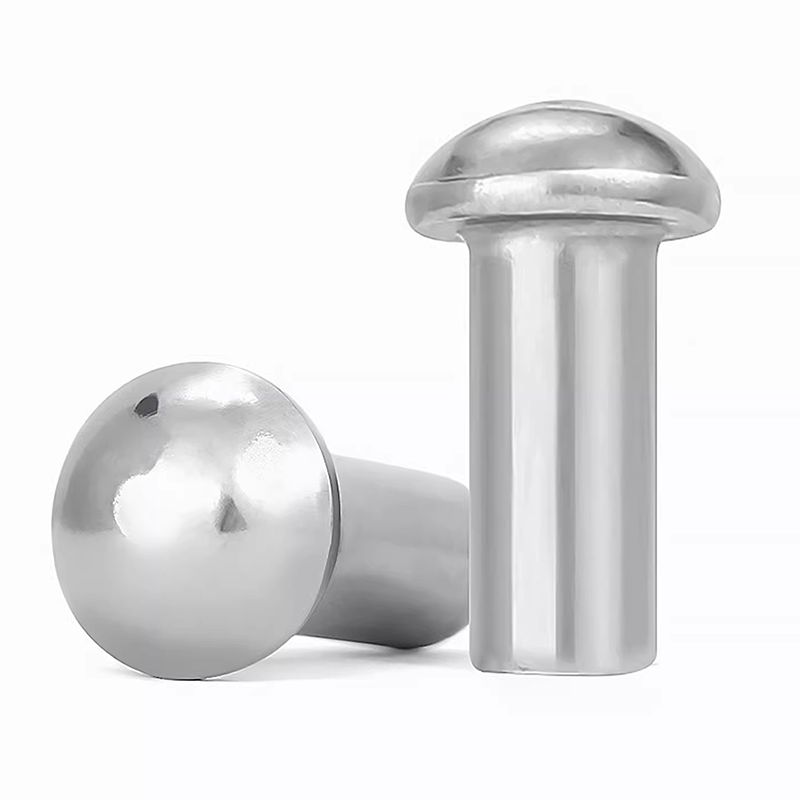
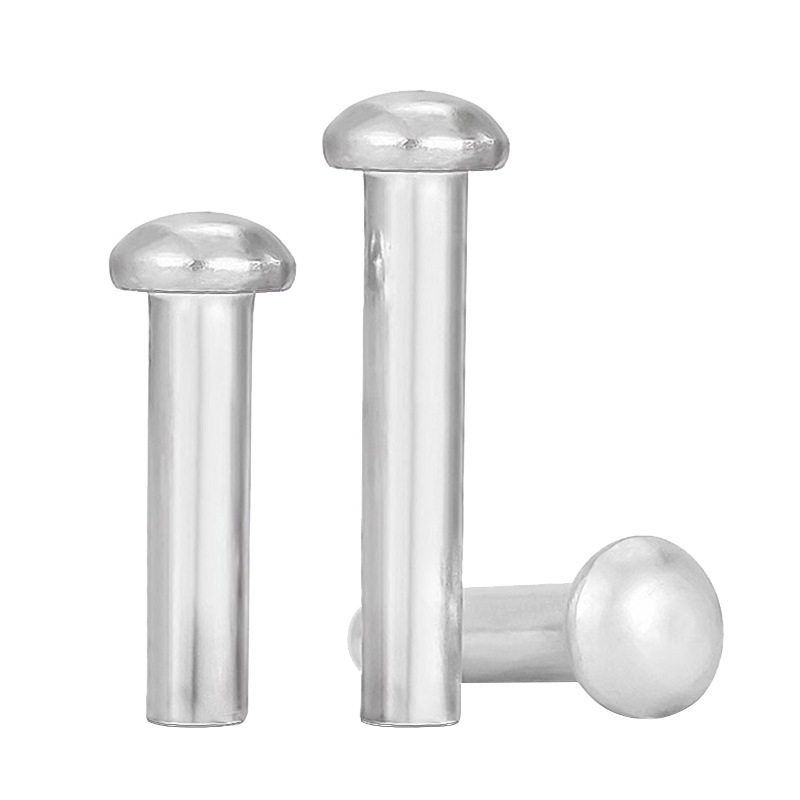
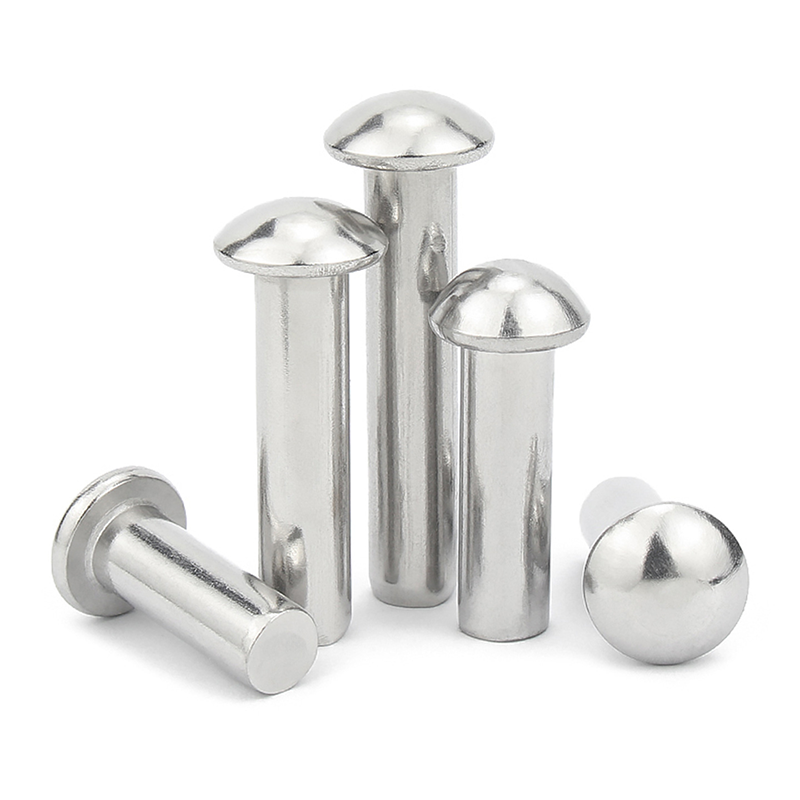
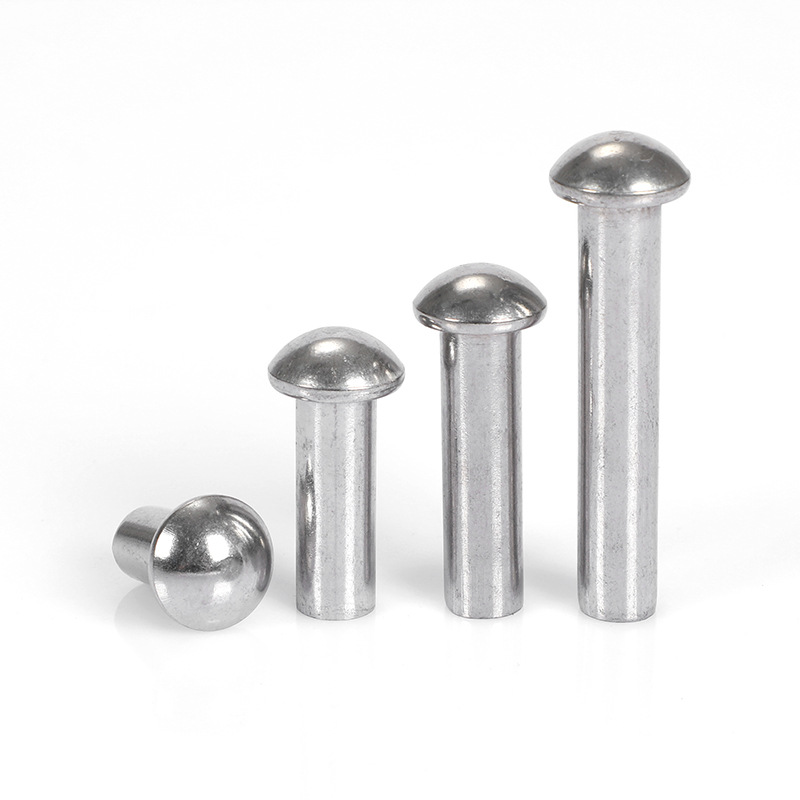
The solid rivet is the most traditional and highest load-bearing rivet fastening component, formed by upsetting a solid metal rod, with a pre-formed head on one end and the opposite end forming a rivet head during installation through hammering or press riveting, permanently locking the workpieces together. By relying on the plastic deformation of the entire rivet shank to fill the rivet hole, it creates a mechanical interlock, offering superior shear and tensile strength compared to blind rivets. Products are classified by head type into semi-countersunk head, countersunk head, semi-flush head, flat head, and more, widely used in bridges, building steel structures, vehicles, ships, and heavy machinery where extremely high joint strength is required.
Our products comply with national standards GB/T 867 (finished), GB/T 863.1 (rough), and GB/T 865 (countersunk head), covering materials such as carbon steel (Q235/10#/15#), A2/A4 stainless steel, aluminum alloy, and copper alloy, with surface treatments including zinc plating, black oxide, phosphating, or natural finish.
I. Product Features
Overall solid structure: No rivet mandrel, no hollow interior — the entire cross-section bears the load, providing the highest shear and tensile strength among all rivet types.
Multiple standard head types: Semi-countersunk head (universal high strength), countersunk head (flush surface), flat head (compact space), large pan head (for soft materials), adapting to different installation surface requirements.
Installation requires two-sided access: During riveting, one side supports the pre-formed head while the other side is hammered or press-riveted to form the buck tail, requiring access to both sides of the workpiece.
Both cold and hot riveting applicable: Large carbon steel rivets (≥12 mm) can be hot-riveted, using thermal expansion and contraction to generate clamping force for a tighter joint.
Permanent connection: Cannot be disassembled after riveting; removal is only possible by destructive means, providing extremely high joint reliability.
II. Product Advantages
Extremely high joint strength: The entire shank cross-section participates in shear resistance under load, with load capacity far exceeding that of blind rivets of the same size.
Absolutely reliable vibration and loosening resistance: The shank fills the entire hole wall with no gaps whatsoever, preventing loosening under severe vibration and impact.
Excellent high-temperature performance: Carbon steel or stainless steel rivets can withstand high temperatures without plastic component aging, suitable for boilers, furnace structures, and similar applications.
Long fatigue life: Even stress distribution and resistance to repeated loading make it ideal for critical structures such as bridges and aircraft skins.
Low cost with high benefit: Simple structure and high material utilization result in extremely low per-unit cost in large-scale production.