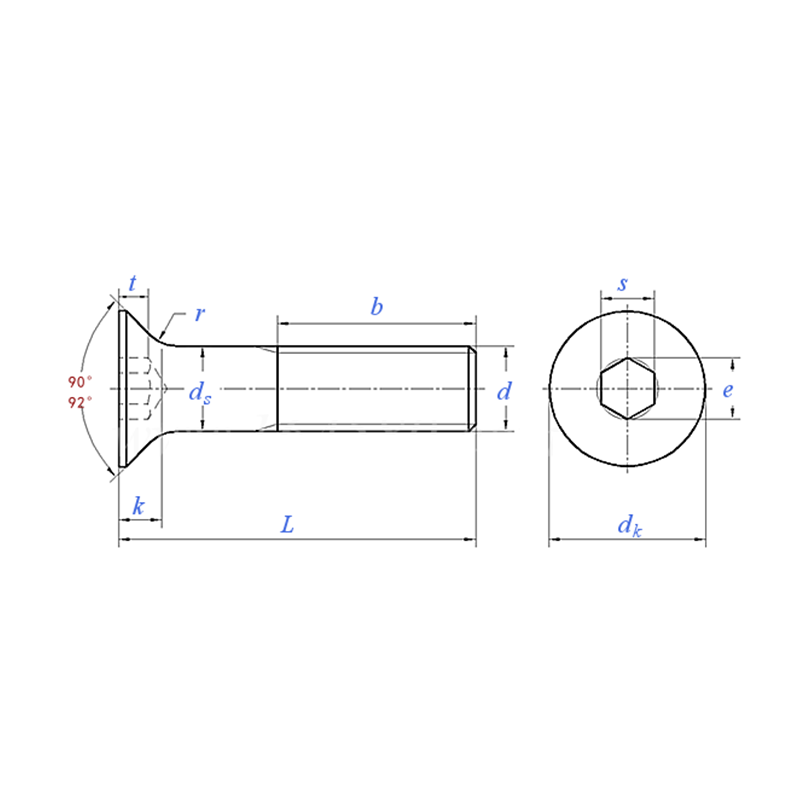
Product Specifications
| Model / Specification | M3 - M20 |
| Material | Carbon steel |
| Thd. size d |
M3 | M4 | M5 | M6 | M8 | M10 | M12 | (M14) | M16 | M20 | ||
| P | Pitch | 0.5 | 0.7 | 0.8 | 1 | 1.25 | 1.5 | 1.75 | 2 | 2 | 2.5 | |
| dk ③ | Theor. | Max. | 6.72 | 8.96 | 11.20 | 13.44 | 17.92 | 22.40 | 26.88 | 30.8 | 33.60 | 40.32 |
| Act. | Min. | 5.54 | 7.53 | 9.43 | 11.34 | 15.24 | 19.22 | 23.12 | 26.52 | 29.01 | 36.05 | |
| ds | Max. | 3 | 4 | 5 | 6 | 8 | 10 | 12 | 14 | 16 | 20 | |
| Min. | 2.86 | 3.82 | 4.82 | 5.82 | 7.78 | 9.78 | 11.73 | 13.73 | 15.73 | 19.67 | ||
| e ① | Min. | 2.303 | 2.873 | 3.443 | 4.583 | 5.723 | 6.863 | 9.149 | 11.429 | 11.429 | 13.716 | |
| k | Max. | 1.86 | 2.48 | 3.1 | 3.72 | 4.96 | 6.2 | 7.44 | 8.4 | 8.8 | 10.16 | |
| s ① | Nom. | 2 | 2.5 | 3 | 4 | 5 | 6 | 8 | 10 | 10 | 12 | |
| Max. | 2.080 | 2.58 | 3.080 | 4.095 | 5.140 | 6.140 | 8.175 | 10.175 | 10.175 | 12.212 | ||
| Min. | 2.020 | 2.52 | 3.020 | 4.020 | 5.020 | 6.020 | 8.025 | 10.025 | 10.025 | 12.032 | ||
| t | Min. | 1.1 | 1.5 | 1.9 | 2.2 | 3 | 3.6 | 4.3 | 4.5 | 4.8 | 5.6 | |
| Minimum tensile load (N) ② | 8.8 | 3220 | 5620 | 9080 | 12900 | 23400 | 37100 | 53900 | 73600 | 100000 | 162000 | |
| 10.9 | 4180 | 7300 | 11800 | 16700 | 30500 | 48200 | 70200 | 96000 | 130000 | 204000 | ||
| 12.9 | 4910 | 8506 | 13800 | 19600 | 35700 | 56600 | 82400 | 112000 | 154000 | 239000 | ||
| Wt./1000 | - | - | - | - | - | - | - | - | - | - | ||
| Thread length b | Ref. | - | - | - | - | - | - | - | - | - | - | |
Hex Socket Countersunk Head Screw — Product Introduction
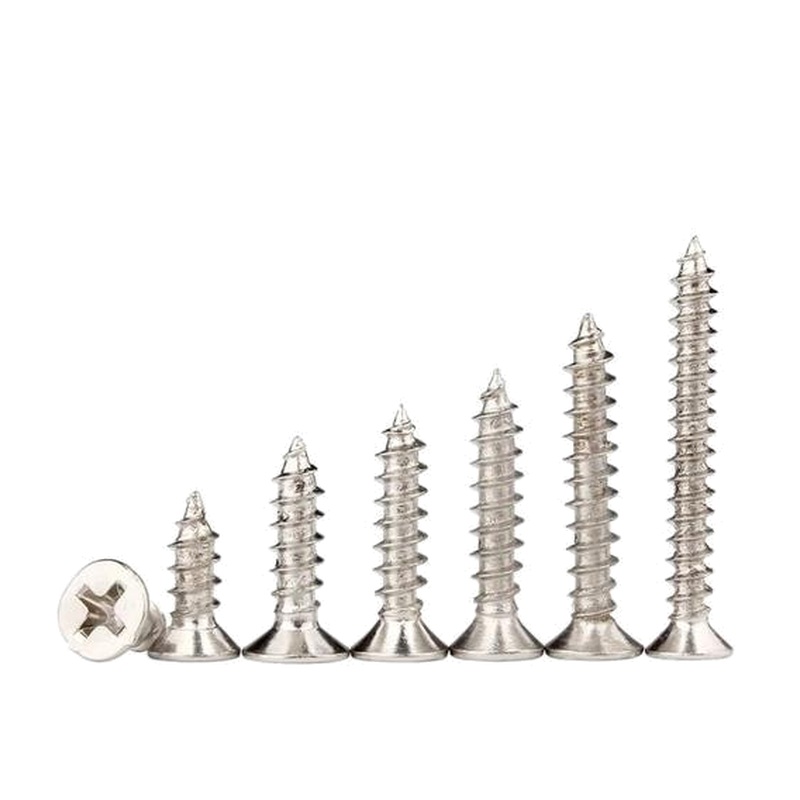
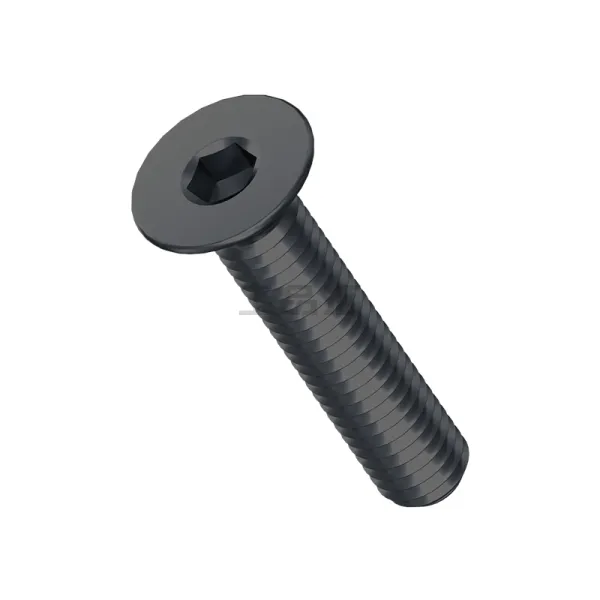
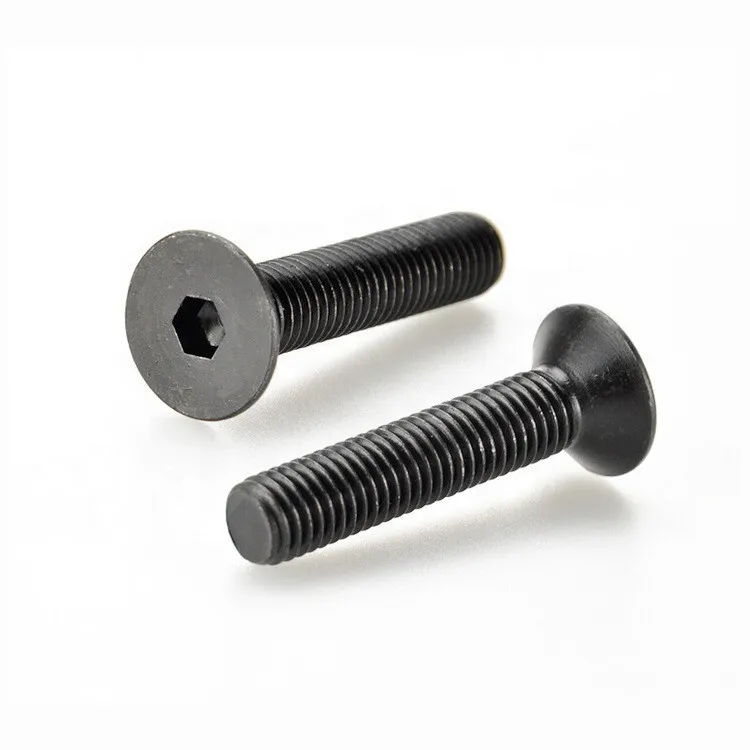
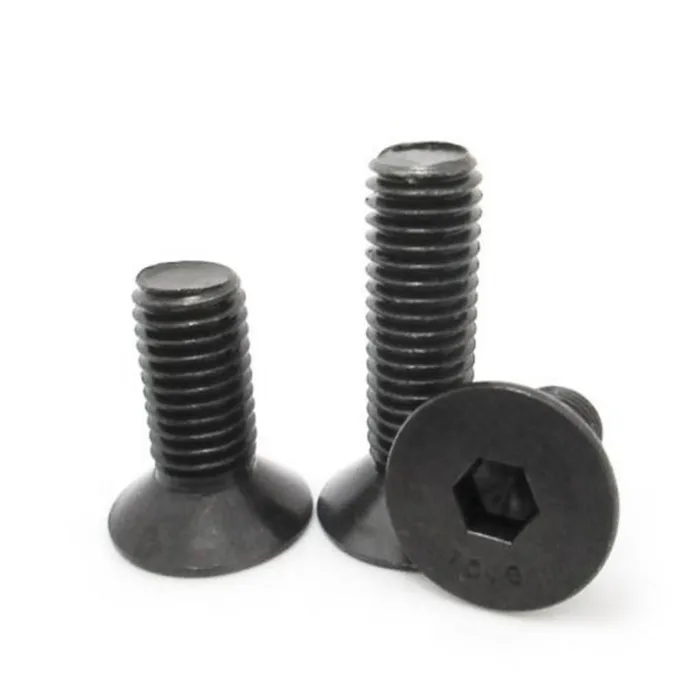
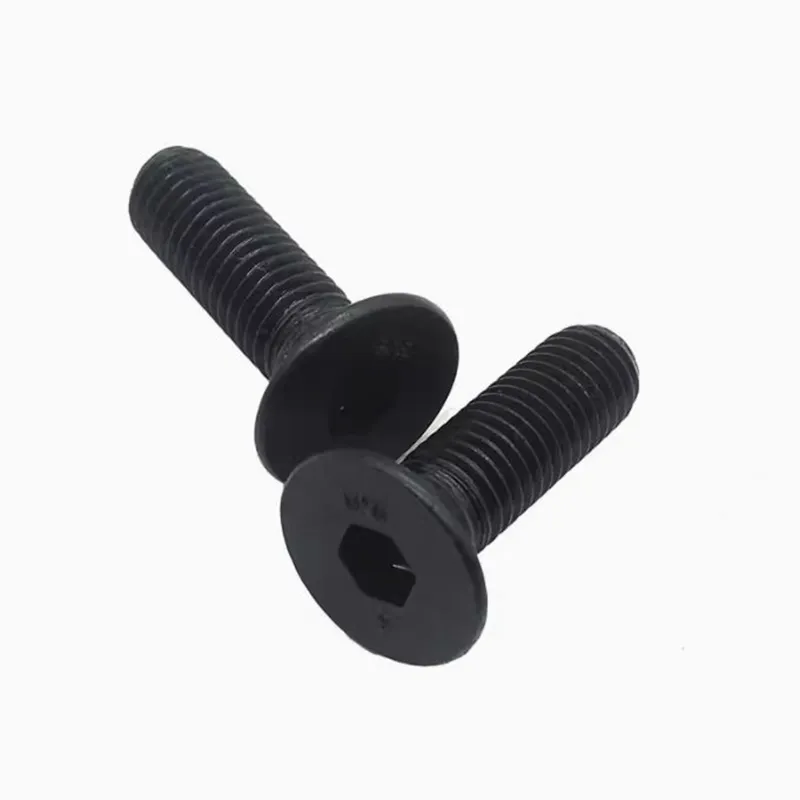
The hex socket countersunk head screw is a fastener with a conical (countersunk) head and an internal hex socket on top. Installation requires a pre-machined 90° countersink seat in the mating part; once tightened, the head sits fully flush with the part surface, delivering a smooth, non-protruding joint. The product is manufactured to GB/T 70.3 (current edition GB/T 70.3-2023) and also conforms to international standards such as ISO 10642 and DIN 7991. Thread sizes range from M2 to M20, with property classes 8.8, 10.9 and 12.9 as well as stainless grades A2-70 and A4-70/A4-80, widely used in electronics, mechanical equipment, automotive manufacturing, tooling and rail transit.
1. Product Features
- Countersunk flush design: The head is a 90° conical surface; when installed into a countersink seat, the top face sits perfectly flush with the mating surface, producing no protrusion or interference.
- Hex socket drive: The top is an internal hex socket, operated with a hex key; torque transfer is stable, tool slip is unlikely, and it suits space-limited assembly.
- Wide size coverage: Thread sizes from M2 to M20, covering the metric coarse-pitch series to meet varied assembly needs.
- Complete material and grade range: Carbon steel, alloy steel (e.g. 10B21, SCM435), stainless steel (304/316) and aluminium alloy are available; property classes include 8.8, 10.9, 12.9 and stainless grades A2-70, A4-80.
- Limited head load capacity: Because the countersunk form reduces the head cross-section, the head carries roughly 80% of the thread-section load; selection must respect this “reduced load capacity” characteristic.
- Varied surface treatment: Carbon steel parts can be black oxide, zinc plated or Dacromet treated; stainless parts are normally supplied as-rolled or bright-cleaned.
2. Product Advantages
- Flush surface after installation: The countersunk form lets the head sit fully embedded, ideal where head protrusion is not allowed; it avoids interference with other parts and improves appearance neatness.
- Precise location and reusability: The countersink seat ensures accurate centering; the screw can be removed and re-tightened at will without damaging the thread or head, suiting equipment needing repeated disassembly.
- Versatile hex socket drive: The hex key can be applied from above or the side, offering advantages over hex bolts in tight spaces; it delivers higher torque with low slip risk.
- Higher preload capability: Compared with ordinary nails or low-strength fasteners, countersunk screws provide greater preload for more reliable joints.
- Flexible corrosion options: Stainless versions (304/316) offer good corrosion resistance for damp, outdoor or mildly corrosive environments.
3. Scope of Application
- Electronics and precision equipment: Cabinets, instrument housings, PCB fixing, consumer-electronics enclosures and other assemblies requiring flush surfaces.
- Mechanical equipment: Motor end covers, gearbox assemblies, automation equipment and machine-tool components in compact joints.
- Automotive and rail transit: Interior panels, lamp brackets, body accessories and other areas needing concealed or smooth-surface joints.
- Moulds and tooling: Injection and stamping mould plates and accessory joints, plus fixtures and gauges requiring low heads and accurate centering.
- Construction and decoration: Aluminium profile joints, curtain-wall members, railings and furniture hardware fixing.
- Medical devices: Assembly of medical equipment parts with demands on surface flatness and corrosion resistance.