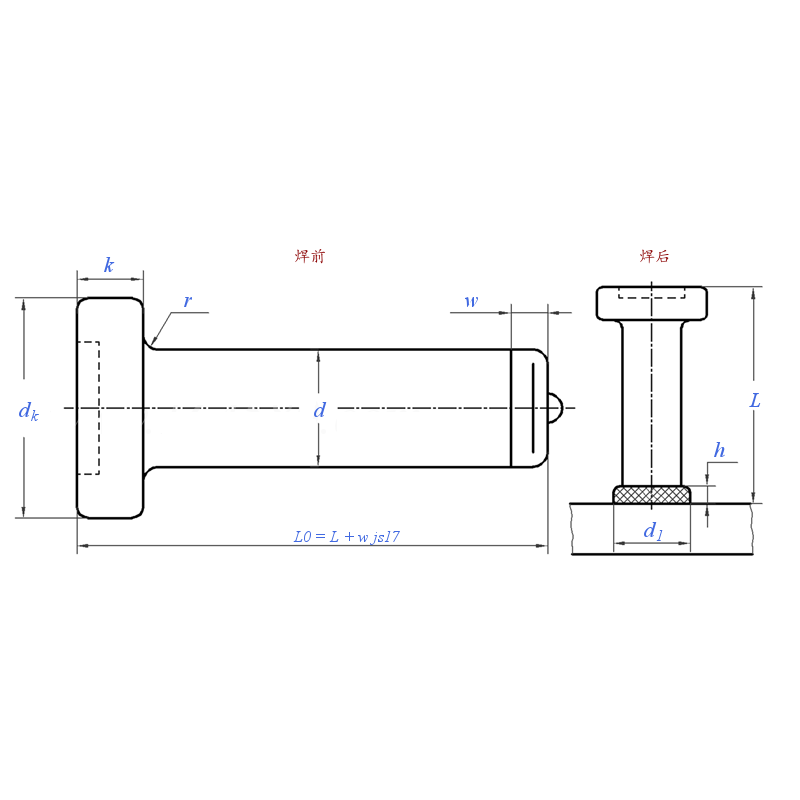
Product Specifications
| Model / Specification | Carbon Steel |
| Material | Carbon Steel |
| Nom. Dia. d |
10 | 13 | 16 | 19 | 22 | 25 | |
| d | Min. | 9.64 | 12.57 | 15.57 | 18.48 | 21.48 | 24.48 |
| Max. | 10 | 13 | 16 | 19 | 22 | 25 | |
| dk | Max. | 18.35 | 22.42 | 29.42 | 32.5 | 35.5 | 40.5 |
| Min. | 17.65 | 21.58 | 28.58 | 31.5 | 34.5 | 39.5 | |
| d1 | Ref. | 13 | 17 | 21 | 23 | 29 | 31 |
| h | Ref. | 2.5 | 3 | 4.5 | 6 | 6 | 7 |
| k | Max. | 7.45 | 8.45 | 8.45 | 10.45 | 10.45 | 12.55 |
| Min. | 6.55 | 7.55 | 7.55 | 9.55 | 9.55 | 11.45 | |
| r | Min. | 2 | 2 | 2 | 2 | 3 | 3 |
| w | Melt Len. | 4 | 5 | 5 | 6 | 6 | 6 |
| Wt./1,000 pcs (steel) | - | - | - | - | - | - | |
Product Introduction
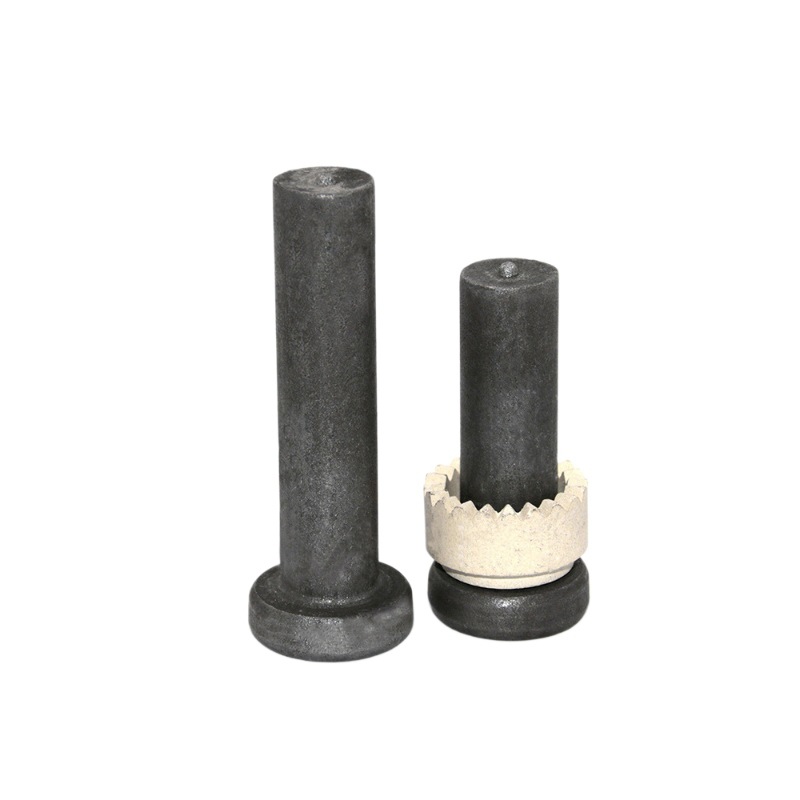
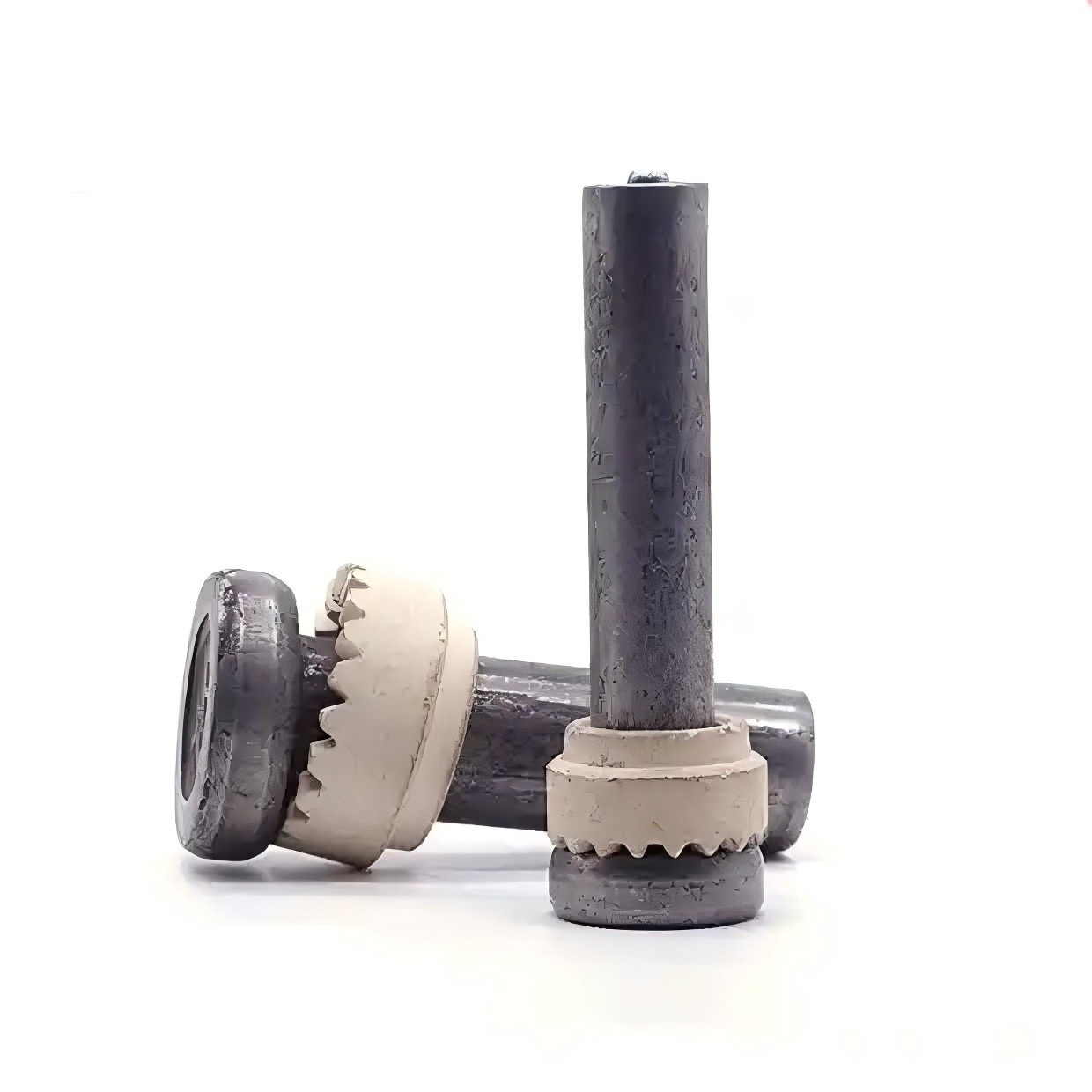
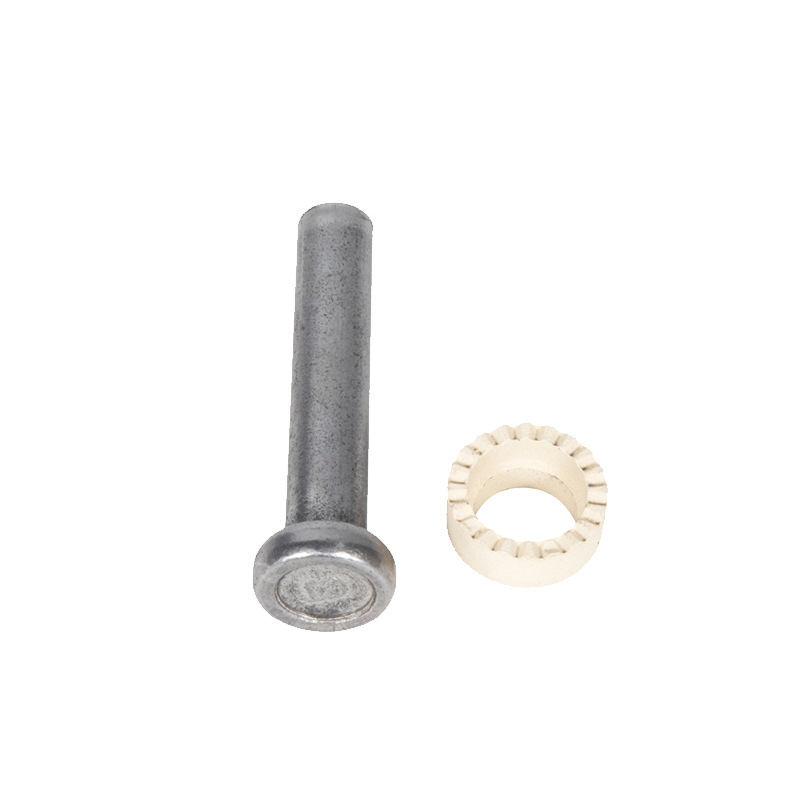
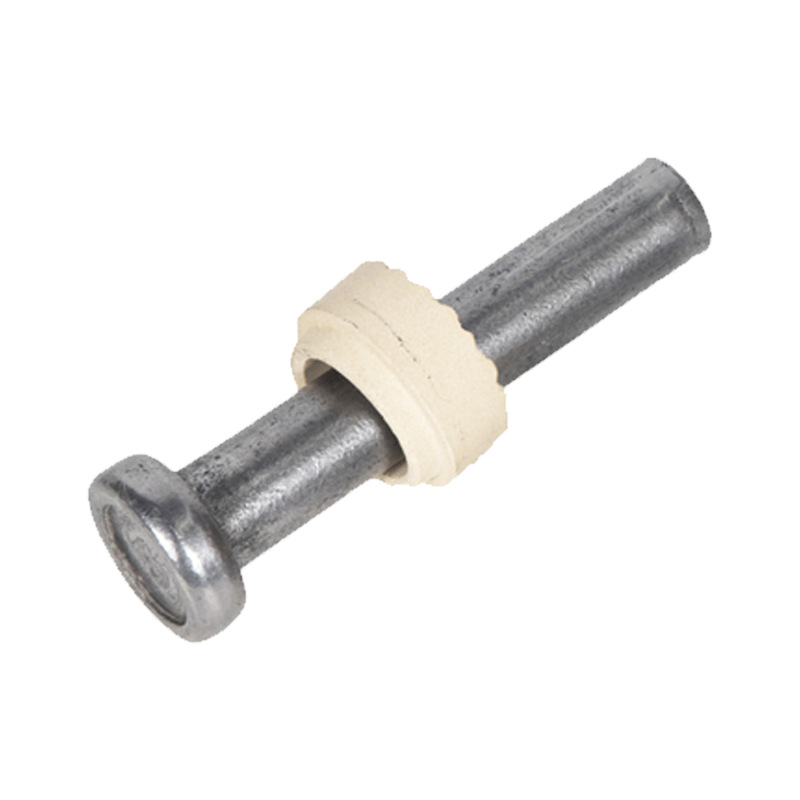
The cylindrical head welding stud for arc stud welding (referred to as welding stud, also called shear stud or shear connector) is a high-strength, high-stiffness connecting fastener with a cylindrical head and an unthreaded shank. It belongs to the category of shear connectors, embedded parts and anchoring parts used in various structures in civil engineering and building construction. The product is manufactured according to GB/T 10433-2002, with nominal diameters ranging from Φ10 to Φ25 mm and total lengths before welding from 40 to 300 mm. During use, a special welding gun is used to weld the stud vertically onto a steel beam or steel plate, and then concrete is poured to form a steel-concrete composite structure, creating a reliable integral cooperative working connection between the steel member and the concrete. The matching ceramic ferrule is used to protect the welding molten pool and shield the arc, ensuring stable welding quality.
1. Product Features
• Cylindrical head with unthreaded structure: The head is cylindrical cap-shaped, and the shank is unthreaded. It is directly welded and fixed by the arc stud welding process.
• Complete specification coverage: Nominal diameters from Φ10 mm to Φ25 mm, and total lengths before welding from 40 mm to 300 mm, meeting different engineering requirements.
• Good weldability of material: Common materials include ML15, ML15AL, SWRCH15A and other low-carbon steels, with good weldability and plasticity.
• Mature welding process: Arc stud welding is adopted: the stud is held in the welding gun, an arc is struck between the stud and the base material, the end is melted and then automatically pressed into the molten pool, and a high-quality weld is formed with the ceramic ferrule.
• Strict surface quality requirements: The national standard specifies that the stud surface should be free from defects such as rust, oxide scale, grease and burrs.
2. Product Advantages
• High connection strength: As a shear connector, the stud transmits longitudinal shear in steel-concrete composite structures. The welded fusion zone can effectively resist shear force, enabling the steel member and concrete to work together.
• High construction efficiency: Single-side welding with a special welding gun allows one stud to be welded within seconds, with a high degree of automation, suitable for large-area batch operations.
• No drilling or tapping required: The stud is directly fixed to the steel plate by welding, without drilling holes or tapping internal threads in the connected parts, simplifying construction procedures.
• Strong adaptability: Suitable for high-rise steel structures, bridges, factory buildings and other engineering scenarios, and can weld through galvanized steel plates.
• High standardization: Product dimensions and performance are uniform, facilitating design selection and engineering procurement, with good interchangeability.
3. Scope of Application
• High-rise and super high-rise buildings: Shear connection between steel members and concrete in steel-reinforced concrete structures, improving structural integrity and load-bearing capacity.
• Bridge engineering: Shear connection between steel beams and concrete bridge decks in steel-concrete composite bridges, a key connector in composite bridge structures.
• Industrial plants and public buildings: Composite floor slabs and shear connector installation in factory steel structures and large public buildings.
• Various steel structure projects: Embedded parts and anchoring parts in steel structure projects such as highways, railways, towers, airports, stations, power plants, pipeline supports and lifting machinery.
• Composite structure reinforcement and renovation: Adding shear connectors to existing steel structures for composite reinforcement or renovation projects.