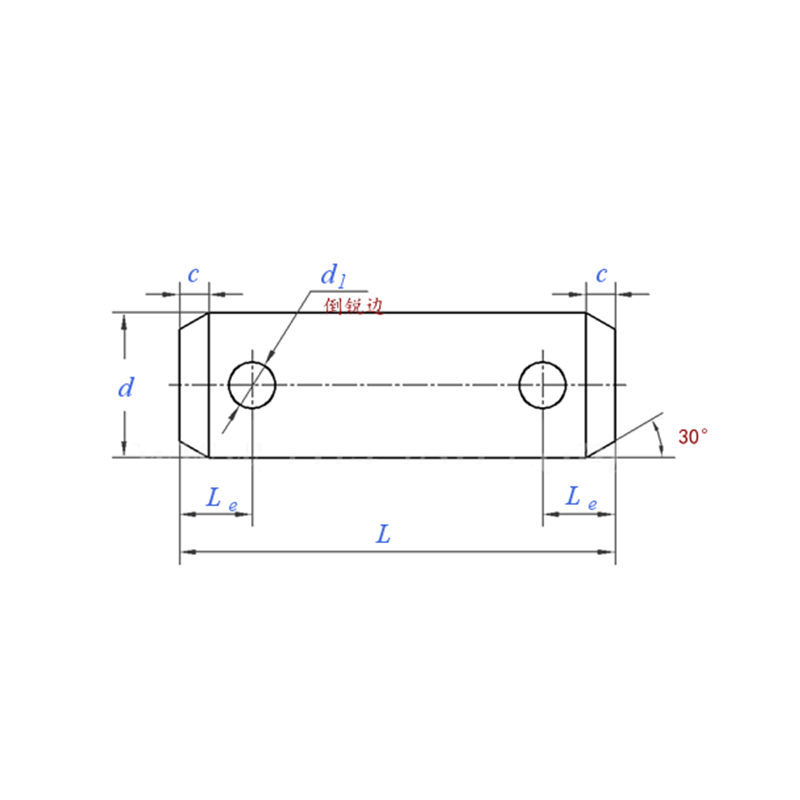
Product Specifications
| Model / Specification | Φ3 - Φ100 |
| Material | Stainless Steel |
| Nom. Dia. d |
Φ3 | Φ4 | Φ5 | Φ6 | Φ8 | Φ10 | Φ12 | Φ14 | Φ16 | Φ18 | Φ20 | Φ22 | Φ24 | |
| d ① | Max. = Nom. (h11) | 3 | 4 | 5 | 6 | 8 | 10 | 12 | 14 | 16 | 18 | 20 | 22 | 24 |
| Min. | 2.94 | 3.925 | 4.925 | 5.925 | 7.91 | 9.91 | 11.89 | 13.89 | 15.89 | 17.89 | 19.87 | 21.87 | 23.87 | |
| d1 ② | Min. = Nom. (H13) | 0.8 | 1 | 1.2 | 1.6 | 2 | 3.2 | 3.2 | 4 | 4 | 5 | 5 | 5 | 6.3 |
| Max. | 0.94 | 1.14 | 1.34 | 1.74 | 2.14 | 3.38 | 3.38 | 4.18 | 4.18 | 5.18 | 5.18 | 5.18 | 6.52 | |
| c | Max. | 1 | 1 | 2 | 2 | 2 | 2 | 3 | 3 | 3 | 3 | 4 | 4 | 4 |
| Le | Min. | 1.6 | 2.2 | 2.9 | 3.2 | 3.5 | 4.5 | 5.5 | 6 | 6 | 7 | 8 | 8 | 9 |
| Wt./1,000 pcs (steel) | - | - | - | - | - | - | - | - | - | - | - | - | - | |
| Nom. Dia. d |
Φ27 | Φ30 | Φ33 | Φ36 | Φ40 | Φ45 | Φ50 | Φ55 | Φ60 | Φ70 | Φ80 | Φ90 | Φ100 | |
| d ① | Max. = Nom. (h11) | 27 | 30 | 33 | 36 | 40 | 45 | 50 | 55 | 60 | 70 | 80 | 90 | 100 |
| Min. | 26.87 | 29.87 | 32.84 | 35.84 | 39.84 | 44.84 | 49.84 | 54.81 | 59.81 | 69.81 | 79.81 | 89.78 | 99.78 | |
| d1 ② | Min. = Nom. (H13) | 6.3 | 8 | 8 | 8 | 8 | 10 | 10 | 10 | 10 | 13 | 13 | 13 | 13 |
| Max. | 6.52 | 8.22 | 8.22 | 8.22 | 8.22 | 10.22 | 10.22 | 10.22 | 10.22 | 13.27 | 13.27 | 13.27 | 13.27 | |
| c | Max. | 4 | 4 | 4 | 4 | 4 | 4 | 4 | 6 | 6 | 6 | 6 | 6 | 6 |
| Le | Min. | 9 | 10 | 10 | 10 | 10 | 12 | 12 | 14 | 14 | 16 | 16 | 16 | 16 |
| Wt./1,000 pcs (steel) | - | - | - | - | - | - | - | - | - | - | - | - | - | |
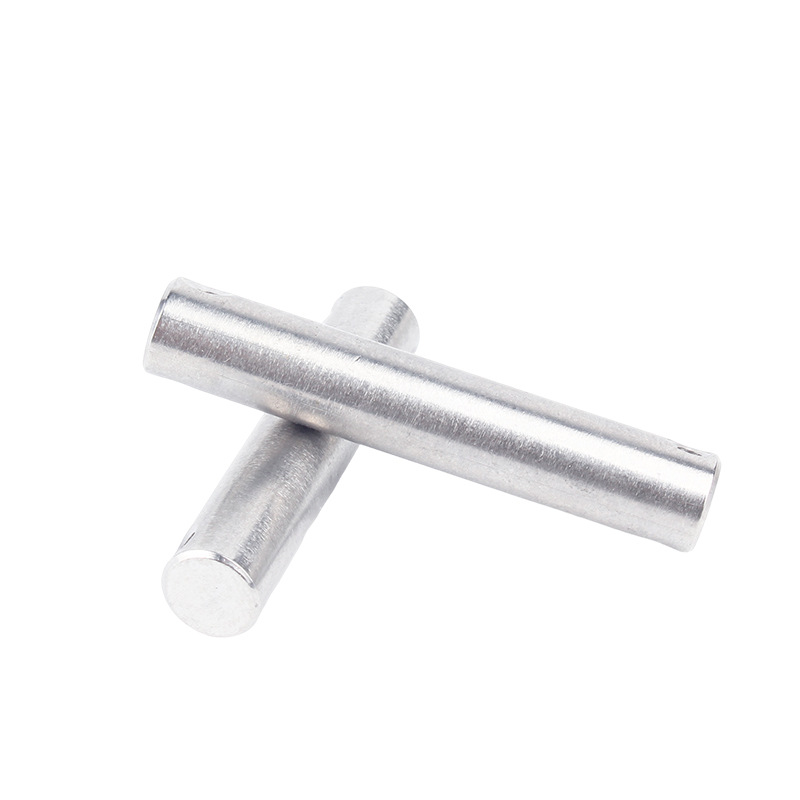
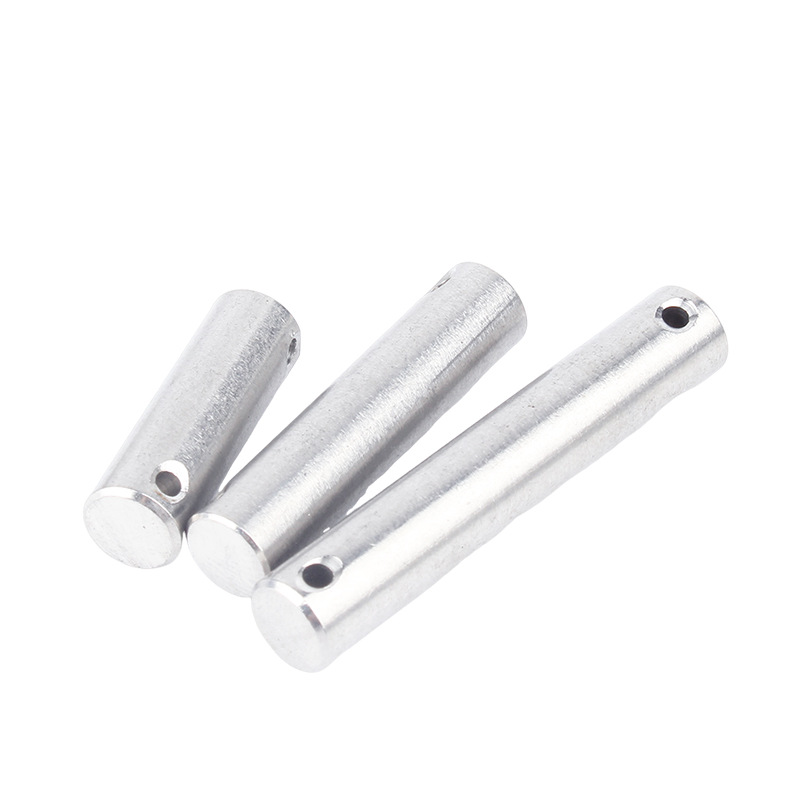
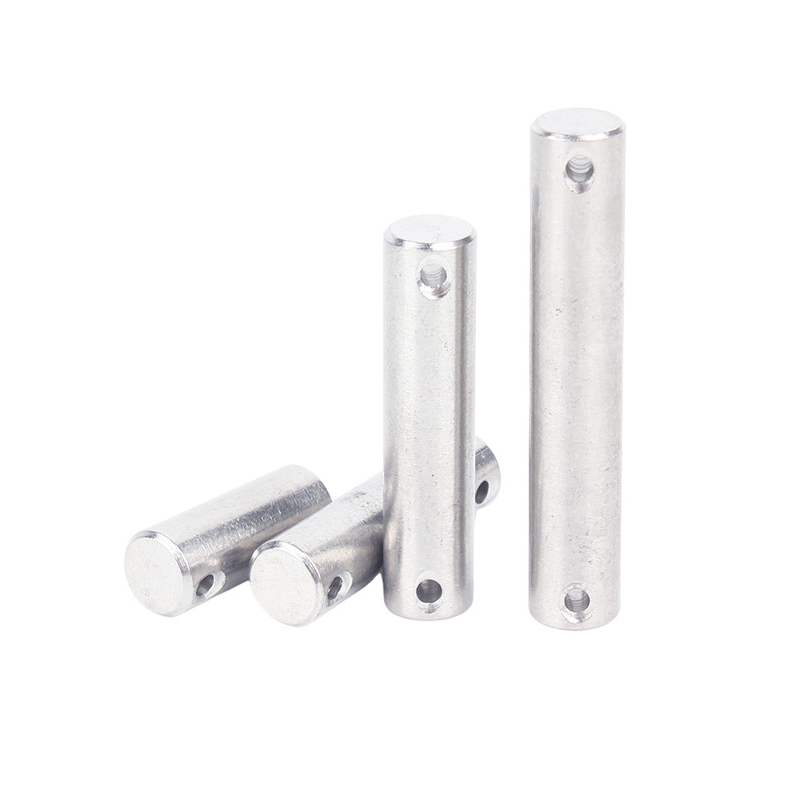
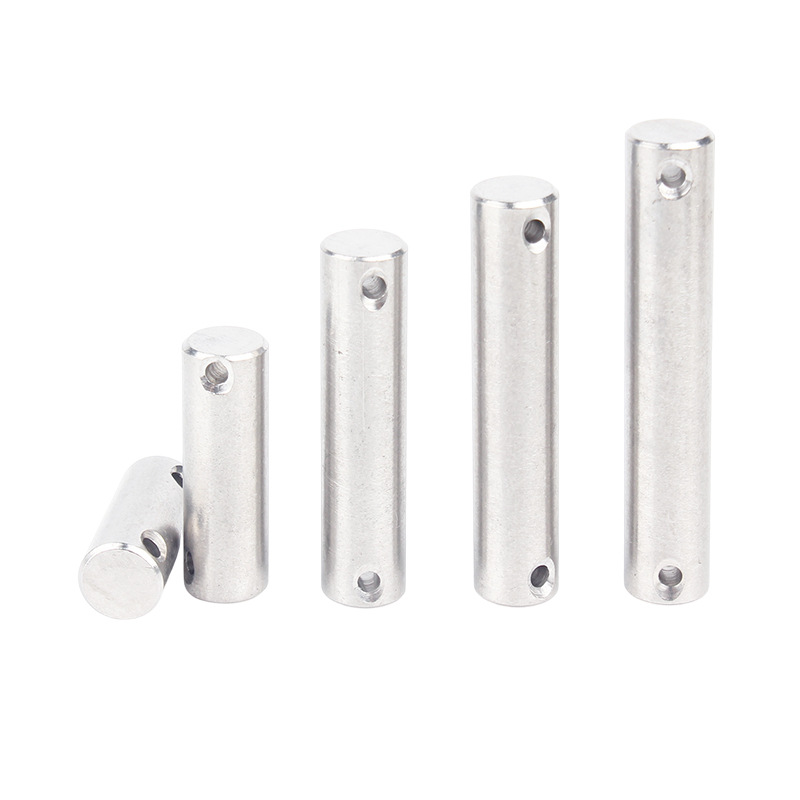
Headless Pin Shaft Type B (Pin with Hole) — Product Introduction
The headless pin shaft Type B (pin with hole) is a cylindrical locating fastener conforming to GB/T 880-2008. It has no protruding head structure, and one or both ends of the shank are provided with a cotter pin hole. During use, the pin shaft is inserted into the hinge hole of the connected parts, and then a cotter pin or elastic retaining ring is inserted into the pin hole at the end, achieving axial locking through mechanical stopping and preventing the pin shaft from coming out. Nominal diameters cover 3 mm to 100 mm, suitable for mechanical structural applications requiring hinged connections, positioning or anti-loosening fixation.
1. Product Features
• Type B hole structure: Compared with Type A (without cotter pin hole), Type B has a cotter pin hole at the end of the shank. The hole diameter matches the nominal specification of GB/T 91 cotter pins and is used for inserting a cotter pin to achieve axial locking.
• Headless cylindrical design: The overall shape is cylindrical with no protruding head. After installation, it can be flush with the surface of the connected parts, suitable for compact spaces or applications requiring a flat appearance.
• Wide specification coverage: Nominal diameters from 3 mm to 100 mm, with complete length specifications, meeting different needs from small precision mechanisms to heavy machinery.
• Flexible material selection: The standard does not limit specific material grades. Common materials include 35 steel, 45 steel, 40Cr, 304 stainless steel, 316 stainless steel, brass, etc., which can be selected according to strength, rust prevention or electrical conductivity requirements.
• Various surface treatments: Oxidation, phosphating, zinc plating and passivation, etc. can be applied. Stainless steel materials are usually supplied in natural color.
2. Product Advantages
• Mechanical anti-loosening, safe and reliable: Locking is achieved by mechanical stopping of the cotter pin rather than simple friction, making it less likely to loosen under vibration and impact conditions. It is suitable for hinged parts requiring long-term stable connection.
• Convenient installation and disassembly: After inserting into the pin hole, fixation is completed by inserting the cotter pin; during disassembly, the pin shaft can be withdrawn by removing the cotter pin, facilitating maintenance and parts replacement.
• High positioning accuracy: When used as a locating pin, it can cooperate with a reamed hole to achieve precise position fixation, ensuring the relative position accuracy of the connected parts.
• Suitable for frequent assembly and disassembly: Compared with threaded fasteners, pin shaft connections are less likely to damage threads after repeated assembly and disassembly, suitable for parts requiring frequent adjustment or maintenance.
• Good standardized interchangeability: As a national standard product, dimensions are uniform, and qualified products from different suppliers can be used interchangeably, facilitating spare parts management.
3. Scope of Application
• Mechanical hinged connections: Connecting parts requiring relative rotation, such as linkage mechanisms, hinges, steering knuckles and lever pivots.
• Positioning and fixation: Applications requiring precise position fixation in molds, fixtures and machine tool accessories.
• Anti-loosening locking: Structures requiring prevention of axial movement of the pin shaft, such as shelves, ladders and guardrails.
• Automotive and agricultural machinery: Hinge points such as brake pedals, clutch linkages, suspension systems and tractor three-point hitches.
• General industry: Applications requiring reliable hinging or positioning, such as lifting machinery, conveying equipment and construction machinery.