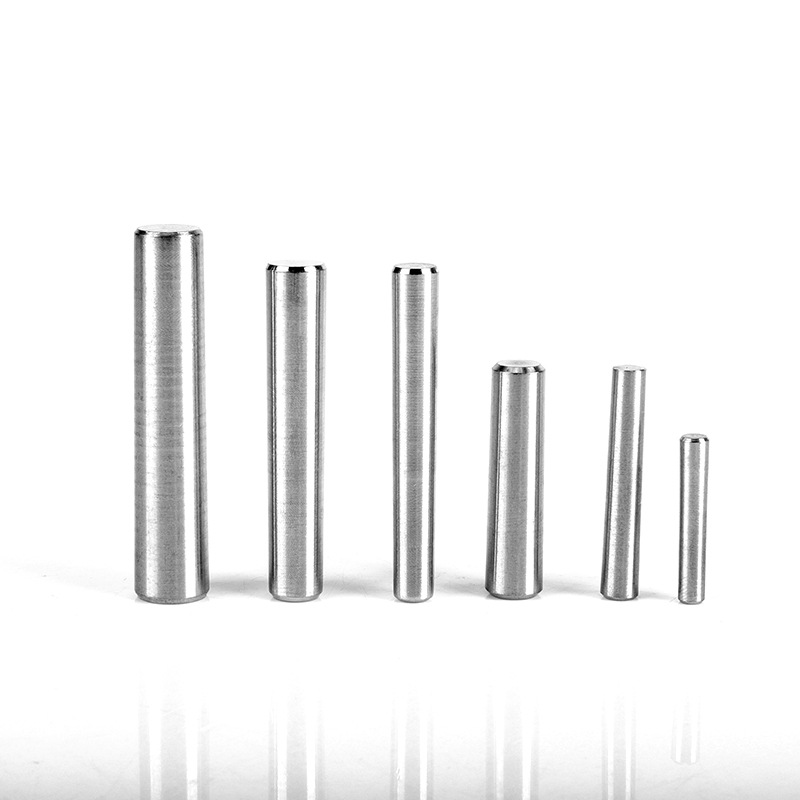
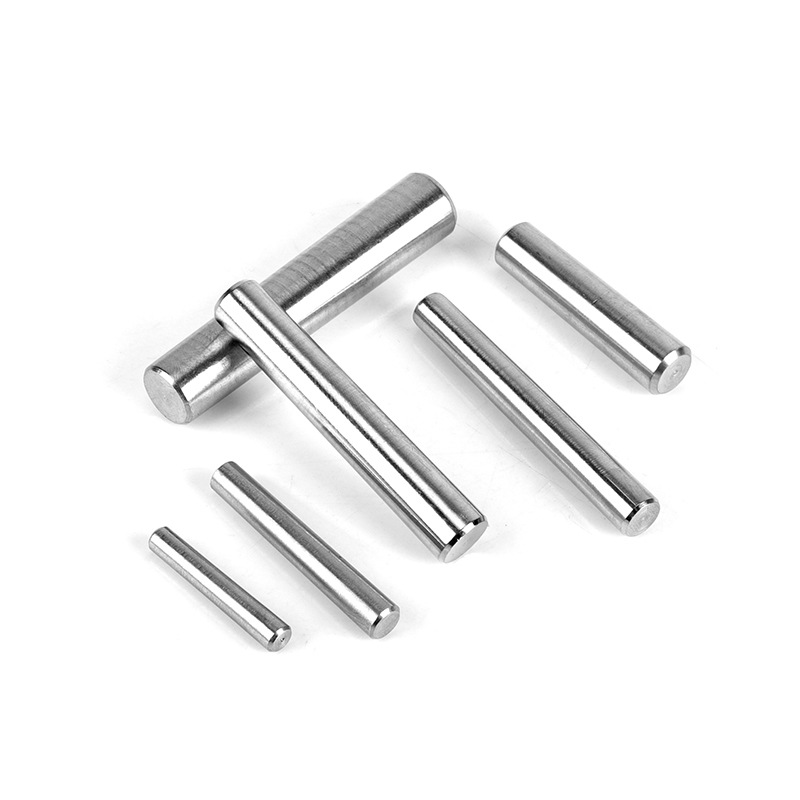
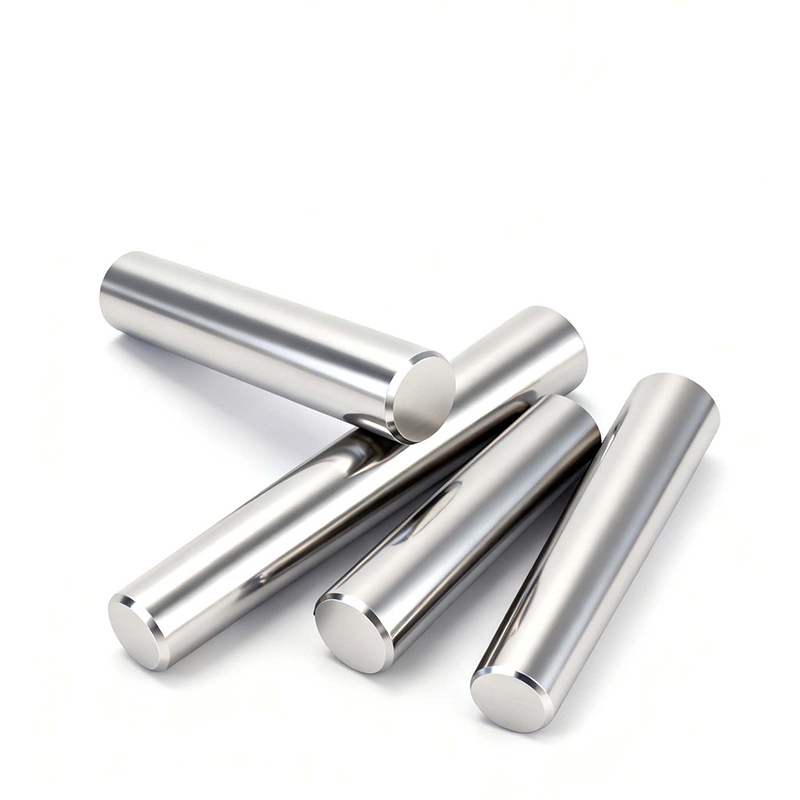
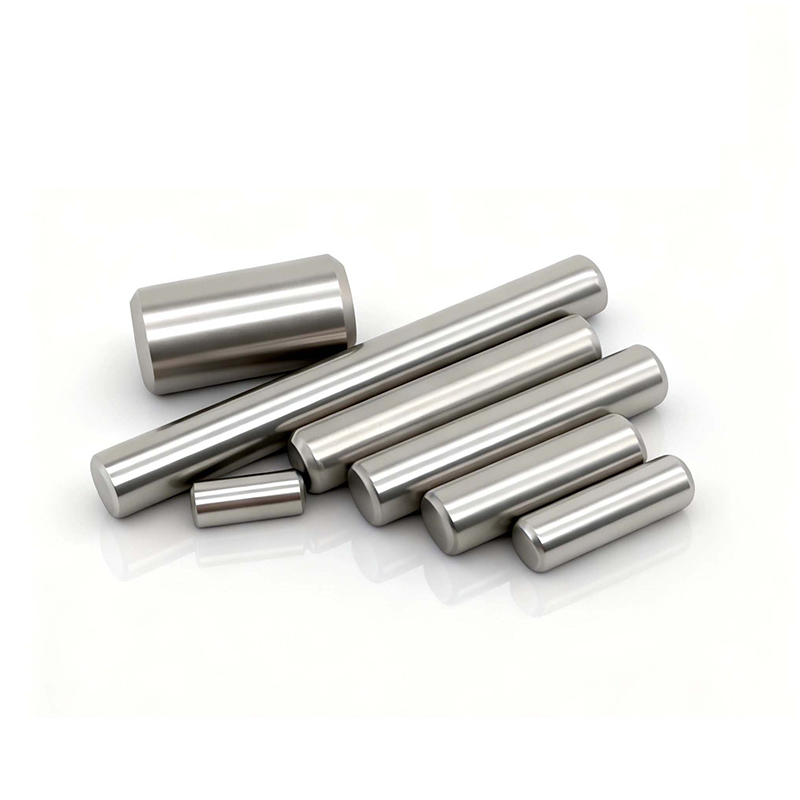
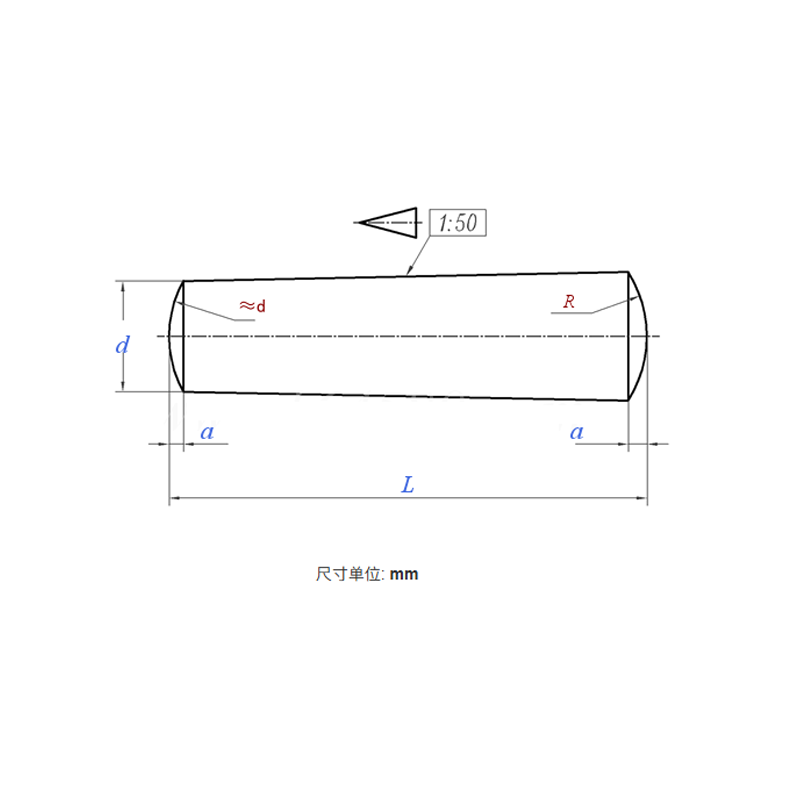
Product Specifications
| Model / Specification | M0.6 - 50 |
| Material | Stainless Steel |
| Nom. Dia. d |
0.6 | 0.8 | 1 | 1.2 | 1.5 | 2 | 2.5 | 3 | 4 | 5 | |
| d ① | Max.=Nom. (h10) | 0.6 | 0.8 | 1 | 1.2 | 1.5 | 2 | 2.5 | 3 | 4 | 5 |
| Min. | 0.56 | 0.76 | 0.96 | 1.16 | 1.46 | 1.96 | 2.46 | 2.96 | 3.952 | 4.952 | |
| a | ≈ | 0.08 | 0.1 | 0.12 | 0.16 | 0.2 | 0.25 | 0.3 | 0.4 | 0.5 | 0.63 |
| Steel Wt. ≈ kg/1000 pcs | - | - | - | - | - | - | - | - | - | - | |
| Nom. Dia. d |
6 | 8 | 10 | 12 | 16 | 20 | 25 | 30 | 40 | 50 | |
| d ① | Max.=Nom. (h10) | 6 | 8 | 10 | 12 | 16 | 20 | 25 | 30 | 40 | 50 |
| Min. | 5.952 | 7.942 | 9.942 | 11.93 | 15.93 | 19.916 | 24.916 | 29.916 | 39.9 | 49.9 | |
| a | ≈ | 0.8 | 1 | 1.2 | 1.6 | 2 | 2.5 | 3 | 4 | 5 | 6.3 |
| Steel Wt. ≈ kg/1000 pcs | - | - | - | - | - | - | - | - | - | - | |
Taper Pin – Product Introduction
The taper pin is a cylindrical fastener with a 1:50 taper ratio. It achieves precise positioning, connection, or locking of components through an interference fit between the tapered surface and the pin hole. Relying on the friction generated by driving or pressing in, it provides self-locking capability and can withstand a certain amount of axial force and torque.
Our taper pins strictly comply with national standards (GB/T 117, GB/T 118, GB/T 881, etc.), DIN standards (DIN 1, DIN 7977), and international standards (ISO 2339). Materials include stainless steel (A2/A4) and high-quality carbon steel. They are widely used in mechanical transmission and structural connection applications that require repeated assembly/disassembly while maintaining positioning accuracy.
I. Product Features
1:50 Standard Taper: Provides excellent self-locking performance, preventing loosening under static loads. Pin holes of the same taper ratio can be reworked with a standard taper reamer and reused with new pins.
Diverse End Configurations: Available in standard type (no auxiliary removal), internal thread type (internal thread at the large end for blind-hole extraction), and threaded-end type (external thread with nut for locations where driving is impractical) — meeting various assembly requirements.
High Surface Finish: Tapered surfaces are machined by turning or grinding with low roughness, ensuring tight contact with the pin hole and high positioning accuracy.
Optional Split-End Design: Split-end taper pins (GB/T 877) feature a slot at the small end that expands after installation, providing excellent vibration resistance and anti-loosening performance.
II. Product Advantages
Easy Assembly/Disassembly, Simple Maintenance: Especially for internal thread and threaded-end taper pins, they can be easily pulled out from blind holes or confined spaces, greatly facilitating equipment maintenance and part replacement.
Restorable Positioning Accuracy: When a pin hole wears oversized, simply re-ream it with a standard taper reamer and install a new pin of the same size to restore original accuracy — resulting in low life-cycle cost.
Dual Function of Load-Bearing and Positioning: Compared to parallel pins, taper pins can withstand limited one-sided axial loads, combining positioning and fastening in one component and simplifying the structure.
Strong Material Adaptability: Stainless steel versions offer acid/alkali corrosion resistance, suitable for food and chemical equipment. Carbon steel versions achieve high surface hardness after heat treatment, providing wear resistance and shear strength.
III. Application Areas
Precision Machine Tools and Jigs & Fixtures: Used for precise positioning of worktables, spindle boxes, and die plates, ensuring repeatable assembly accuracy.
Power Transmission and Rotating Components: Circumferential fixing and torque transmission of motor shafts, pulleys, couplings, gears, and similar components to shafts.
Automotive and Rail Transit: Positioning and safety locking of steering knuckles, suspension links, and brake components.
General Machinery and Instruments: Floating hinge pins for small mechanisms, operator handle fixation, and precise closure positioning of instrument enclosures.
Frequent Assembly/Disassembly or Blind-Hole Scenarios: Structures requiring regular inspection are recommended to use internal thread or threaded-end taper pins.