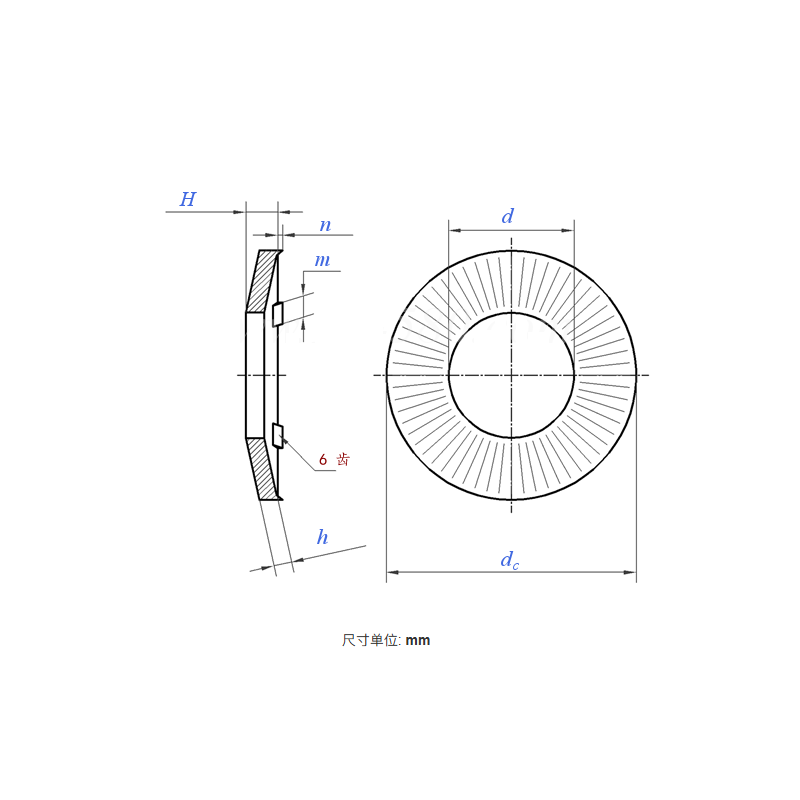
Product Specifications
| Model / Specification | M3 – M20 |
| Material | Stainless Steel |
| Applicable Thread | M3 | M3.5 | M4 | M5 | M6 -001 |
M6 -002 |
M8 -001 |
M8 -002 |
|
| d | Min | 3.1 | 3.6 | 4.1 | 5.1 | 6.1 | 6.1 | 8.2 | 8.2 |
| Max | 3.4 | 3.9 | 4.4 | 5.4 | 6.4 | 6.4 | 8.5 | 8.5 | |
| dc | Min | 5.8 | 6.8 | 7.8 | 9.8 | 11.8 | 11.8 | 15.8 | 15.8 |
| Max | 6.2 | 7.2 | 8.2 | 10.2 | 12.2 | 12.2 | 16.2 | 16.2 | |
| H | Min | 0.8 | 0.95 | 1 | 1.25 | 1.5 | 1.5 | 1.95 | 2.15 |
| Max | 0.95 | 1.1 | 1.15 | 1.5 | 1.8 | 1.8 | 2.4 | 2.4 | |
| h | Min | 0.57 | 0.67 | 0.77 | 0.97 | 1.16 | 1.16 | 1.36 | 1.36 |
| Max | 0.63 | 0.73 | 0.83 | 1.03 | 1.24 | 1.24 | 1.44 | 1.44 | |
| m | Min | 0.7 | 0.9 | 1.1 | 1.9 | 2 | 2 | 2 | 2 |
| Max | 0.9 | 1.1 | 1.3 | 2.1 | 2.2 | 2.2 | 2.2 | 2.2 | |
| n | Min | 0.2 | 0.2 | 0.2 | 0.3 | 0.3 | 0.9 | 0.3 | 0.9 |
| Max | 0.4 | 0.4 | 0.4 | 0.7 | 0.7 | 1.3 | 0.7 | 1.3 | |
| Weight per 1000 Pieces (Steel) ≈ kg | 0.083 | 0.138 | 0.209 | 0.426 | 0.76 | 0.76 | 1.55 | 1.55 | |
| Applicable Thread | M10 -001 |
M10 -002 |
M12 -001 |
M12 -002 |
M16 -001 |
M16 -002 |
M20 -001 |
M20 -002 |
|
| d | Min | 10.2 | 10.2 | 12.4 | 12.4 | 16.4 | 16.4 | 20.5 | 20.5 |
| Max | 10.6 | 10.6 | 12.8 | 12.8 | 16.8 | 16.8 | 21 | 21 | |
| dc | Min | 19.75 | 19.75 | 23.75 | 23.75 | 31.7 | 31.7 | 39.7 | 39.7 |
| Max | 20.25 | 20.25 | 24.25 | 24.25 | 32.3 | 32.3 | 40.3 | 40.3 | |
| H | Min | 2.15 | 2.15 | 2.15 | 2.15 | 3.5 | 3.5 | 4.2 | 4.2 |
| Max | 2.6 | 2.6 | 2.6 | 2.6 | 3.95 | 3.95 | 4.65 | 4.65 | |
| h | Min | 1.56 | 1.56 | 1.56 | 1.56 | 2.42 | 2.42 | 2.92 | 2.92 |
| Max | 1.64 | 1.64 | 1.64 | 1.64 | 2.58 | 2.58 | 3.08 | 3.08 | |
| m | Min | 2 | 2 | 2 | 2 | 4.5 | 4.5 | 4.5 | 4.5 |
| Max | 2.2 | 2.2 | 2.2 | 2.2 | 4.7 | 5.5 | 4.7 | 5.5 | |
| n | Min | 0.3 | 0.9 | 0.3 | 0.9 | 0.3 | 0.9 | 0.4 | 1 |
| Max | 0.7 | 1.3 | 0.7 | 1.3 | 0.7 | 1.3 | 0.8 | 1.4 | |
| Weight per 1000 Pieces (Steel) ≈ kg | 2.78 | 2.78 | 3.97 | 3.97 | 11.2 | 11.2 | 20.8 | 20.8 | |
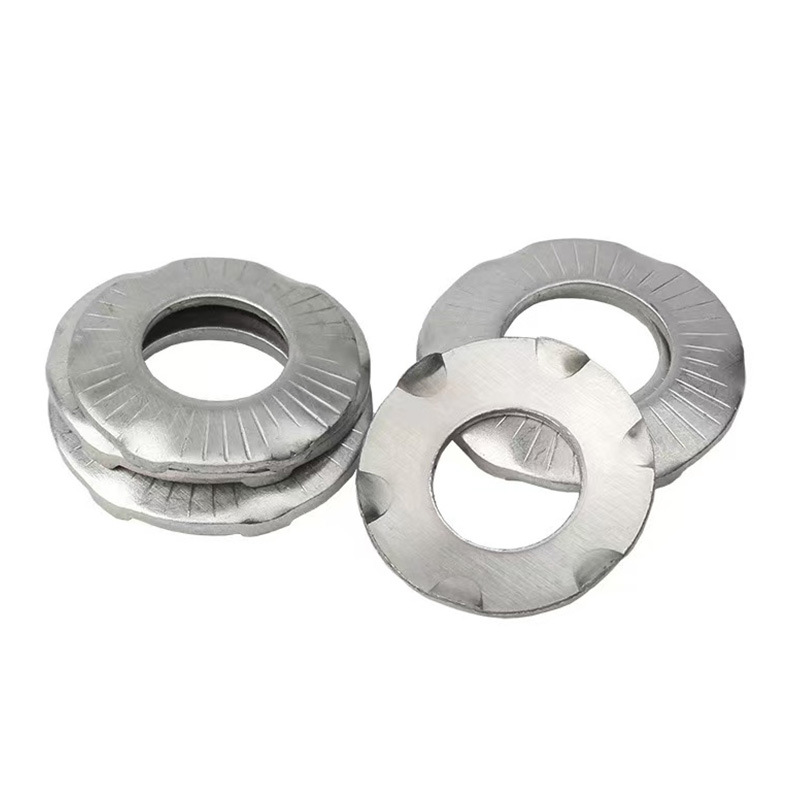
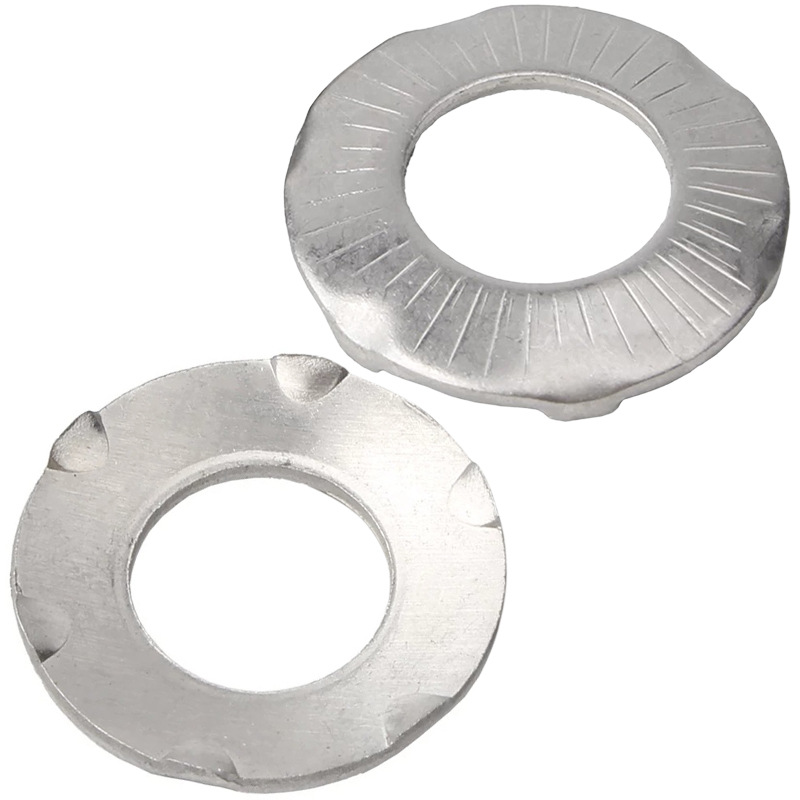
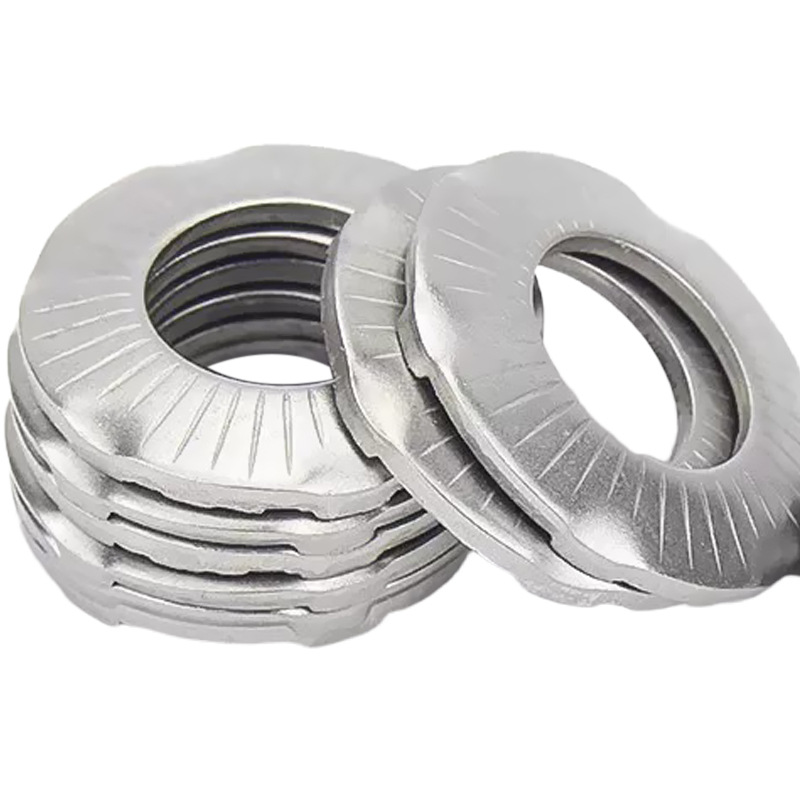
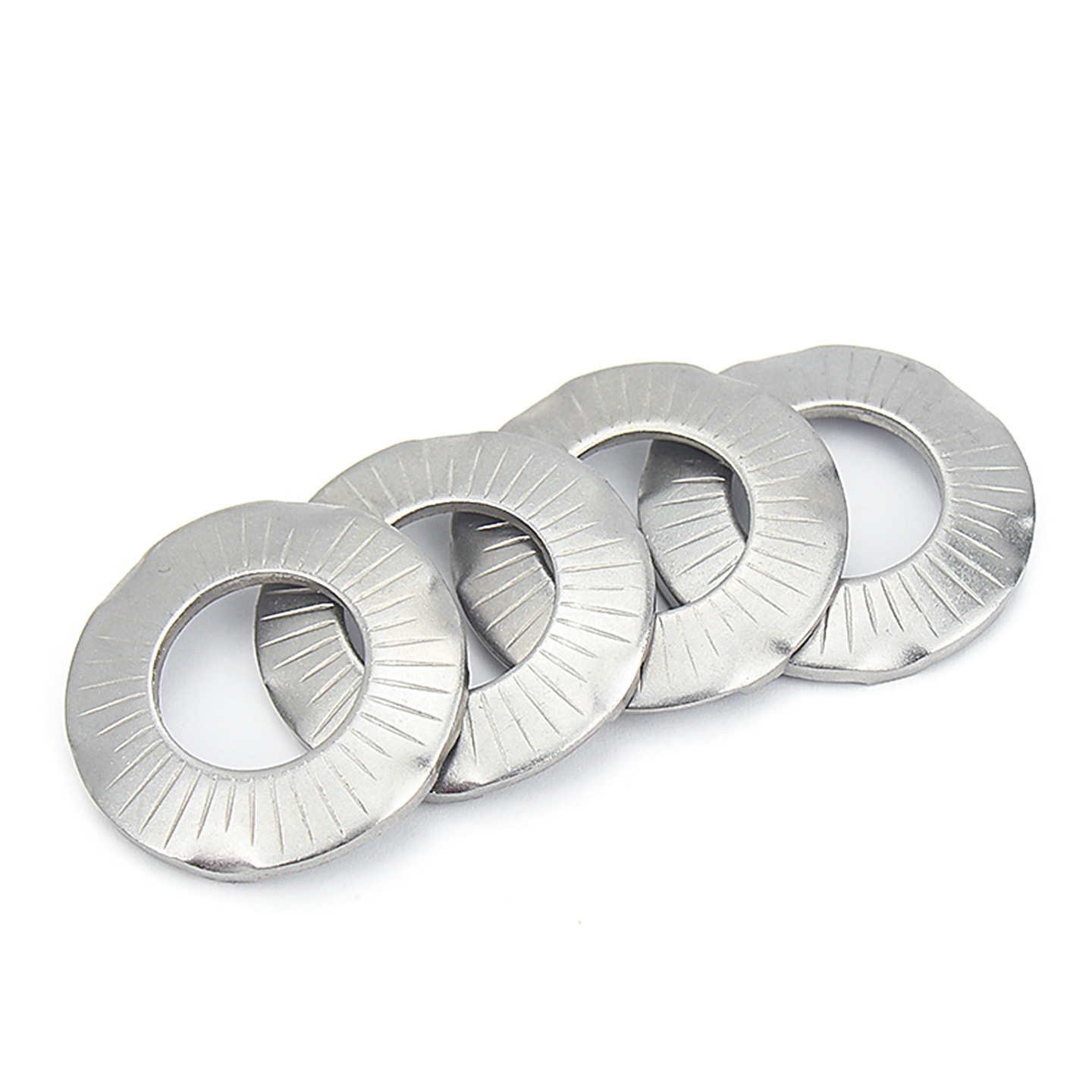
GROUNDING WASHER (DIN 6795) — PRODUCT INTRODUCTION
A grounding washer is a fastening accessory that achieves low-resistance electrical connection through mechanical bite-in. Typically installed between the bolt head/nut and the connected component, its sharp teeth embed into the substrate surface during tightening, piercing through oxide layers, paint films, or plating to form a firm metal-to-metal direct contact. This provides a durable and reliable ground continuity path while simultaneously delivering anti-loosening locking performance. Wind power and electrical equipment commonly use SUS304 stainless steel or phosphorus bronze as materials.
I. PRODUCT FEATURES
Multi-Tooth / Wedge Bite Structure: The washer features sharp protrusions or radial teeth on one or both sides, capable of piercing into the mating surface under minimal displacement. The tooth geometry is optimized to concentrate clamping force on the tooth tips, ensuring clean penetration through coatings with low tightening torque.
High-Hardness Substrate: To ensure lasting elasticity and reliable bite-in capability, the washer is typically made from high-hardness stainless steel or heat-treated spring steel/copper alloy. The hardness significantly exceeds that of standard flat washers, allowing teeth to maintain their sharp edges and penetration performance throughout extended service life under cyclic loading.
Reliable Electrical Conductivity: The design objective is to form a stable, low-resistance metal pathway between the washer and the connected component after tightening, allowing leakage currents to pass through unimpeded. Contact resistance is typically maintained below 10 mΩ, meeting the requirements of most grounding and equipotential bonding standards.
Balanced Corrosion Resistance and Conductivity: Stainless steel materials provide inherent corrosion resistance; for carbon steel versions, zinc or nickel plating is applied. When tightened, the tooth tips pierce through the surface coating, so even if the surrounding areas retain plating or develop light oxidation, the tooth tip contact points still ensure reliable conductivity.
II. PRODUCT ADVANTAGES
No Additional Surface Preparation Required: During installation, there is no need to specially grind or remove paint or oxide layers from the mounting surface — the washer’s teeth self-penetrate through insulating layers, significantly simplifying the grounding installation process and reducing labor time and cost.
Dual Function: Anti-Loosening + Grounding in One Component: The structure combines the anti-loosening function of spring washers with the dedicated grounding function. One single component simultaneously solves two problems: fastener loosening and circuit continuity — reducing part count and simplifying assembly.
Long-Term Grounding Stability: Compared to grounding methods that rely on simple flat-surface contact, the tooth-bite mechanism resists micro-vibration effectively. Over long-term use, it does not suffer from degraded grounding performance caused by re-oxidation or paint film rebound. Excellent salt spray resistance ensures stable electrical connection in harsh outdoor and marine environments.
Minimal Surface Coating Damage: For equipment with aesthetic or rust-prevention coating requirements, the washer only disrupts the coating in an extremely small area at the tooth tip points to achieve conductivity. This prevents large-area coating peeling and avoids introducing corrosion risk to the protected surface.
III. APPLICATION AREAS
Wind Power and Renewable Energy: Equipotential bonding inside wind turbine nacelles and towers, lightning protection grounding systems, and ground bus connections for converter cabinets and control cabinets.
Power Distribution and Electrical Enclosures: Ground cross-bonding across door panels and cabinet frames of high/low voltage switchgear, shell grounding for photovoltaic inverters and combiner boxes.
Railway Transportation and Automotive: Body grounding for railway vehicles, grounding of signal equipment, and ground connections for electric vehicle battery pack housings and motor controller enclosures.
Telecommunications and Lightning Protection: Grounding bus bar connections for base station equipment cabinet doors and outdoor telecommunications equipment lightning protection systems.
General Industrial Manufacturing: Machine tool control cabinets, chemical vessel flange cross-bonding, and process equipment grounding — any application requiring both secure mechanical fastening and reliable electrical conductivity between enclosures.