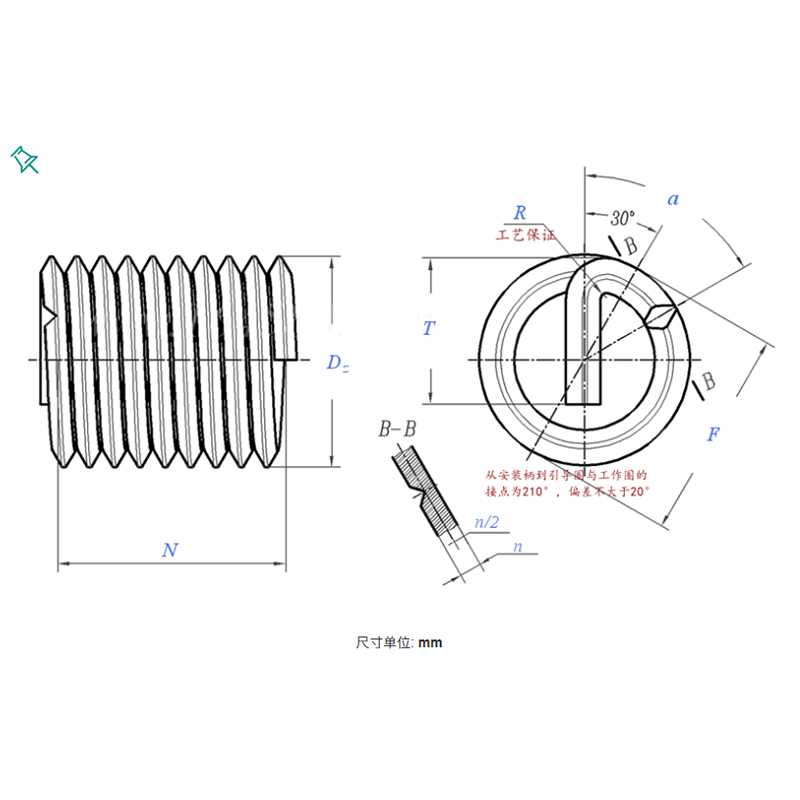
Product Specifications
| Model / Specification | M2 – M39 |
| Material | Stainless Steel |
| Thread Specification | M2 | M2.5 | M3 | M4 | M5 | M6 | M7 | M8 | M10 | M12 | M14 | ||
| P | Pitch (Coarse Pitch) | 0.4 | 0.45 | 0.5 | 0.7 | 0.8 | 1 | 1 | 1.25 | 1.5 | 1.75 | 2 | |
| F | First Coil Outside Diameter (OD) | Min. | - | - | - | - | - | 7.28 | 8.28 | 9.55 | 11.82 | 14.2 | 16.47 |
| Max. | - | - | - | - | - | 7.58 | 8.58 | 9.85 | 12.1 | 14.5 | 16.87 | ||
| Dz | Free State Outside Diameter | Min. | 2.53 | 3.2 | 3.8 | 5.05 | 6.25 | 7.58 | 8.58 | 9.85 | 12.1 | 14.5 | 16.87 |
| Max. | 2.7 | 3.7 | 4.35 | 5.6 | 6.8 | 7.95 | 9.2 | 10.35 | 12.8 | 15 | 17.87 | ||
| T | Tang Length | Min. | 1.2 | 1.8 | 1.8 | 2.4 | 2.9 | 3.5 | 4 | 4.7 | 5.8 | 6.9 | 8.1 |
| Max. | 1.6 | 2 | 2.4 | 3.2 | 4 | 4.8 | 5.5 | 6.3 | 7.9 | 9.5 | 11 | ||
| a | Tang Break Notch Position | Min. | 40° | 40° | 40° | 40° | 40° | 40° | 40° | 40° | 40° | 40° | 40° |
| Max. | 90° | 90° | 90° | 90° | 90° | 90° | 80° | 80° | 80° | 70° | 70° | ||
| R | Tang-to-Coil Transition Fillet Radius | Max. | 0.3 | 0.3 | 0.4 | 0.5 | 0.6 | 0.7 | 0.8 | 1 | 1.2 | 1.6 | 2 |
| Thread Specification | M16 | M18 | M20 | M22 | M24 | M27 | M30 | M33 | M36 | M39 | ||
| P | Pitch (Coarse Pitch) | 2 | 2.5 | 2.5 | 2.5 | 3 | 3 | 3.5 | 3.5 | 4 | 4 | |
| F | First Coil Outside Diameter (OD) | Min. | 18.47 | 21 | 23.01 | 25.01 | 27.55 | 30.55 | 34.1 | 37.09 | 40.63 | 43.63 |
| Max. | 18.87 | 21.4 | 23.46 | 25.61 | 28.15 | 31.15 | 34.7 | 37.7 | 41.33 | 44.33 | ||
| Dz | Free State Outside Diameter | Min. | 18.87 | 21.4 | 23.46 | 25.61 | 28.15 | 31.15 | 34.7 | 37.7 | 41.33 | 44.33 |
| Max. | 19.9 | 22 | 24.4 | 26.9 | 29.1 | 32.4 | 35.81 | 39.01 | 42.67 | 45.75 | ||
| T | Tang Length | Min. | 9.1 | 10.4 | 11.4 | 12.4 | 13.6 | 15.1 | 16.9 | 18.4 | 20.2 | 21.7 |
| Max. | 12.5 | 14.2 | 15.7 | 17.2 | 18.8 | 21.1 | 23.4 | 25.7 | 28.1 | 30.3 | ||
| a | Tang Break Notch Position | Min. | 30° | 30° | 30° | 30° | 30° | 30° | 30° | 30° | 30° | 30° |
| Max. | 70° | 70° | 60° | 60° | 60° | 60° | 60° | 60° | 60° | 60° | ||
| R | Tang-to-Coil Transition Fillet Radius | Max. | 2 | 3 | 3 | 3 | 3 | 3 | 3 | 3 | 3 | 3 |
WIRE THREAD INSERT (STANDARD TYPE, COARSE PITCH) — PRODUCT INTRODUCTION
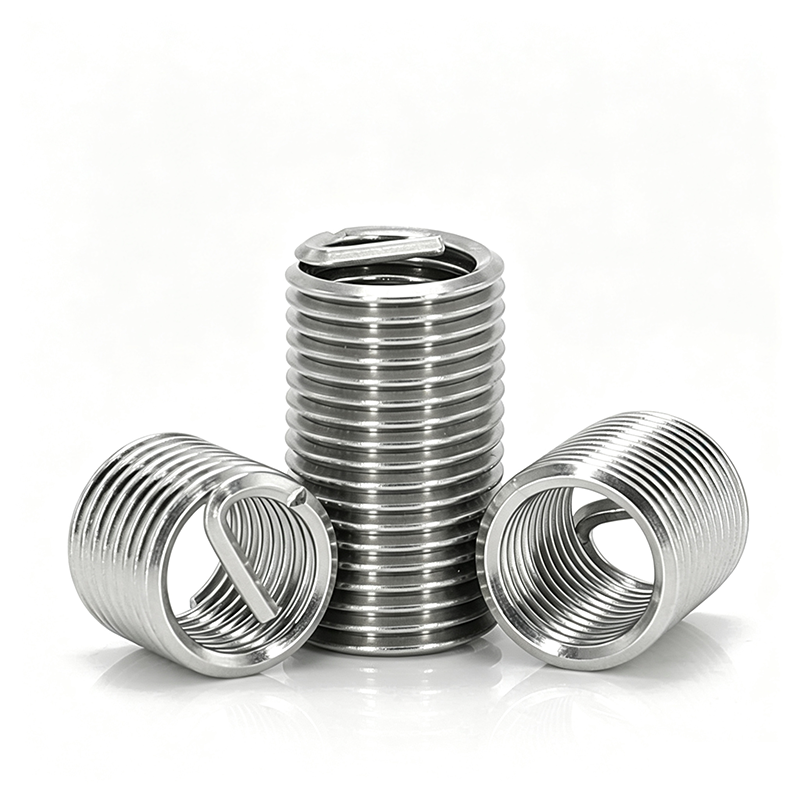
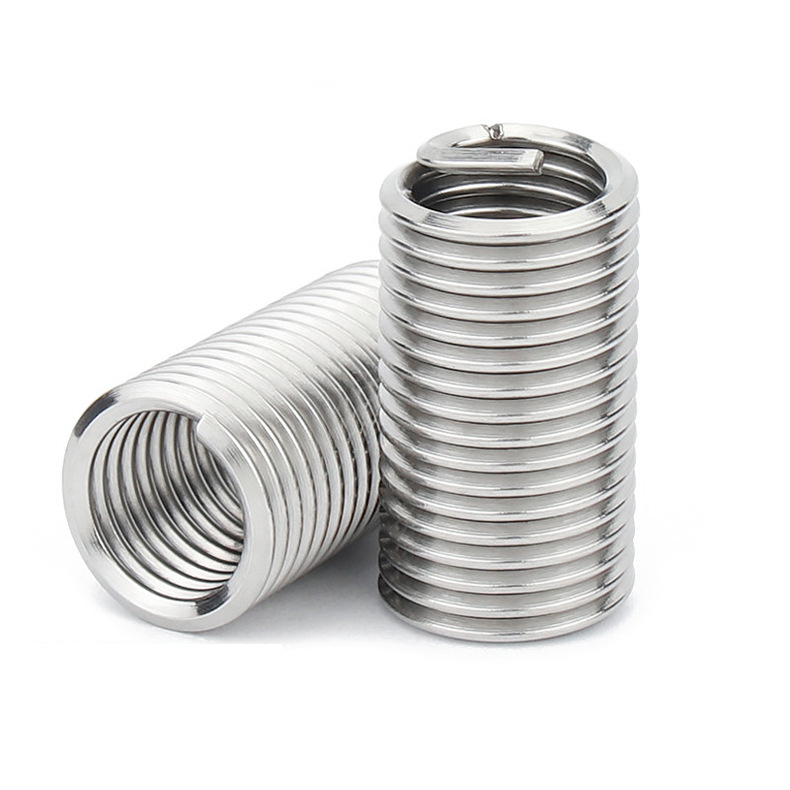
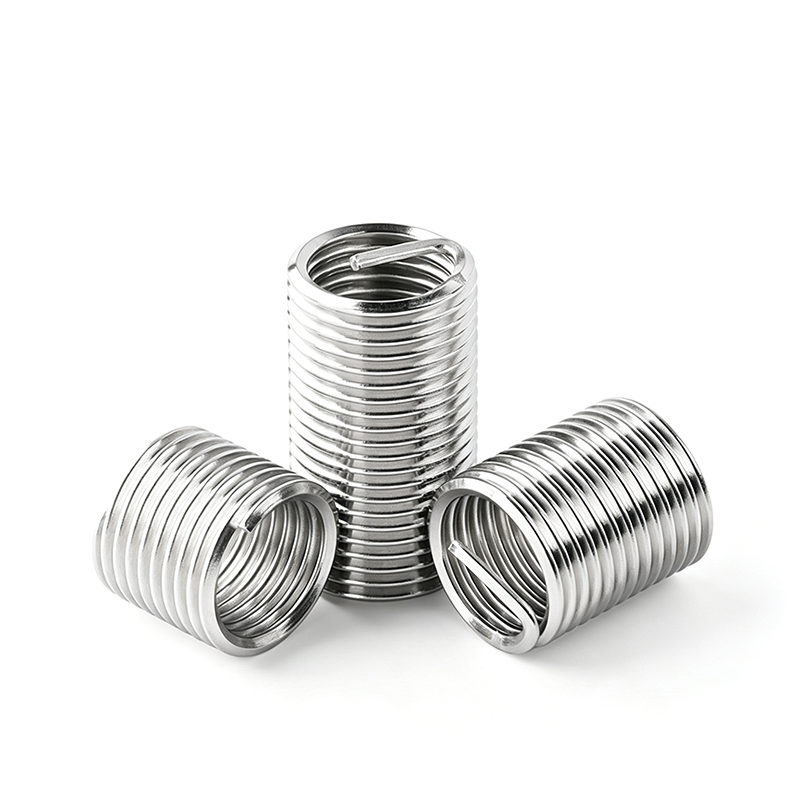
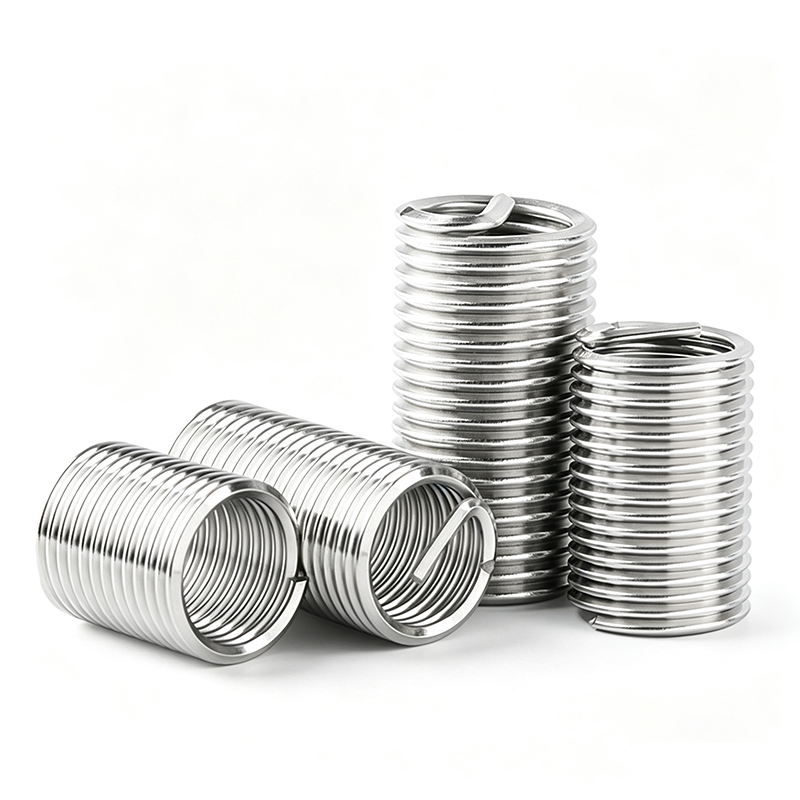
Wire Thread Insert (Standard Type, Coarse Pitch) is manufactured in accordance with the GB/T 24425.1 standard, with SUS304 (06Cr19Ni10) austenitic stainless steel as the standard material. The insert features a spring-like coil geometry; its outer diameter interlocks with the pre-tapped pilot hole while its inner diameter forms a standard coarse-pitch female thread. After installation, the installation tang (mandrel) is broken off at the notch, leaving a complete internal thread that conforms to the GB/T 196 coarse-pitch standard. It is widely used in threaded bores requiring frequent assembly/disassembly, resistance to vibration or thermal cycling, or in applications where the base material has insufficient strength.
I. PRODUCT FEATURES
Standard Coarse-Pitch Internal Thread: The internal thread is a standard coarse pitch (e.g., M6×1.0, M10×1.5, etc.), providing perfect mating with ordinary coarse-pitch bolts without the need for special fasteners.
High-Strength, Corrosion-Resistant Material: Made from cold-rolled SUS304 stainless steel wire with tensile strength exceeding 1,400 MPa, combined with excellent corrosion resistance, oxidation resistance, and high-temperature performance. The surface finish is natural metallic luster.
Elastic Structure with Uniform Load Distribution: In its free state, the insert pitch is slightly smaller than the standard pitch. After insertion, radial and axial elasticity are generated, automatically compensating for pitch errors and distributing thread load more evenly across all engaged turns.
Tang-Designed Installation: The tail end features an installation tang, allowing smooth screwing into the pilot hole using a dedicated installation tool. After installation, the tang is simply broken off at the notch to leave a complete internal thread.
Wear Resistance & Reduced Friction: The smooth stainless steel wire surface has a low coefficient of friction, reducing torque loss and the risk of thread seizure during bolt insertion, while significantly extending the wear life of the threaded connection.
II. PRODUCT ADVANTAGES
Multiplies Thread Strength and Service Life: Increases the threaded connection strength on low-strength base materials (such as aluminum alloy) by several times, preventing thread stripping and pull-out — particularly suitable for frequently assembled/disassembled locations.
Perfect Solution for Stripped Threads: Re-tapping a damaged threaded hole and inserting a wire thread insert restores the original coarse-pitch thread size, eliminating the need to replace expensive large castings or housings, thereby reducing repair costs and downtime.
Uniform Load Distribution: Elastic compensation ensures axial loads are evenly distributed across every thread turn of the base material, significantly improving the fatigue strength and vibration-resistance of the fastening assembly.
Ideal Companion for Lightweight Design: Enables the use of high-strength bolts in aluminum, magnesium, and other lightweight alloys, helping wind power, automotive, and other equipment achieve weight reduction goals without sacrificing connection reliability.
Wide Temperature Range Adaptability: Maintains stable mechanical properties and corrosion resistance across a range of -196°C to 425°C, adapting well to high-low temperature alternating operating conditions.
III. APPLICATION AREAS
Automotive & Engine: Thread reinforcement and repair in aluminum alloy components such as engine blocks, transmission housings, oil pans, braking systems, and wheel hubs.
Wind Power & Energy Equipment: High-strength coarse-pitch threaded connection points in aluminum/magnesium alloy components of wind turbine yaw reducers, pitch gearboxes, generator housings, and control cabinets.
Rail Transit & Aerospace: Thread reinforcement in the large quantities of aluminum alloy, magnesium alloy, and composite material threaded connections used in metro vehicles, high-speed rail equipment, and aircraft structural components.
Electronics & Precision Machinery: Threaded connections in communication equipment, instruments, industrial robots, and other applications demanding extremely high thread precision and repeated assembly/disassembly on lightweight alloy housings or bases.
General Manufacturing & Maintenance: Hydraulic valve bodies, pneumatic components, plastic products, machine tool accessories, and on-site rapid repair of damaged coarse-pitch threaded bores.