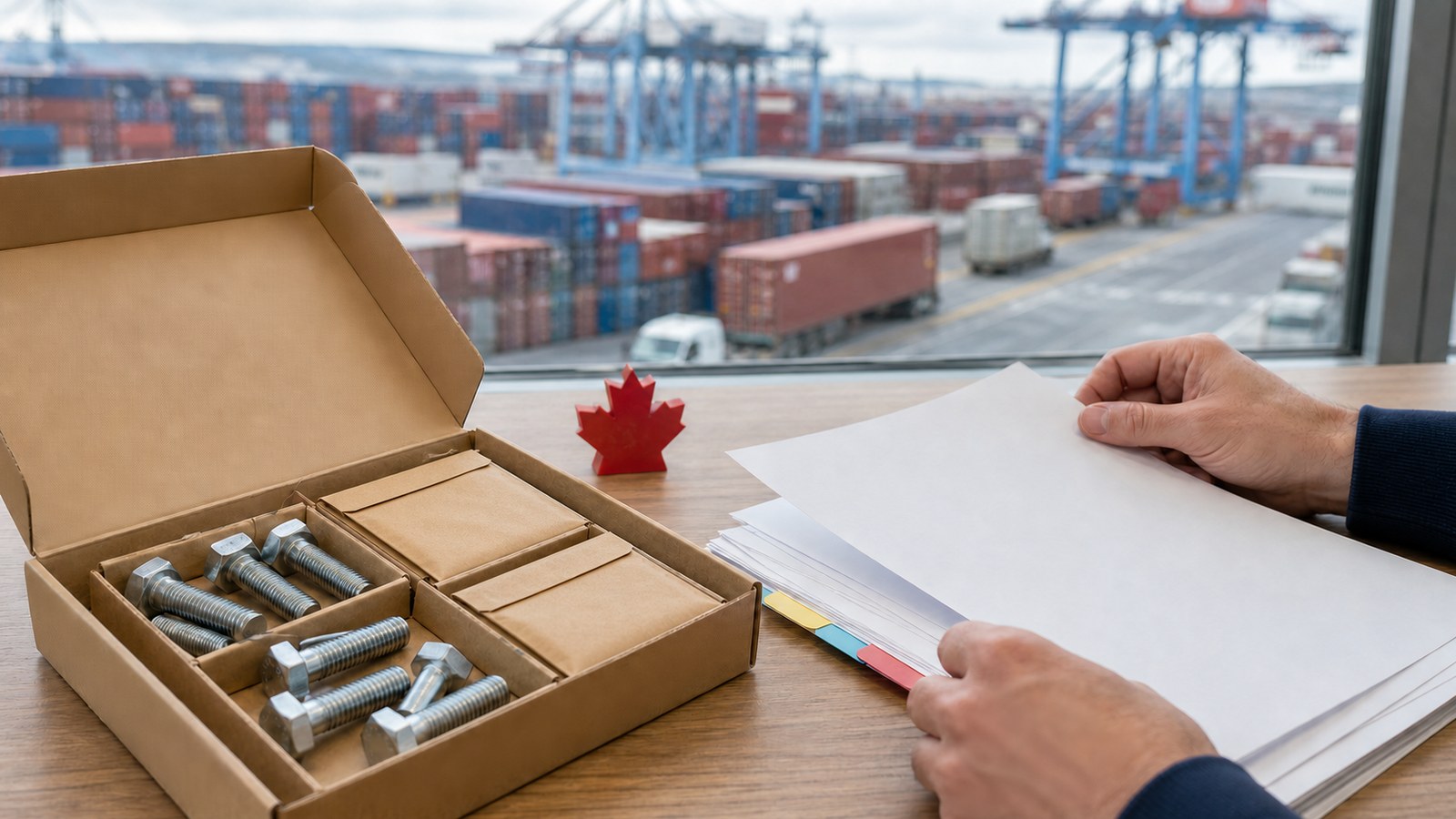
On 25 August 2026, Canada’s Department of Finance announced new counter-tariffs and updated the product list on 26 August. From 12:01 a.m. on 8 September, listed goods treated as U.S.-origin under Canada’s marking rules will face their stated rates. Twelve iron or steel fastener tariff items from HS 7318.11.00 through 7318.29.00 are listed at 50%. The Department also says the measures do not apply to relevant U.S.-origin goods already in transit to Canada when they take effect. Department of Finance product list
This is not a 50% tariff on every fastener imported into Canada. For importers and distributors, the practical question is whether competing quotations use the same basis: a similar product name may hide a different tariff item, origin analysis or shipment status. A clear unit price is not yet a comparable landed-cost position.
HS 7318 covers many products, but the product name is not the tariff item
The listed items include coach screws, other wood screws, screw hooks and rings, self-tapping screws, other screws and bolts, nuts, spring or lock washers, other washers, rivets, cotters and cotter-pins. Describing a line simply as “steel bolt” or “fastener” is not enough to determine which listed item applies.
Canada’s 2026 Customs Tariff, Chapter 73 also shows further product distinctions within some eight-digit items. A supplier may identify the product and suggest a coding direction, but the Canadian importer or customs broker remains responsible for confirming the final tariff classification.
The 50% rate turns on U.S. origin, not only on where the goods ship from
The Department of Finance uses U.S. origin as defined through Canada’s country-of-origin marking rules for CUSMA countries. A U.S. seller, U.S. invoice or U.S. port of loading does not by itself establish that the goods meet that origin test; the actual production facts and applicable Canadian rules still matter.
Timing is a separate question. The Department provides an exception for relevant U.S.-origin goods already in transit to Canada when the measure takes effect and says administrative details will appear in CBSA Customs Notices. Importers and their brokers should use the later notice to confirm transit eligibility, filing treatment and evidence. Existing transport records can be retained, but no single document should be treated in advance as the official qualifying proof.
The announcement also does not establish one universal rate for every other origin. Other duties, surtaxes or trade-remedy measures must still be checked for the product and import arrangement concerned; the news should not be rewritten as automatic duty-free or lower-cost treatment for another source.
Compare the unit price and the import assumptions together
Before comparing quotations for a Canadian fastener project, align at least four points: the specific product and tariff item, the importer’s origin basis, whether the shipment falls within the effective-date transit question, and who bears import duties under the agreed Incoterms. Without that common basis, the lowest supplier price may not produce the lowest landed cost.
For a new enquiry, buyers can provide the drawing or specification, material and finish, quantity, Canadian destination, expected shipment timing and the tariff item being considered. Hebei Wohe Fastener Manufacturing Co., Ltd. can then define the product and quotation scope. Final classification, origin, transit eligibility and the counter-tariff amount remain subject to confirmation by the Canadian importer, customs broker and customs authority.
Buyers comparing bolts, nuts, screws or washers for Canada can review Wohe’s fastener range and send the project details through the contact page. Prices can be compared only after the import basis behind those prices is aligned.
Sources and timing: This article uses the Department of Finance announcement of 25 August 2026, the product list updated to 26 August, and the CBSA 2026 Customs Tariff Chapter 73 and Customs Notices pages checked on 31 August 2026. Official updates should be reviewed again before the measure takes effect and at the time of import.