Product Specifications
| Material | Stainless Steel |
Product Introduction
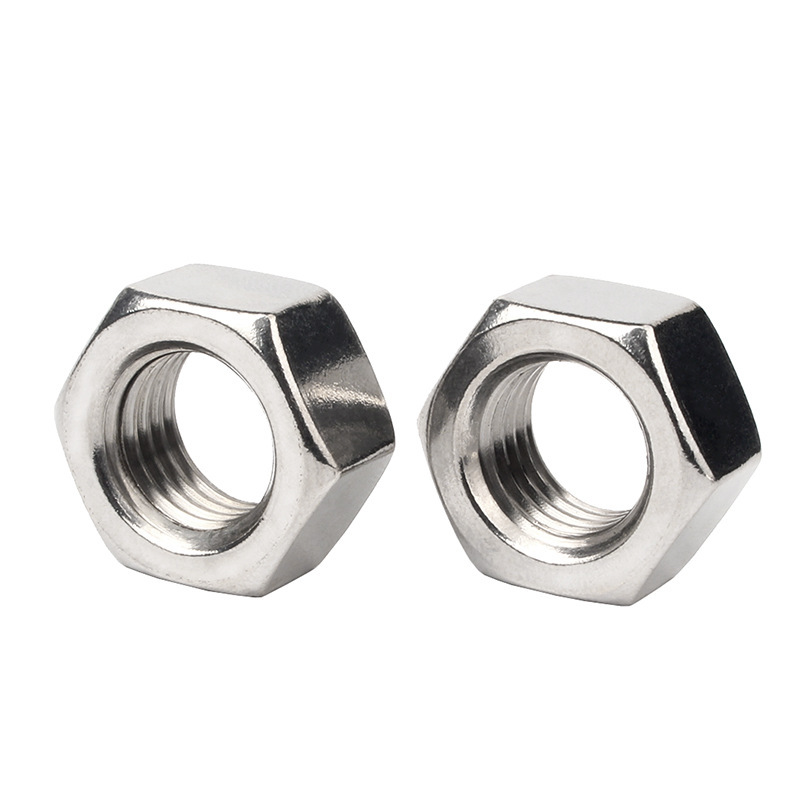
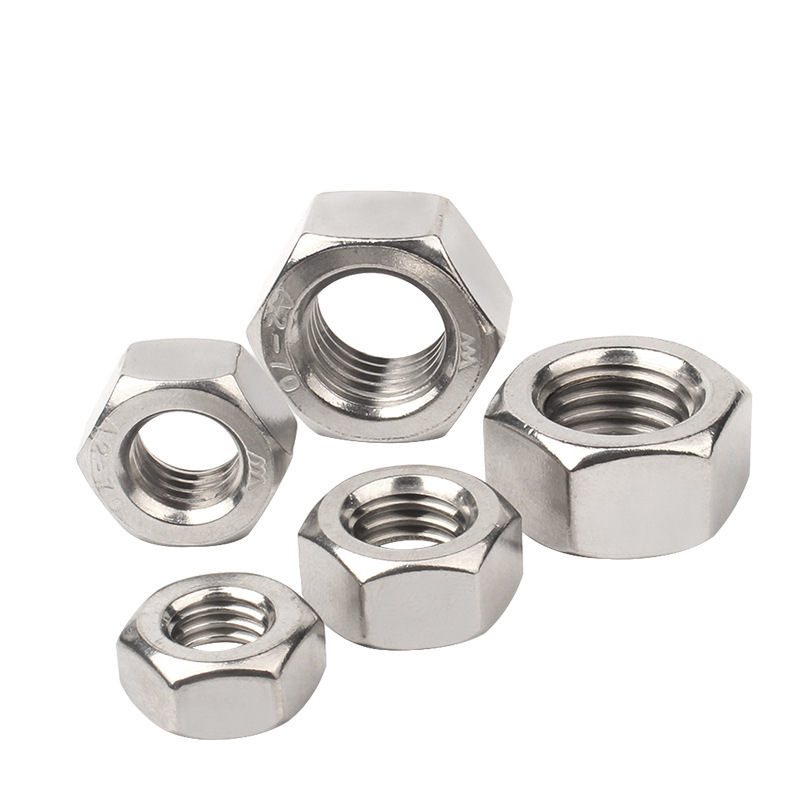
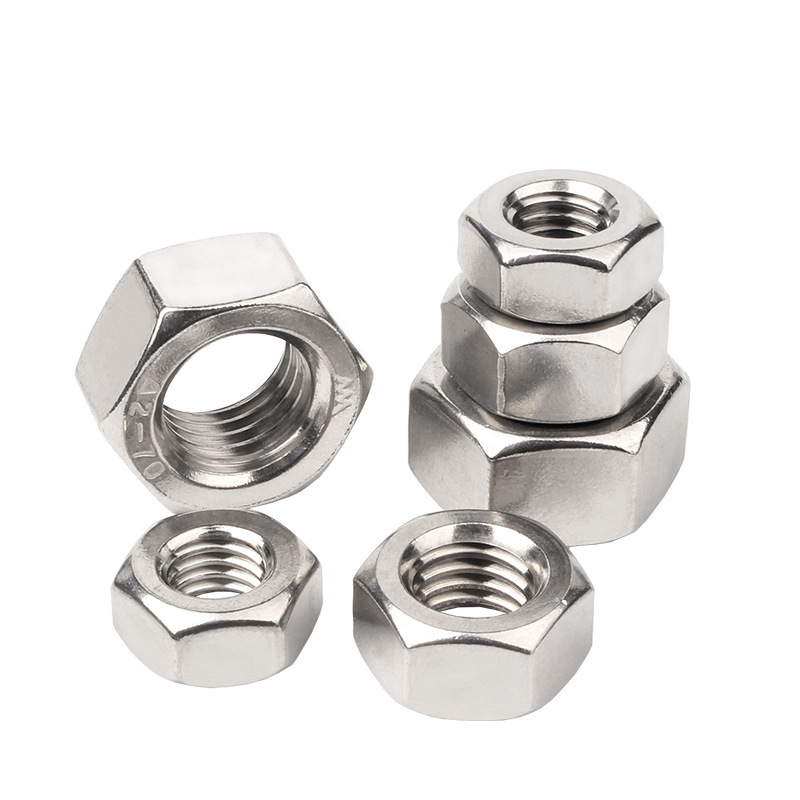
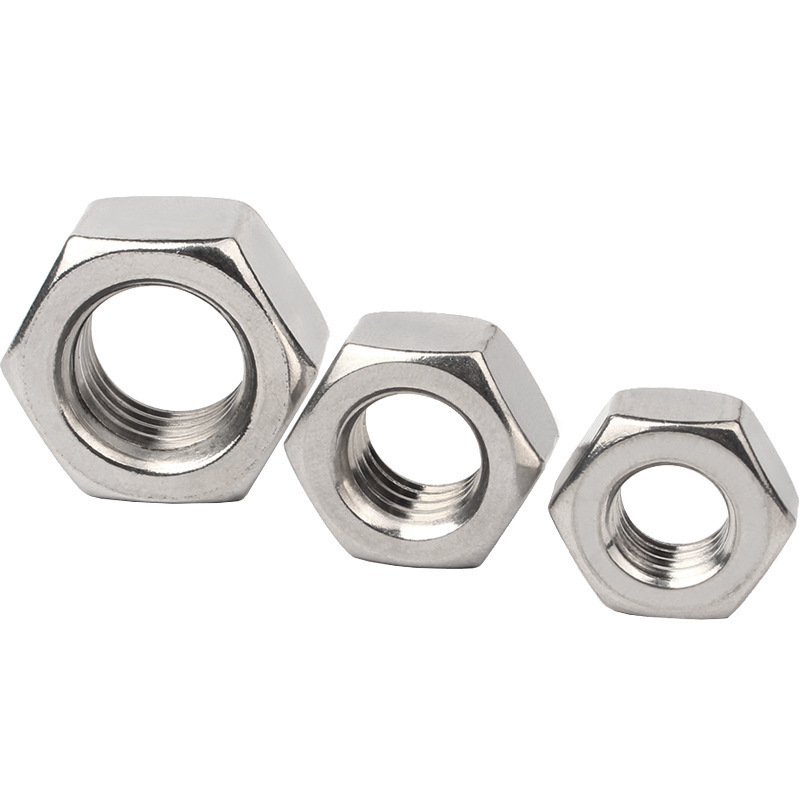
Stainless steel nuts are nut-type fasteners made from stainless steel materials, most commonly austenitic stainless steels such as the 304/A2 and 316/A4 series. Their core advantage lies in the excellent corrosion resistance of the material itself, so they usually do not require additional surface coating treatment and can serve long-term in humid, acidic, or marine environments. The products are generally manufactured according to standards such as GB/T 6170 (style 1 hex nuts) and GB/T 6172.1 (hex thin nuts), with thread specifications covering M1.6–M64. The strength grades of stainless steel nuts are usually expressed by material groups, commonly A2-70 (304 material, proof stress 700 MPa) and A4-80 (316 material, proof stress 800 MPa); lower strength grades such as 50 and A2-50 are also available.
I. Product Features
Clear material groups: The most common are A2 (304 stainless steel) and A4 (316 stainless steel). A2 is suitable for general outdoor and industrial environments; A4, due to the addition of molybdenum, has extremely strong resistance to chlorides such as seawater and de-icing salt.
No surface treatment required: Stainless steel itself has a dense passive film and is usually delivered in a plain or pickled/cleaned condition without electroplating, avoiding the hydrogen embrittlement risk associated with electroplating processes.
Appearance and hygiene: The surface is smooth and attractive, resistant to dirt accumulation, and easy to clean. Unlike rusting carbon steel, it will not contaminate the connected parts.
Diverse specifications and types: In addition to standard hex nuts, they can also be made into nylon-insert lock nuts, flange nuts, cap nuts, and other types.
Good temperature resistance: In high-temperature or extremely cold environments (even as low as -196°C), they can still maintain good mechanical properties and corrosion resistance.
II. Product Advantages
Outstanding corrosion-resistant life and maintenance-free performance: In outdoor, humid, or mildly corrosive environments, stainless steel nuts do not rust or fade and are almost maintenance-free throughout their life cycle, eliminating the cost of regular anti-rust coating.
Lubrication options to prevent galling: Austenitic stainless steel is prone to cold welding and galling during high-speed tightening. High-quality stainless steel nuts are usually subjected to special surface lubrication treatment (such as dry-film lubrication with molybdenum disulfide, wax, etc.), effectively reducing the friction coefficient and preventing thread seizure.
No hydrogen embrittlement risk: For high-strength fasteners, electroplating can easily cause hydrogen embrittlement fracture, while stainless steel nuts fundamentally eliminate this hidden risk from the material source, providing higher safety.
Whole-life cost advantage: Although the unit price is higher than ordinary zinc-plated carbon steel parts, the labor and material costs of frequent replacement and anti-corrosion maintenance are eliminated, resulting in a lower overall cost of use.
III. Scope of Application
Food, medical, and pharmaceutical equipment: 304 or 316 materials are often selected to meet strict hygiene standards, resist corrosion from cleaning agents and disinfectants, and be easy to clean.
Marine engineering and ships: Seawater desalination equipment, ship fittings, yachts, dock facilities, etc., must use 316 (A4) material to resist high salt-spray corrosion.
Chemical and environmental protection equipment: Fastening of reactors, pipeline flanges, and environmental exhaust gas treatment equipment that come into contact with chemical media such as acids, alkalis, and salts.
Building curtain walls and outdoor facilities: Exterior curtain walls of high-end buildings, railings and handrails, outdoor billboards, photovoltaic supports, etc., balancing structural strength with long-term aesthetics.
High-end equipment and precision instruments: Equipment sensitive to magnetism (such as medical MRI equipment), electronic instruments, and cleanroom environments requiring contamination prevention.