Wohe Research · Article revision V1
Repeated tightening of zinc-plated bolts: why the same torque may not produce the same preload
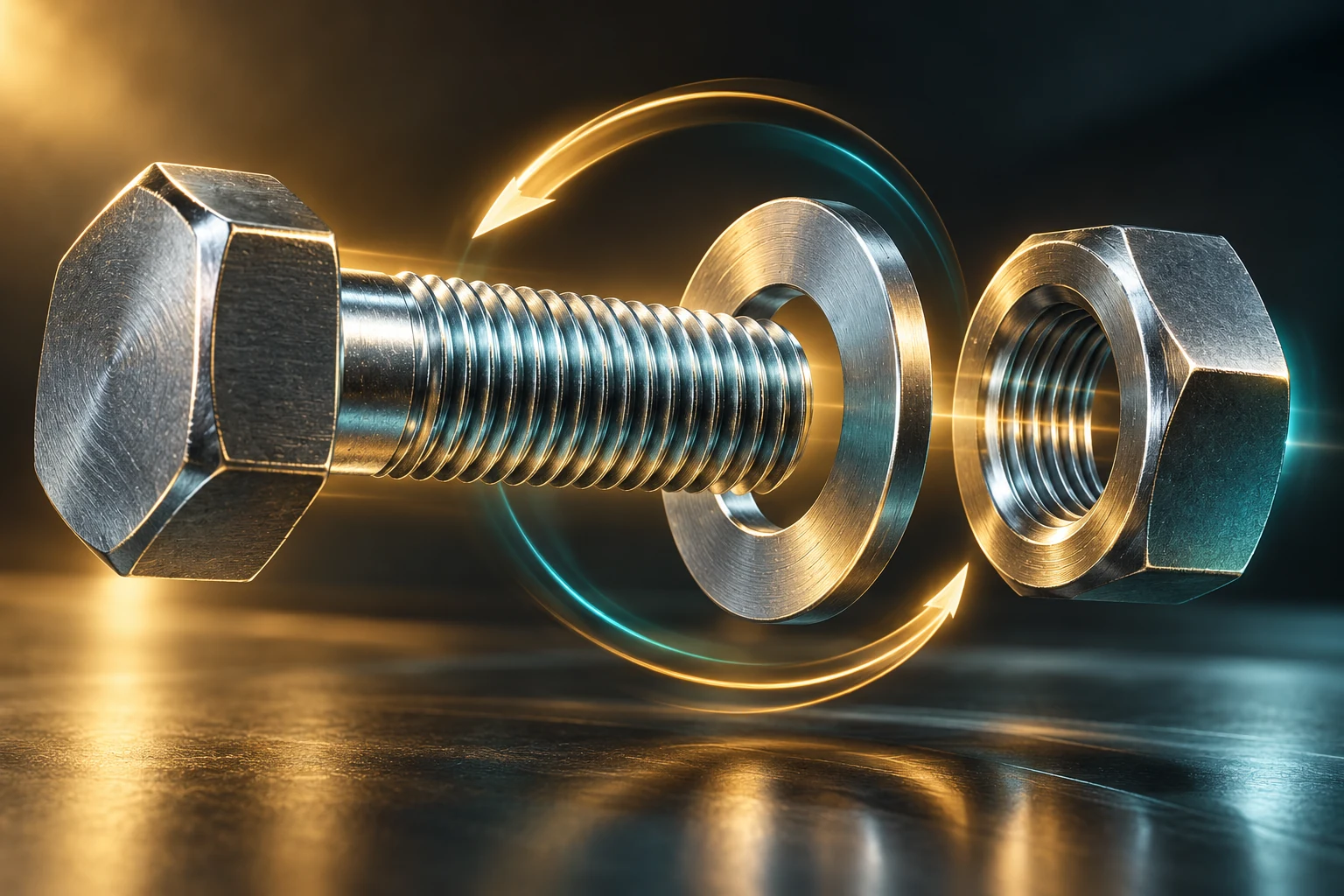
At a glance
Wohe Research interprets tests on repeated tightening of zinc-plated bolts, discussing torque, friction, lubrication and mating-component conditions, and proposes validation directions for surface treatment and assembly consistency.
Research question
How do changes in contact conditions during repeated tightening affect preload consistency?
Guidance & practice
Research observation / proposed research topic
This article interprets publicly available literature as of 2026-10-16. Wohe's research proposals are suggested directions; they do not represent approved projects, completed tests or developed products.
Joint conditions may change when a bolt is removed and tightened again. Research into repeated tightening needs to consider contact surfaces, lubrication, mating components and operating conditions, rather than simply comparing torque settings.
Drawing on recent published research, Hebei Wohe Fastener Manufacturing Co., Ltd. discusses the effects of repeated tightening on joint consistency and proposes research directions for surface treatment and assembly validation.
What did recent tests find?
A study published in 2025 tested repeated tightening of zinc-plated bolts at different torque levels, examining lubrication, nut replacement and stress distribution. The results indicated that repeated-tightening behavior depended on torque level and operating conditions, with associated changes in preload and contact-surface condition. Research source: repeated tightening behavior of zinc-plated bolts at different torque levels
The results apply to particular specimens and test combinations. They cannot be generalized into rules for every zinc-plated bolt, or used to justify changing torque or adding lubricant on site without assessment.
Why record surface conditions as well?
The study evaluated friction, wear, preload and stress distribution together. For engineering interpretation, it highlights that repeated tightening is not simply the same operation repeated.
If the same torque setting applies to different components and contact conditions, its outcome needs to be confirmed again.
| Condition | What to record in research |
|---|---|
| Surface treatment | Type, batch and relevant process information |
| Lubrication | Presence, type and application method |
| Mating components | Condition of nuts, washers and contact surfaces |
| Operating process | Speed, program and number of disassembly/reassembly cycles |
| Results | Preload, process data and surface changes |
Wohe's proposed research direction
For a product with one specified coating/plating system, a test sequence of “initial tightening — removal — retightening” could be established under controlled conditions.
Each test group should keep the main conditions fixed and record whether mating components are replaced. Research priorities include:
1. The distribution of preload at initial assembly.
2. How that distribution changes after repeated operations.
3. Whether surface damage corresponds to measurement changes.
4. Which changes require further investigation.
Results should be reported with complete conditions, rather than as a single average.
Can this establish how many times a bolt may be reused?
A single experiment or an average result cannot directly establish a universal reuse count.
Whether reuse is permitted must also be confirmed against applicable specifications, product instructions, joint design and maintenance procedures. For critical joints, research data cannot automatically replace engineering approval.
Likewise, relatively stable lubrication behavior in one test group does not justify a general recommendation to “add oil on site.” Lubrication forms part of the assembly conditions; changing it requires appropriate assessment.
Looking ahead: can surface-treatment records include assembly-consistency information?
Wohe proposes a direction worth exploring: beyond corrosion resistance, appearance and dimensional requirements, study the relationship between surface-treatment condition and assembly outcomes according to the customer's application.
This could move discussions beyond the name of a coating toward whether joint behavior is consistent under agreed conditions.
Future surface-treatment research could address protection, assembly and maintenance together, while supporting each performance claim with defined methods and evidence.
Methods, conditions and evidence
Public literature interpretation and engineering-question analysis are used to propose future validation directions. No Wohe in-house tests have been conducted or reported. The cited findings apply to the conditions of the original papers and cannot be directly extrapolated into product conclusions.
Findings
This page presents research observations and proposed topics. It does not mean that Wohe has approved a project, completed tests, deployed a system or developed a product. Actual engineering applicability still requires independent validation.
Scope and limitations
This article does not establish joint safety, product certification or suitability for a particular application. The research proposals do not mean that projects have been approved or validation completed. Findings from individual publications must not be used directly to set on-site torque, lubrication, reuse counts or disposition of critical joints. Actual applications should be assessed by appropriate technical personnel against the design, applicable specifications and confirmed inspection conditions.
Evidence and sources
Based on research-observation manuscripts supplied by the website owner, with all original literature links retained in the body. The manuscripts state a literature-search cutoff of 2026-10-16. For this publication, relevant publication details and publicly accessible abstracts or indexed excerpts were editorially checked; this was not a full-text review of every paper, and no Wohe on-site tests were conducted. The cited research findings belong to the original paper authors; the future proposals in this article are suggested directions.
Source document ↗https://www.sciencedirect.com/science/article/pii/S2352012425009142Check the issuing organization for the full document and its latest status.
Article revision V1
First publication of research observations and proposed topics based on manuscripts supplied by the owner, using AI-assisted translation and conceptual illustrations.
You are reading the published revision. Later drafts are reviewed before they replace this page.