Wohe Research · Article revision V1
Can smart fasteners detect loosening? New directions in bolt maintenance through preload monitoring
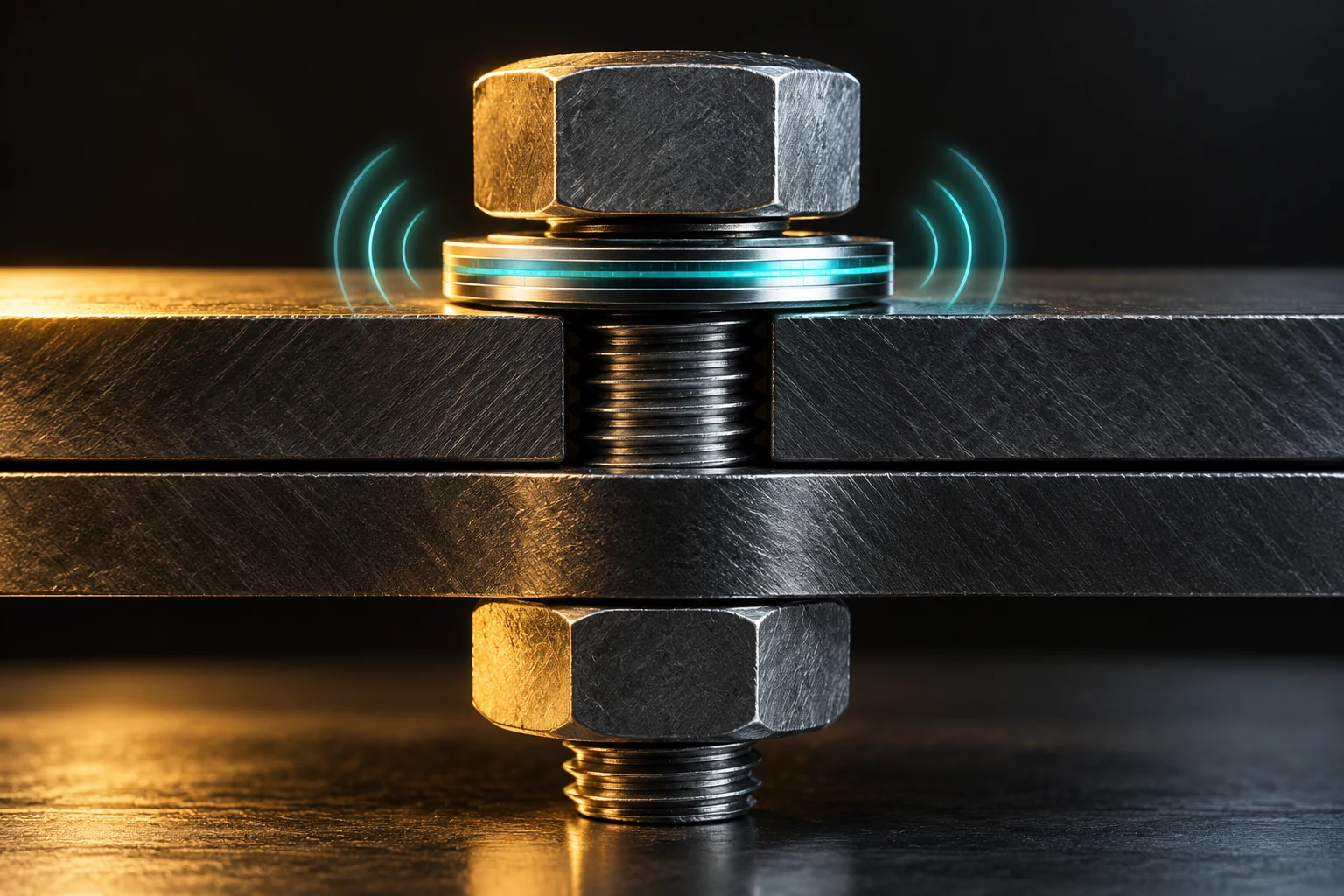
At a glance
Drawing on publications from 2025–2026, Wohe Research discusses sensing methods, environmental interference, calibration and durability in smart fasteners, and proposes approaches to validating preload monitoring.
Research question
Under what conditions can sensor signals reflect preload or loosening?
Guidance & practice
Research observation / proposed research topic
This article interprets publicly available literature as of 2026-10-16. Wohe's research proposals are suggested directions; they do not represent approved projects, completed tests or developed products.
How a joint changes after a bolt has been installed is an important question in smart-fastener research. Beyond recording installation alone, preload monitoring seeks to answer whether a joint still maintains its intended condition after a period in service.
Hebei Wohe Fastener Manufacturing Co., Ltd. follows this field and asks, from a manufacturing and quality-management perspective: could future fastener delivery information extend beyond dimensions, materials and property reports to include a traceable joint condition?
What is recent research examining?
A systematic review published in 2025 surveyed sensing technologies for smart fasteners and smart washers, including approaches to monitoring loads, preload and loosening. It also identified sensor integration, durability, calibration and cost as continuing challenges for industrial application. Research source: review of sensing technologies for smart fasteners and washers
Another review in 2026 discussed ultrasonic, piezoelectric, vision-based and data-fusion methods, emphasizing the relationship between different signals and failure mechanisms. Research source: review of high-strength bolt health monitoring and intelligent diagnosis
These studies show that smart fasteners involve several stages, including measurement, interpretation and long-term use.
Does a signal establish that a joint is safe?
The two cannot be equated directly.
Sensors initially measure acoustic, strain, electrical or image information. Interpreting that information as a change in preload or an abnormal condition requires a defined measurement principle, calibration method and applicable conditions.
The research particularly highlights interference from temperature, sensor condition and installation conditions. Evaluating a monitoring approach should therefore address all of the following:
| Research question | What needs validation |
|---|---|
| What was measured? | The relationship between the signal and the target condition |
| Is the measurement stable? | Repeatability, drift and environmental effects |
| Can it be used on another batch? | Effects of differences in material, geometry and installation |
| What does an alarm mean? | The basis for thresholds, false alarms and missed detections |
| What if it fails over time? | Distinguishing sensor faults from joint abnormalities |
Monitoring results can provide condition information, but cannot be treated as a joint-safety conclusion without engineering assessment.
Wohe's proposed research direction
One possible starting point for discussion is to establish test samples for a joint with one specification and clearly defined assembly conditions, and compare a candidate sensing approach against an independent reference load measurement.
The research could proceed in stages:
1. Evaluate measurement repeatability in a controlled environment.
2. Change temperature, assembly conditions and other factors separately to observe interference.
3. Introduce controlled changes in joint condition and evaluate detection capability.
4. Then validate continuous operation and sensor durability.
The aim would be to establish under which conditions measurement is possible before discussing on-site alarms.
Looking ahead: fasteners as an entry point for maintenance information
From Wohe's research perspective, one model worth exploring links product identity and initial assembly information to subsequent monitoring records.
Its potential value lies in maintaining critical joints: maintenance personnel could retrieve the initial condition, historical changes and evidence for reassessment. Whether every individual fastener needs monitoring, however, should depend on application value, maintenance conditions and cost.
Making smart fasteners practical requires both product reliability and measurement reliability. Consistently providing trustworthy information warrants more research than simply adding a sensor.
Methods, conditions and evidence
Public literature interpretation and engineering-question analysis are used to propose future validation directions. No Wohe in-house tests have been conducted or reported. The cited findings apply to the conditions of the original papers and cannot be directly extrapolated into product conclusions.
Findings
This page presents research observations and proposed topics. It does not mean that Wohe has approved a project, completed tests, deployed a system or developed a product. Actual engineering applicability still requires independent validation.
Scope and limitations
This article does not establish joint safety, product certification or suitability for a particular application. The research proposals do not mean that projects have been approved or validation completed. Findings from individual publications must not be used directly to set on-site torque, lubrication, reuse counts or disposition of critical joints. Actual applications should be assessed by appropriate technical personnel against the design, applicable specifications and confirmed inspection conditions.
Evidence and sources
Based on research-observation manuscripts supplied by the website owner, with all original literature links retained in the body. The manuscripts state a literature-search cutoff of 2026-10-16. For this publication, relevant publication details and publicly accessible abstracts or indexed excerpts were editorially checked; this was not a full-text review of every paper, and no Wohe on-site tests were conducted. The cited research findings belong to the original paper authors; the future proposals in this article are suggested directions.
Source document ↗https://www.mdpi.com/2673-8392/5/4/196Check the issuing organization for the full document and its latest status.
Article revision V1
First publication of research observations and proposed topics based on manuscripts supplied by the owner, using AI-assisted translation and conceptual illustrations.
You are reading the published revision. Later drafts are reviewed before they replace this page.