Product Specifications
| Material | Carbon Steel |
Hot-Dip Galvanized Flat Washer — Product Introduction
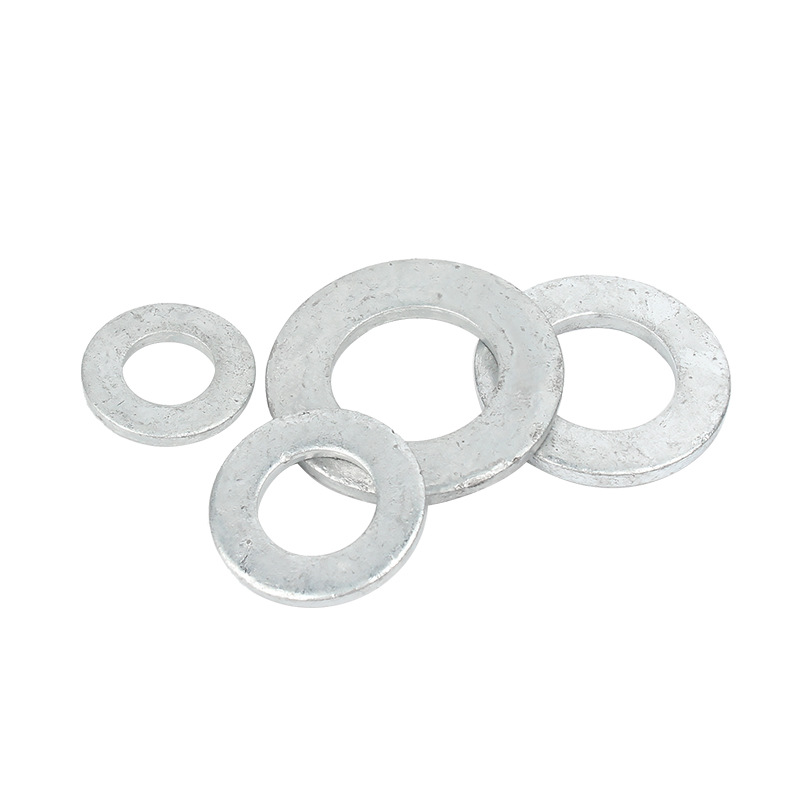
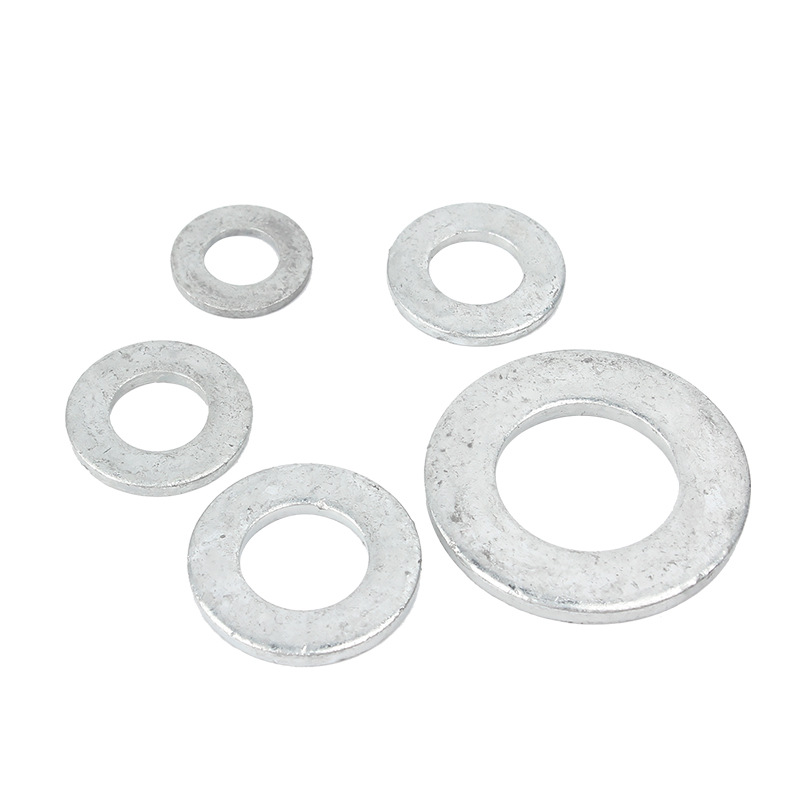
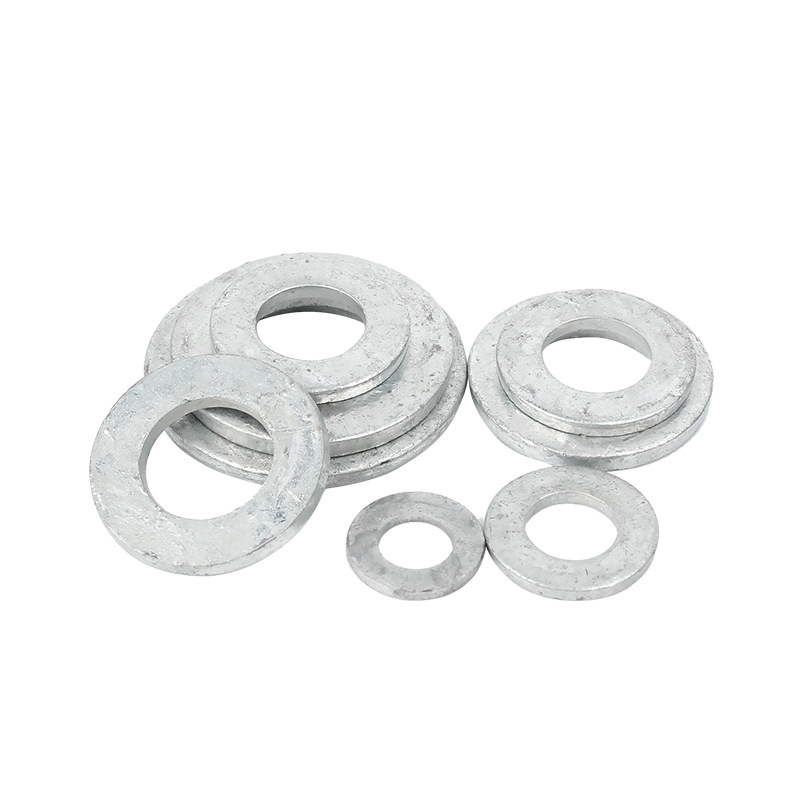
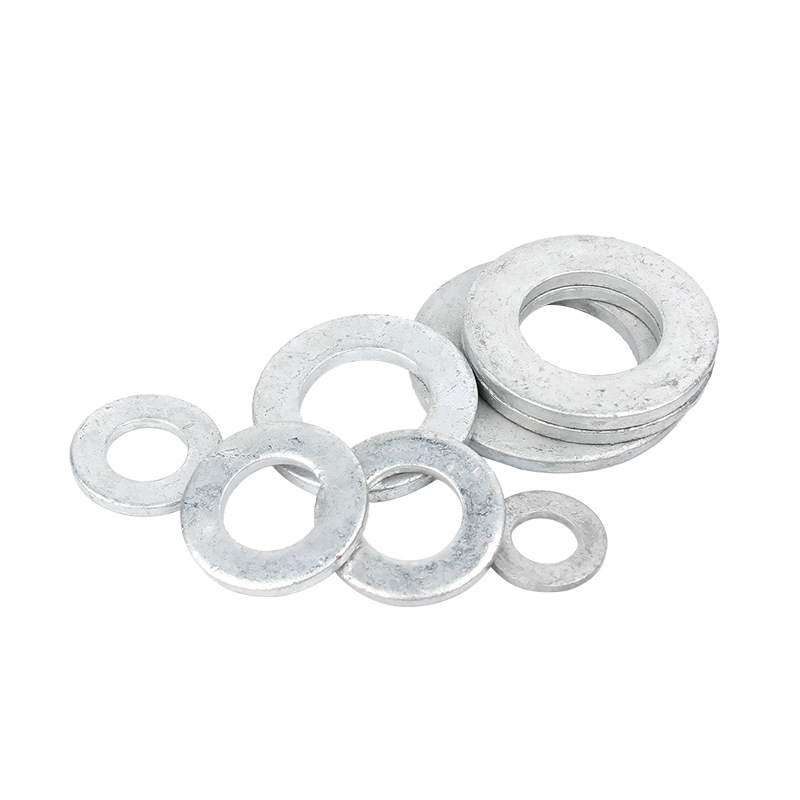
Hot-dip galvanized flat washers (also known as hot-dip zinc flat washers) are fastener accessories made by subjecting standard flat washers to pre-treatments such as degreasing and derusting, and then immersing them entirely into a molten zinc bath at approximately 450°C, forming a dense zinc-iron alloy layer and a pure zinc layer on the surface. The zinc layer thickness is typically no less than 40–50 μm, providing anti-corrosion capabilities far superior to electro-galvanizing. Hot-dip galvanized flat washers are mainly manufactured according to standards such as GB/T 97.1 (standard type), GB/T 97.2 (chamfered type), or GB/T 96 (large series). Nominal specifications usually cover M5–M64, and the material is mostly carbon steel. They are often used in conjunction with hot-dip galvanized bolts and nuts, placed between the bolt head or nut and the connected parts to distribute pressure, protect the workpiece surface, and enhance the overall anti-corrosion performance.
I. Product Features
-
Heavy-duty anti-corrosion metallurgical bonding: The washer is entirely immersed in the zinc bath, forming a firm metallurgical bond between the zinc layer and the steel substrate. There are no missed plating blind spots at edges, corners, or inner holes, ensuring extreme weather and corrosion resistance.
-
Clear coating thickness: The hot-dip galvanized layer thickness is typically over 40–50 μm, much thicker than ordinary electro-galvanizing, effectively resisting erosion in high-humidity and high-salt-fog environments.
-
Inner hole dimension allowance: To match hot-dip galvanized bolts/nuts (which have enlarged tolerances on external threads), the inner diameter of hot-dip galvanized flat washers is usually appropriately enlarged or controlled to special tolerances, ensuring smooth fitting without damaging the zinc layer on the threads.
-
Diverse specifications and types: Covers standard type, large series (larger outer diameter and bearing area), and chamfered type, etc. Commonly made of carbon steel, the surface presents a slightly rough, silver-gray zinc-iron alloy texture.
-
Strong compatibility: As standard fasteners, they have uniform dimensions, forming a perfect "anti-corrosion matching system" with hot-dip galvanized bolts and nuts of the same grade.
II. Product Advantages
-
Dual anti-corrosion mechanism: On one hand, the zinc layer acts as a physical barrier to isolate moisture and oxygen; on the other hand, when the zinc layer is locally damaged, zinc is more active than iron and will corrode first (sacrificial anode protection), thereby protecting the internal steel substrate from rusting.
-
Protects the surface of connected parts: The flat washer increases the contact area between the bolt head or nut and the connected part, reducing pressure per unit area and preventing crushing or scratching of wood, thin aluminum plates, painted surfaces, and other soft/vulnerable surfaces during tightening.
-
Distributes pressure and prevents loosening: It can effectively distribute the clamping force. Combined with the rough surface friction coefficient of hot-dip galvanized nuts, it provides better anti-loosening effects under outdoor vibration conditions.
-
Low life-cycle cost: Compared with stainless steel flat washers, hot-dip galvanized flat washers have significant cost advantages in large-scale outdoor projects (such as towers and photovoltaics), and are almost maintenance-free after installation, saving the cost of subsequent anti-rust painting.
III. Scope of Application
-
Power and communication towers: Bolted connection nodes of transmission line towers, substation structures, and communication base stations. This is the most core application scenario for hot-dip galvanized flat washers.
-
New energy engineering: Component clamping block fixation in photovoltaic mounting systems, and external fastening of wind turbine towers, which need to withstand wind and sun for a long time.
-
Transportation and bridge facilities: Connections of highway W-beam guardrails, bridge steel structures, and railway track fasteners, especially suitable for coastal or high-humidity areas.
-
Construction and general steel structures: Industrial plants, large-span steel structure space frames, outdoor curtain wall supports, large outdoor fences, and other projects requiring long-term anti-corrosion.