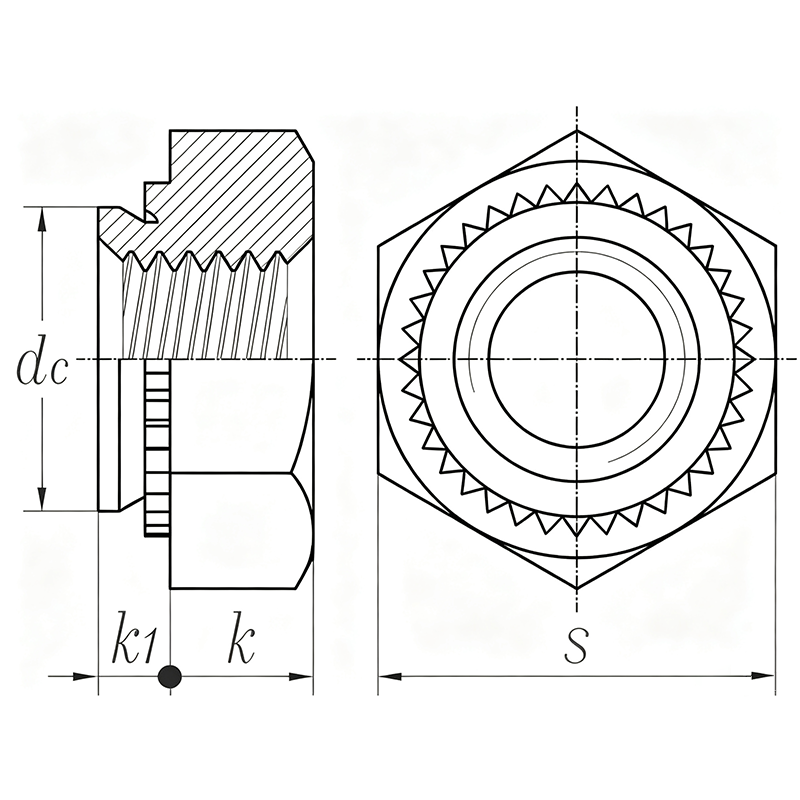
Product Specifications
| Model / Specification | 6# - M8 |
| Material | Carbon Steel |
| Thread | 6# | 6# | 8# | 8# | 10# | 10# | 10# | 10# | 1/4 | 1/4 | M3 | M3 | |
| P | - | - | - | - | - | - | - | - | - | - | 0.5 | 0.5 | |
| PP | 32 | 32 | 32 | 32 | 24 | 24 | 32 | 32 | 20 | 20 | - | - | |
| k1 | Max. | 0.038 | 0.054 | 0.038 | 0.054 | 0.038 | 0.054 | 0.038 | 0.054 | 0.054 | 0.087 | 0.8 | 1 |
| dc | Max. | 0.212 | 0.212 | 0.233 | 0.233 | 0.295 | 0.295 | 0.295 | 0.295 | 0.343 | 0.343 | 4.22 | 4.22 |
| s | Nom. | 0.216 | 0.216 | 0.275 | 0.275 | 0.315 | 0.315 | 0.315 | 0.315 | 0.394 | 0.394 | 5.5 | 5.5 |
| Max. | 0.226 | 0.226 | 0.285 | 0.285 | 0.325 | 0.325 | 0.325 | 0.325 | 0.404 | 0.404 | 5.75 | 5.75 | |
| Min. | 0.206 | 0.206 | 0.265 | 0.265 | 0.305 | 0.305 | 0.305 | 0.305 | 0.384 | 0.384 | 5.25 | 5.25 | |
| k | Nom. | 0.090 | 0.090 | 0.090 | 0.090 | 0.120 | 0.120 | 0.120 | 0.120 | 0.170 | 0.170 | 2 | 2 |
| Max. | 0.095 | 0.095 | 0.095 | 0.095 | 0.125 | 0.125 | 0.125 | 0.125 | 0.175 | 0.175 | 2.1 | 2.1 | |
| Min. | 0.085 | 0.085 | 0.085 | 0.085 | 0.115 | 0.115 | 0.115 | 0.115 | 0.165 | 0.165 | 1.9 | 1.9 | |
| Sheet Thk. | Min. | 0.040 | 0.056 | 0.040 | 0.056 | 0.040 | 0.056 | 0.040 | 0.056 | 0.056 | 0.091 | 0.8 | 1 |
| Hole Size | Min. = Nom. | 0.213 | 0.213 | 0.234 | 0.234 | 0.296 | 0.296 | 0.296 | 0.296 | 0.344 | 0.344 | 4.25 | 4.25 |
| Max. | 0.216 | 0.216 | 0.237 | 0.237 | 0.299 | 0.299 | 0.299 | 0.299 | 0.347 | 0.347 | 4.33 | 4.33 | |
| Code | Spec. (shank code) | 1 | 2 | 0 | 1 | 0 | 1 | 0 | 1 | 1 | 2 | 0 | 1 |
| CS | BOB | BOB | BOB | BOB | BOB | BOB | BOB | BOB | BOB | BOB | BOB | BOB | |
| SS | BOBS | BOBS | BOBS | BOBS | BOBS | BOBS | BOBS | BOBS | BOBS | BOBS | BOBS | BOBS | |
| HSS | BOB4 | BOB4 | BOB4 | BOB4 | BOB4 | BOB4 | BOB4 | BOB4 | BOB4 | BOB4 | BOB4 | BOB4 | |
| Thread | M3 | M4 | M4 | M4 | M5 | M5 | M5 | M6 | M6 | M8 | M8 | |
| P | 0.5 | 0.7 | 0.7 | 0.7 | 0.8 | 0.8 | 0.8 | 1 | 1 | 1.25 | 1.25 | |
| PP | - | - | - | - | - | - | - | - | - | - | - | |
| k1 | Max. | 1.35 | 0.8 | 1 | 1.35 | 0.8 | 1 | 1.35 | 1.15 | 1.4 | 1.15 | 1.4 |
| dc | Max. | 4.22 | 5.38 | 5.38 | 5.38 | 6.38 | 6.38 | 6.38 | 8.72 | 8.72 | 10.47 | 10.47 |
| s | Nom. | 5.5 | 7 | 7 | 7 | 8 | 8 | 8 | 10 | 10 | 12.7 | 12.7 |
| Max. | 5.75 | 7.25 | 7.25 | 7.25 | 8.25 | 8.25 | 8.25 | 10.25 | 10.25 | 12.95 | 12.95 | |
| Min. | 5.25 | 6.75 | 6.75 | 6.75 | 7.75 | 7.75 | 7.75 | 9.75 | 9.75 | 12.45 | 12.45 | |
| k | Nom. | 2 | 2.2 | 2.2 | 2.2 | 3 | 3 | 3 | 4.1 | 4.1 | 5 | 5 |
| Max. | 2.1 | 2.3 | 2.3 | 2.3 | 3.1 | 3.1 | 3.1 | 4.2 | 4.2 | 5.1 | 5.1 | |
| Min. | 1.9 | 2.1 | 2.1 | 2.1 | 2.9 | 2.9 | 2.9 | 4 | 4 | 4.9 | 4.9 | |
| Sheet Thk. | Min. | 1.4 | 0.8 | 1 | 1.4 | 0.8 | 1 | 1.4 | 1.2 | 1.5 | 1.2 | 1.5 |
| Hole Size | Min. = Nom. | 4.25 | 5.4 | 5.4 | 5.4 | 6.4 | 6.4 | 6.4 | 8.75 | 8.75 | 10.5 | 10.5 |
| Max. | 4.33 | 5.48 | 5.48 | 5.48 | 6.48 | 6.48 | 6.48 | 8.83 | 8.83 | 10.58 | 10.58 | |
| Code | Spec. (shank code) | 2 | 0 | 1 | 2 | 0 | 1 | 2 | 1 | 2 | 1 | 2 |
| CS | BOB | BOB | BOB | BOB | BOB | BOB | BOB | BOB | BOB | BOB | BOB | |
| SS | BOBS | BOBS | BOBS | BOBS | BOBS | BOBS | BOBS | BOBS | BOBS | BOBS | BOBS | |
| HSS | BOB4 | BOB4 | BOB4 | BOB4 | BOB4 | BOB4 | BOB4 | BOB4 | BOB4 | BOB4 | BOB4 | |
exagon Self-Clinching Nut——Product Introduction
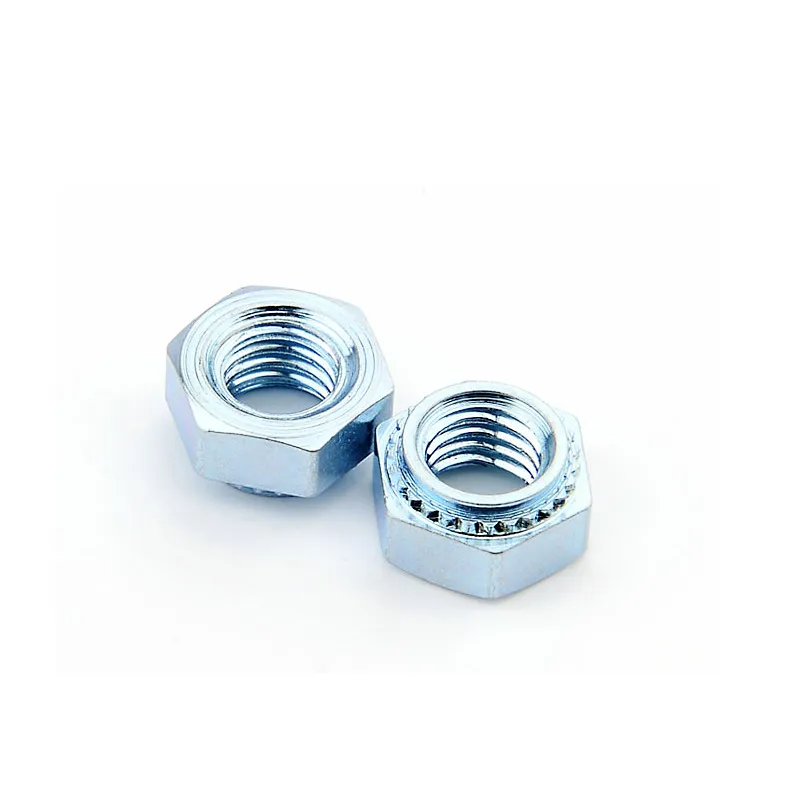
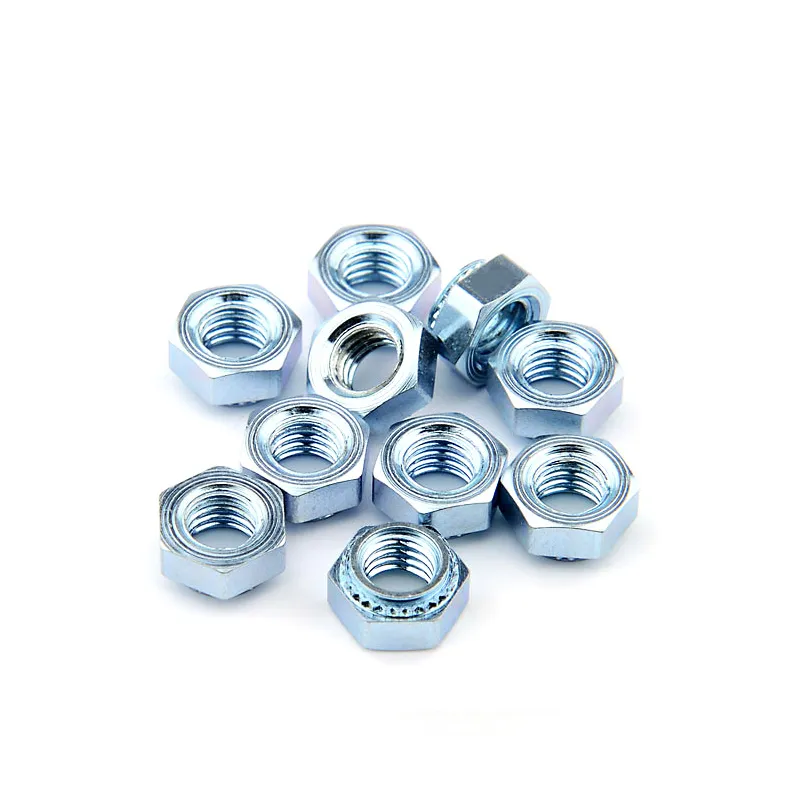
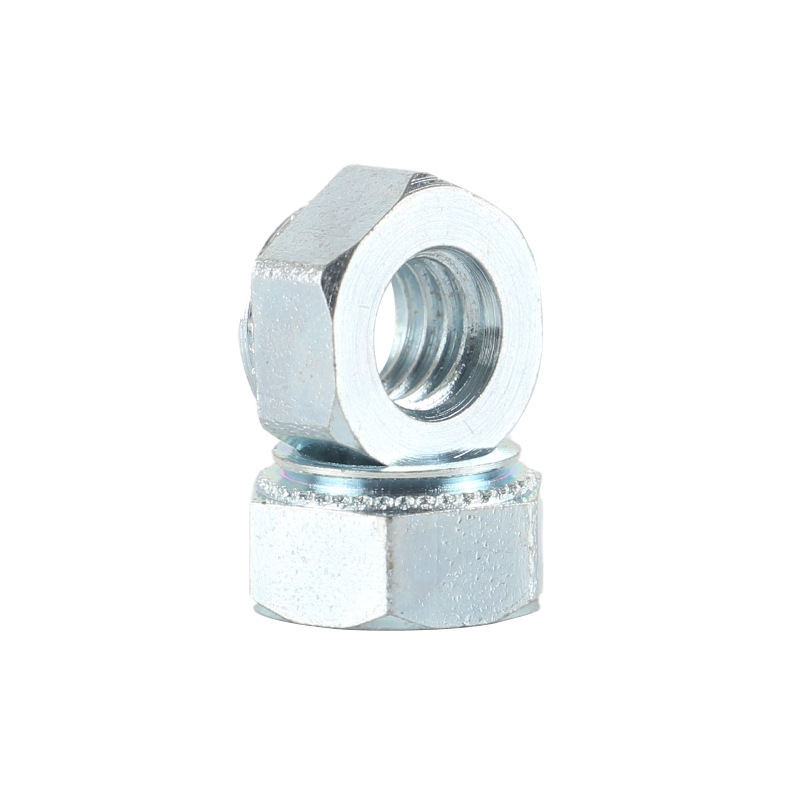
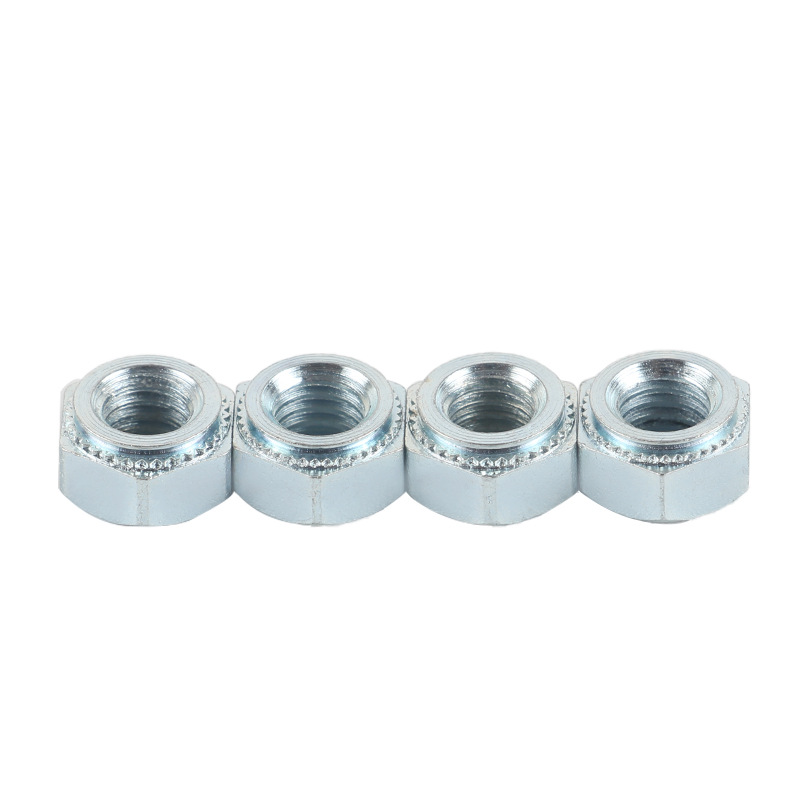
The hexagon self-clinching nut is a fastener specially designed for thin sheet metal assembly. One end is hexagonal and the other end is cylindrical, with a relief groove in the middle and an internal thread inside. During installation, a press is used to press the hexagonal head into a pre-punched hole in the metal sheet, causing plastic deformation around the hole. The deformed material is pressed into the relief groove, thereby firmly clinching the nut onto the thin sheet and forming a reliable internal thread. It mainly solves problems such as easy melting when welding nuts on thin metal sheets or thin tubes, and thread stripping when tapping internal threads. Without welding or tapping, it provides a reusable threaded connection on thin sheets.
1. Product Features
• Hexagonal anti-rotation structure: The hexagonal head fits the pre-punched hole in the sheet, effectively preventing the nut from rotating when tightening a bolt. Its torsion resistance is better than that of round self-clinching nuts.
• Press clinching installation: A special clinching tool applies pressure, causing the sheet to deform plastically and embed into the nut’s relief groove, forming a permanent lock.
• No welding, no tapping: There is no need to weld a nut onto the thin sheet or pre-tap an internal thread, simplifying the assembly process.
• Various materials and surface treatments: Common materials include carbon steel, stainless steel and brass. Surfaces can be treated with blue-white zinc, nickel plating, Dacromet, etc., to meet different anti-corrosion requirements.
• Series specifications: Thread specifications cover M2 to M12, suitable for sheets of different thicknesses (usually above 0.8 mm).
2. Product Advantages
• High installation efficiency: Fixing is completed in one clinching operation, suitable for automated production lines, with assembly efficiency far higher than welding or tapping.
• Single-side operation: Installation can be completed from one side of the sheet, especially suitable for hollow frames, housings or enclosed spaces where the back side is inaccessible.
• Reliable connection: After clinching, the nut and sheet form a mechanical interlock, with high push-out resistance and torsion resistance, providing stable connection strength.
• Protects the sheet: The installation process does not produce high-temperature deformation or melting damage like welding, and also avoids thread stripping that may be caused by tapping.
• Repeated assembly and disassembly: The formed internal thread allows bolts to be repeatedly screwed in and out, facilitating maintenance and parts replacement.
3. Scope of Application
• Electronics and precision equipment: Threaded support installation for chassis, cabinets, control boxes, power cabinets and other sheet metal parts.
• Automotive and rail transit: Thin sheet connection points such as body sheet metal, interior parts and seat frames.
• Communications and instruments: Applications requiring reliable threaded fixation, such as communication equipment, test instruments and medical equipment.
• General sheet metal manufacturing: Fields requiring threaded connections on thin sheets, such as metal furniture, elevator components, refrigeration equipment and switch cabinets.