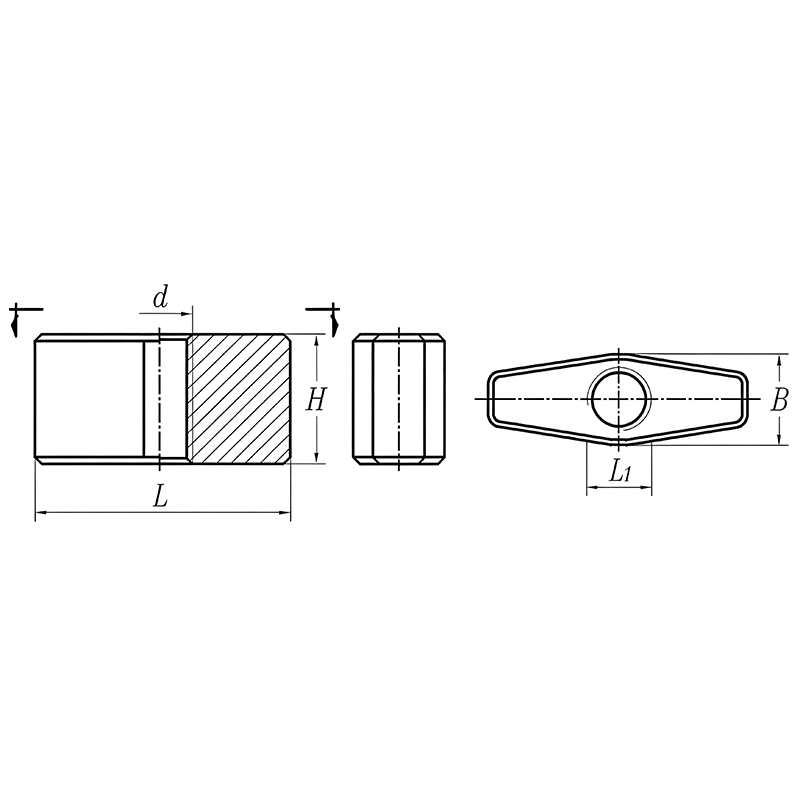
Product Specifications
| Model / Specification | M4–M16 |
| Material | Carbon steel |
| Thd. d |
M4 | M5 | M6 | M8 | M10 | M12 | M16 |
| L | 20 | 25 | 30 | 35 | 40 | 50 | 60 |
| B | 7 | 8 | 10 | 12 | 14 | 16 | 22 |
| H | 8 | 10 | 12 | 16 | 20 | 22 | 25 |
| L1 | 4 | 5 | 6 | 8 | 10 | 12 | 16 |
Diamond Nut — Product Introduction
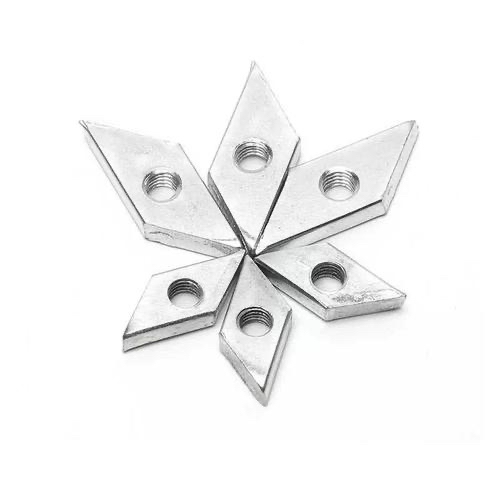
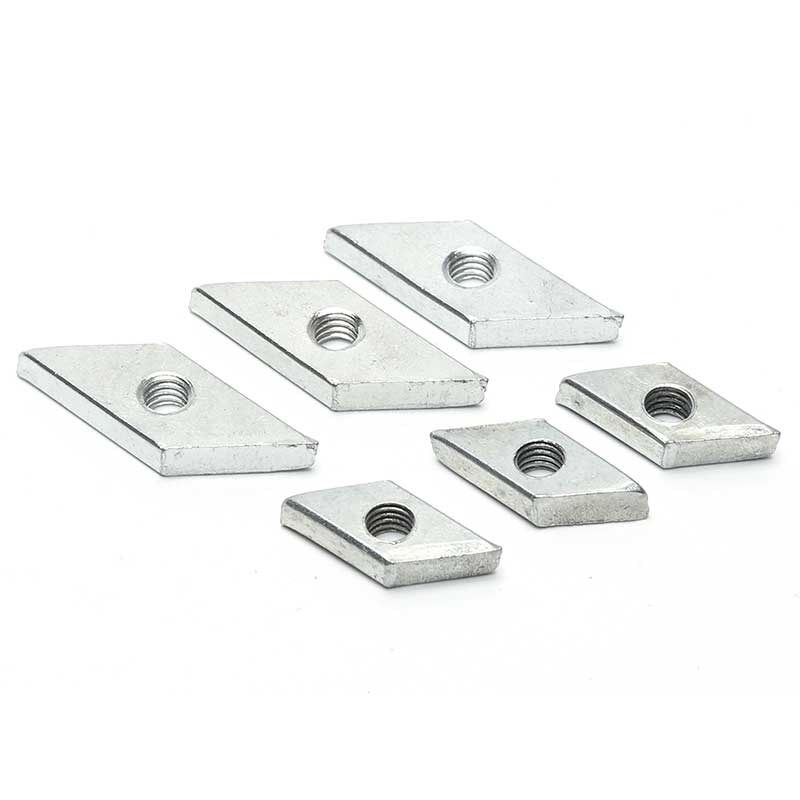
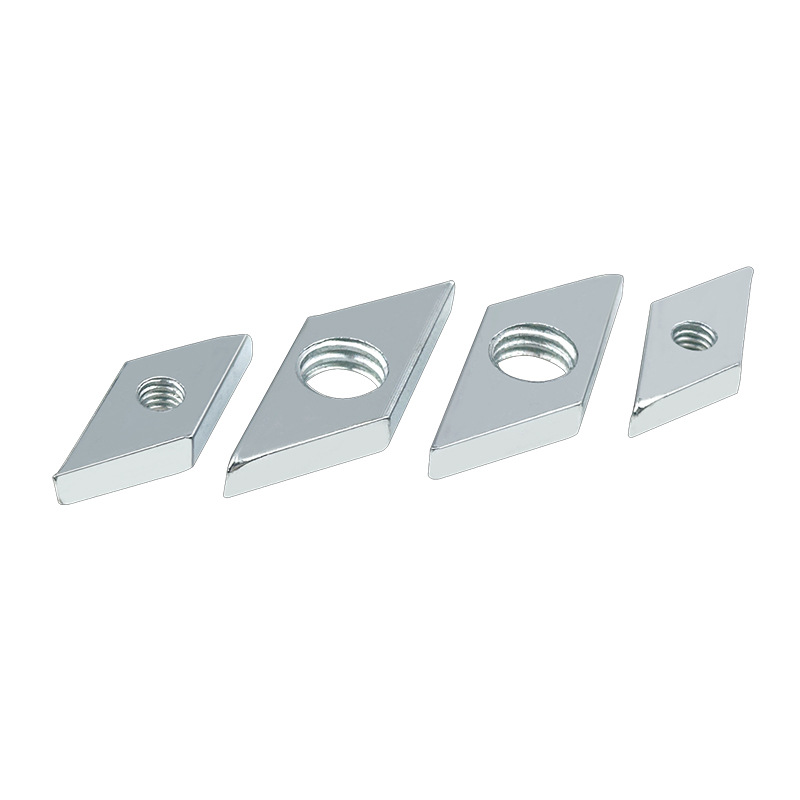
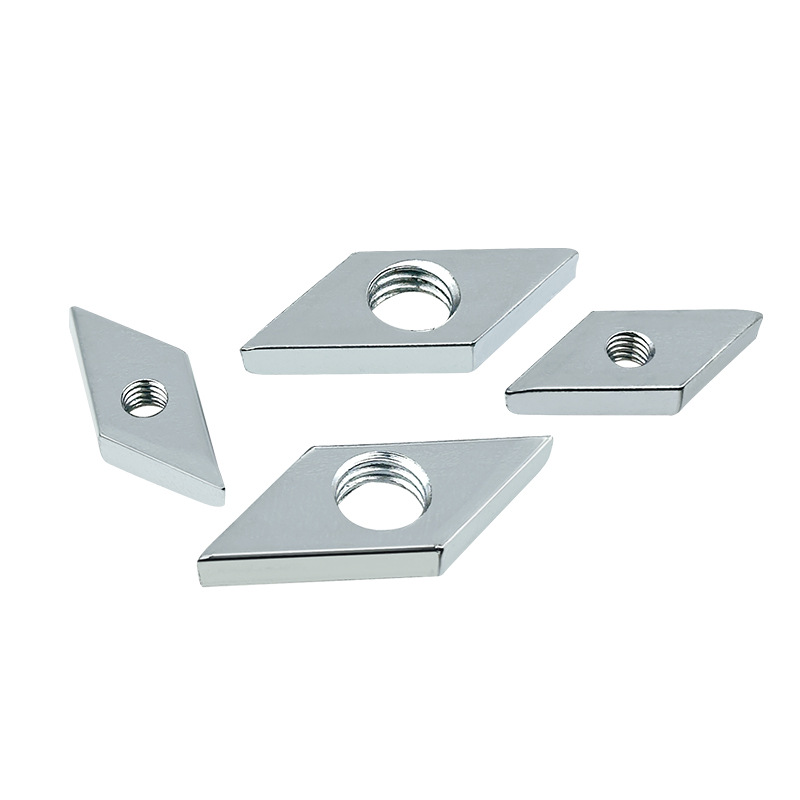
The diamond nut is a commonly used fastening connector in machine tool fixtures. It has a diamond-shaped profile and is usually used in combination with T-slots, bolts, or clamping plates for the positioning, clamping, and adjustment of workpieces. The product is made of high-quality carbon structural steel and undergoes quenching and tempering heat treatment, offering good strength, wear resistance, and torsion resistance. It is suitable for fixture applications requiring frequent assembly and disassembly as well as stable locking.
I. Product Features
-
Diamond profile design
The nut has a diamond-shaped profile, and its four beveled corners form multi-point contact with the walls of the T-slot. When tightened, it automatically wedges in and produces a self-locking effect, providing anti-rotation and anti-loosening functions. -
Top direct-insert installation
It can be inserted directly from above the T-slot and rotated to the locking position to complete positioning, without the need to slide in longitudinally from the slot end, making installation flexible and convenient. -
Complete range of sizes
A variety of common sizes are offered, facilitating fixture design and part replacement and meeting different clamping and connection needs. -
Heat treatment strengthening
After quenching and tempering, the threads and edges have good wear resistance and are not easily deformed under repeated assembly and disassembly and clamping forces. -
Good compatibility
It can be used together with fixture components such as T-slots, bolts, and clamping plates to form a stable positioning and clamping structure.
II. Product Advantages
-
Good anti-loosening performance
The diamond profile forms a self-locking effect with the mating surface, effectively reducing the risk of nut loosening under vibration or dynamic load conditions. -
Anti-rotation and torsion resistance
The four diamond corners make multi-surface contact with the T-slot walls, so the nut does not easily rotate with the bolt when tightened, and it also has a certain radial torsion resistance. -
Convenient installation and removal
The top direct-insert installation method allows operators to quickly replace or adjust the nut position, improving fixture clamping efficiency. -
High interchangeability
As a commonly used standard part, its dimensions and thread fit offer good universality, making it easy to replace products from different batches or manufacturers. -
Durable and reliable
After heat treatment, it has good hardness and wear resistance, can withstand long-term repeated assembly, disassembly, and clamping, and extends the service life of the fixture.
III. Application Scope
-
Machine tool fixtures
Mainly used for fastening connections in machine tool fixtures, working with T-slots and bolts to complete the positioning and clamping of workpieces on the worktable. -
Drilling machine fixtures
Commonly used to lock structures such as drill jig plates and clamping plates, enabling quick clamping and release of workpieces. -
CNC machining centers and CNC machine tools
Used for workpiece positioning and manual clamping in tooling and fixture systems, meeting requirements for high flexibility and repeat positioning accuracy. -
Automation and precision transmission equipment
Can be used in synchronous belt drives, stop block fixing, connector locking, and other applications; suitable for light-load transmission scenarios requiring high-frequency start-stop and precise positioning. -
Other industrial assembly scenarios
It is also widely used in fields such as automotive mold tooling, robotic welding fixtures, quick-change mold fixtures, and aluminum profile frame assembly.