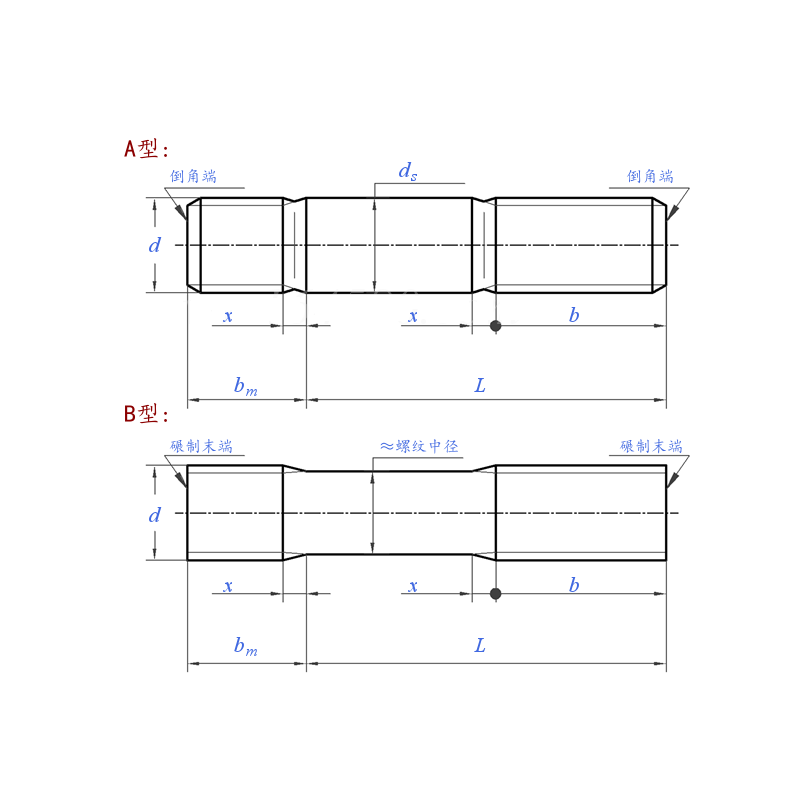
Product Specifications
| Model / Specification | M5–M48 |
| Material | Stainless steel |
| Thd. size d |
M5 | M6 | M8 | M10 | M12 | (M14) | M16 | (M18) | M20 | |
| P ① | Pitch | 0.8 | 1 | 1.25 | 1.5 | 1.75 | 2 | 2 | 2.5 | 2.5 |
| bm | Nom. | 5 | 6 | 8 | 10 | 12 | 14 | 16 | 18 | 20 |
| Min. | 4.4 | 5.4 | 7.25 | 9.25 | 11.1 | 13.1 | 15.1 | 17.1 | 18.95 | |
| Max. | 5.6 | 6.6 | 8.75 | 10.75 | 12.9 | 14.9 | 16.9 | 18.9 | 21.05 | |
| ds | Max. | 5 | 6 | 8 | 10 | 12 | 14 | 16 | 18 | 20 |
| Min. | 4.7 | 5.7 | 7.64 | 9.64 | 11.57 | 13.57 | 15.57 | 17.57 | 19.48 | |
| Approx. wt./1000 pcs ≈ kg | - | - | - | - | - | - | - | - | - | |
| Thread length b | - | - | - | - | - | - | - | - | - | |
| Thd. size d |
(M22) | (M24) | (M27) | (M30) | (M33) | M36 | (M39) | M42 | M48 | |
| P ① | Pitch | 2.5 | 3 | 3 | 3.5 | 3.5 | 4 | 4 | 4.5 | 5 |
| bm | Nom. | 22 | 24 | 27 | 30 | 33 | 36 | 39 | 42 | 48 |
| Min. | 20.95 | 22.95 | 25.95 | 28.95 | 31.75 | 34.75 | 37.75 | 40.75 | 46.75 | |
| Max. | 23.05 | 25.05 | 28.05 | 31.05 | 34.25 | 37.25 | 40.25 | 43.25 | 49.25 | |
| ds | Max. | 22 | 24 | 27 | 30 | 33 | 36 | 39 | 42 | 48 |
| Min. | 21.48 | 23.48 | 26.48 | 29.48 | 32.38 | 35.38 | 38.38 | 41.38 | 47.38 | |
| Approx. wt./1000 pcs ≈ kg | - | - | - | - | - | - | - | - | - | |
| Thread length b | - | - | - | - | - | - | - | - | - | |
Double-End Stud bm=1d — Product Introduction
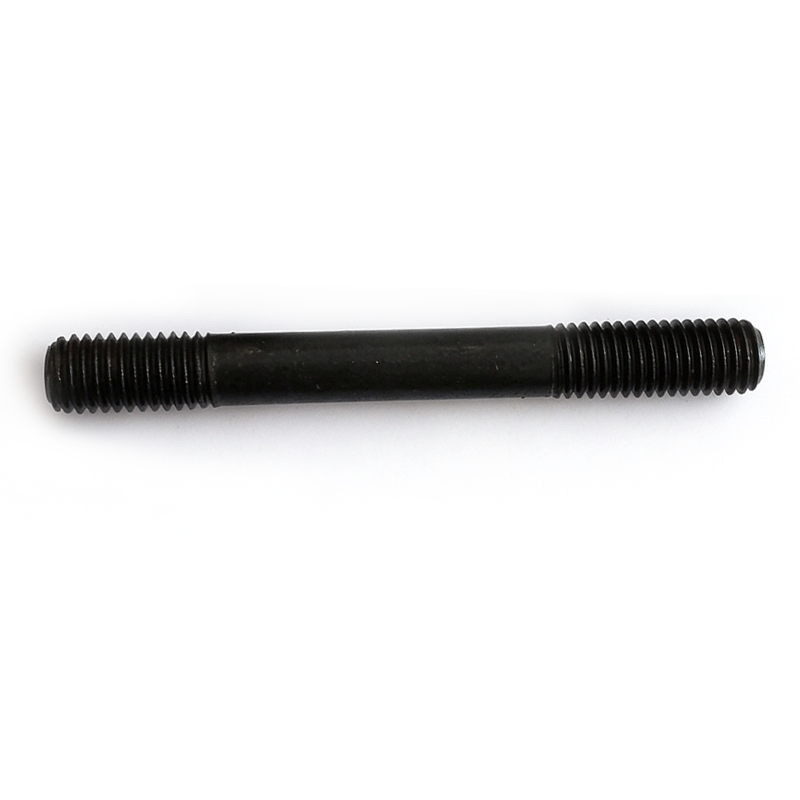
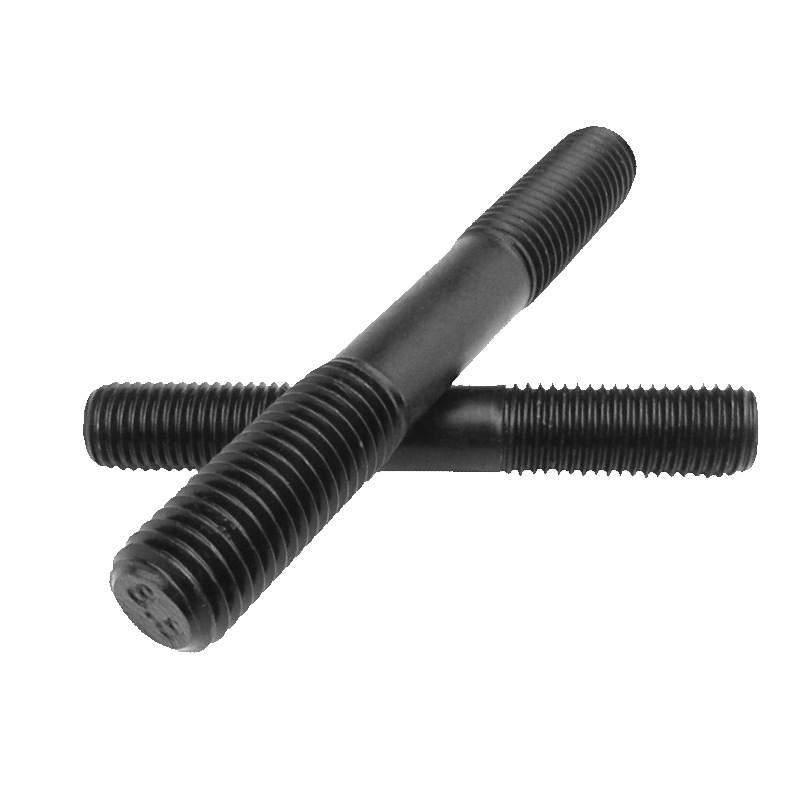
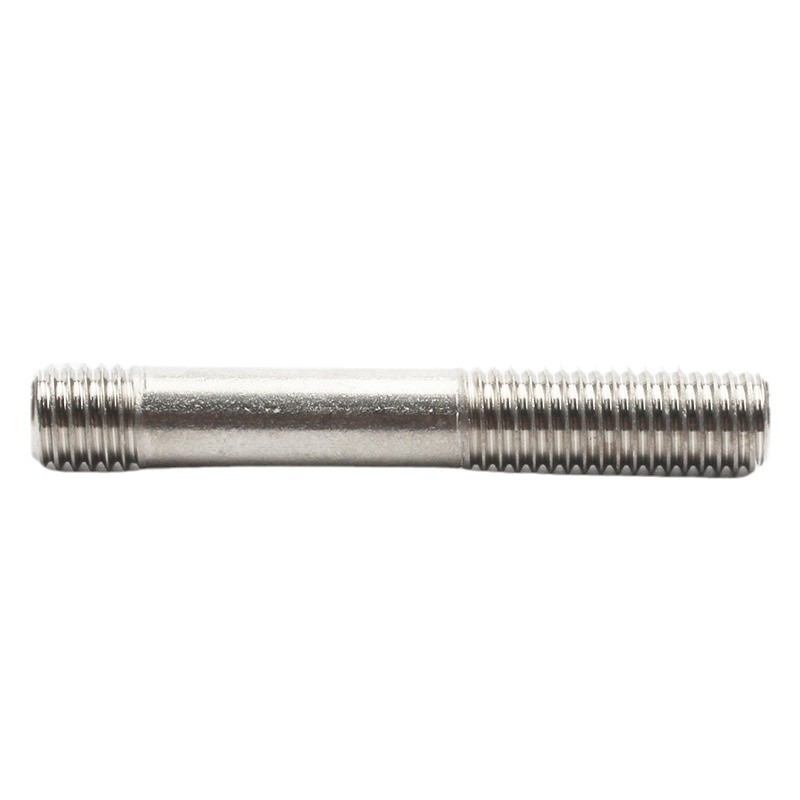
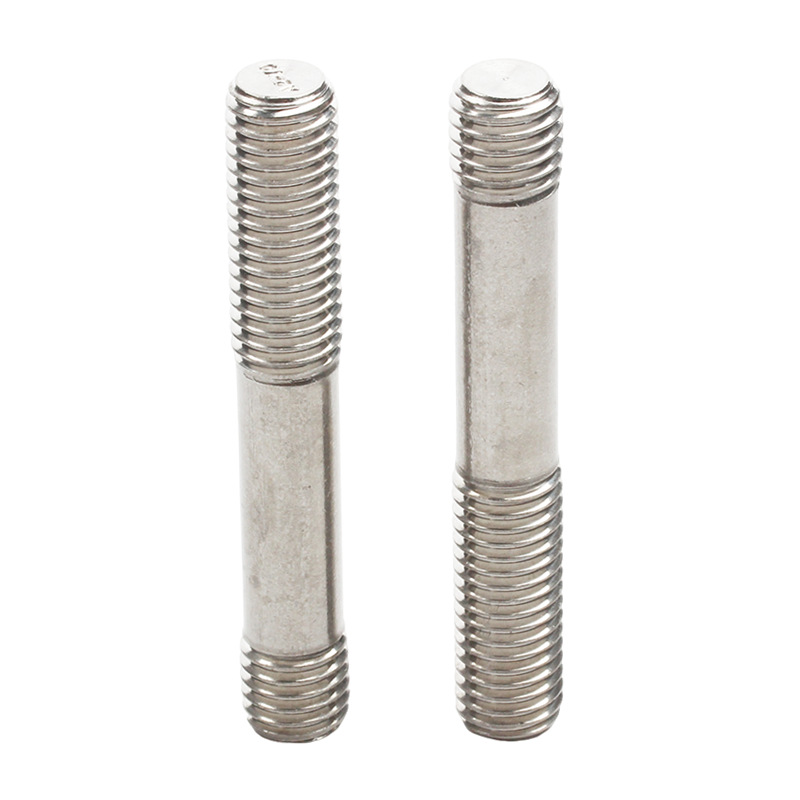
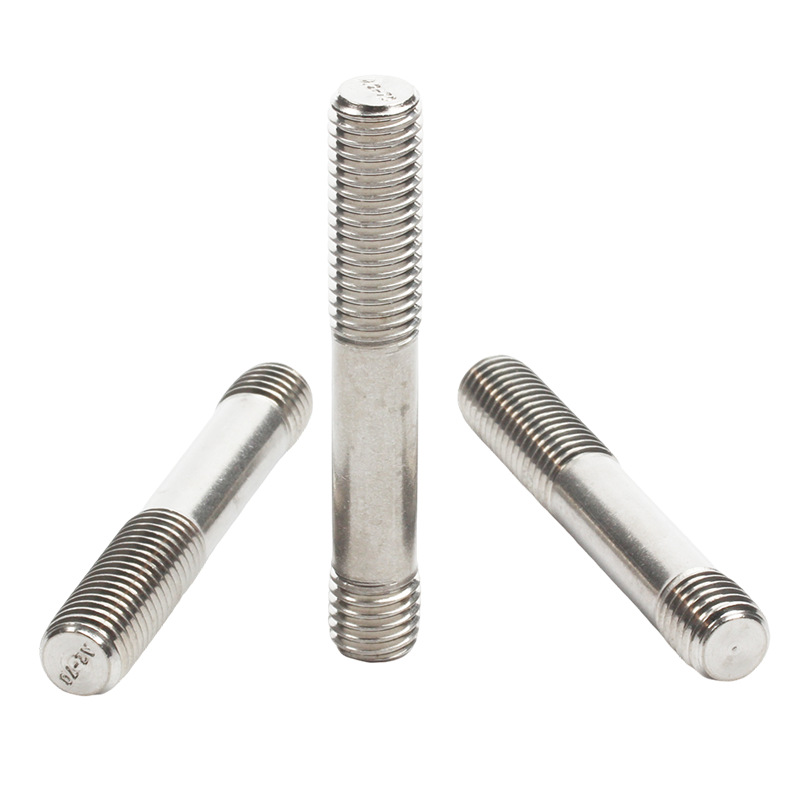
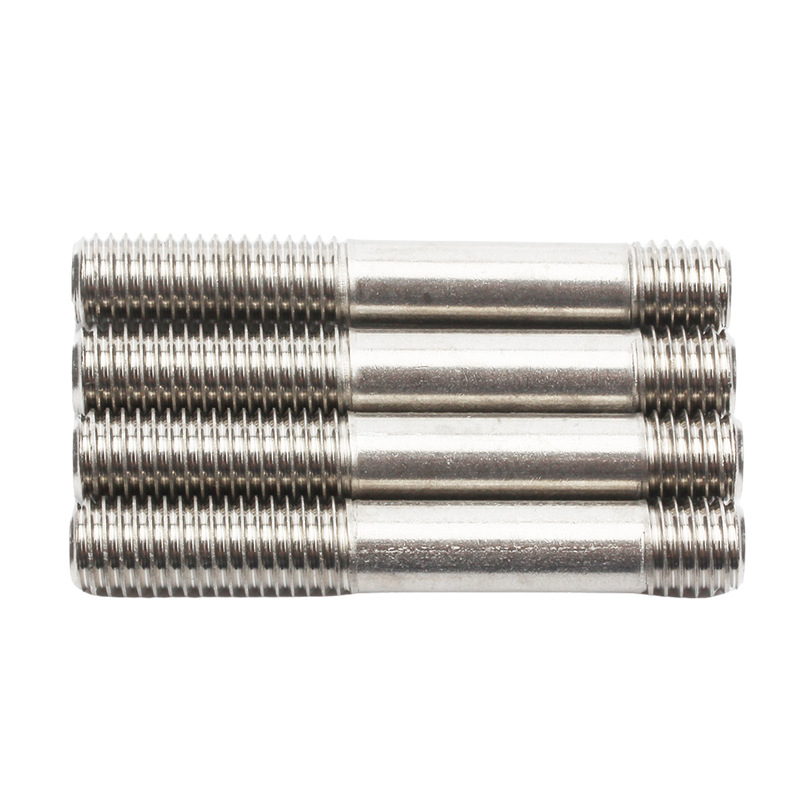
Double-end stud bm=1d (GB/T 897-1988) is a fastener with unequal thread lengths at both ends. The thread length of the engagement end, bm, is equal to 1 times the thread diameter (bm=1d). It is specifically designed to screw one end of the stud into the internal threaded hole of a steel connected part, while the other end passes through a through hole and is tightened with a nut. The standard is currently valid, specifies dimensions and technical conditions for thread diameters from M5 to M48, and was reviewed and confirmed to remain valid in 2022. Its most typical design application is the connection between two steel connected parts, and it is the type with the shortest engagement end in the double-end stud series.
I. Product Features
-
bm=1d engagement end: The thread length of the engagement end is 1 times the thread diameter, making it the shortest engagement end in the double-end stud series. Compared with bm=1.25d/1.5d (for cast iron connections) and bm=2d (for aluminum alloy connections), bm=1d is specially designed for steel connected parts because steel has higher strength, and a shorter engagement depth can meet the connection strength requirements.
-
Unequal thread lengths at both ends: One end is the engagement end (bm=1d), which is screwed into the internal threaded hole of the connected part; the other end is the fastening end, which passes through a through hole and is tightened with a nut.
-
Two structures: Type A and Type B: Type A is a straight shank type (ds approximately equal to the pitch diameter of the thread), and Type B is a reduced shank type (ds approximately equal to the minor diameter of the thread). They can be selected according to assembly space and strength requirements.
-
Flexible thread combinations: Both ends can be coarse ordinary threads, or can be designed as combinations such as a transition fit thread at the engagement end and a fine ordinary thread at the fastening end, meeting different precision requirements.
-
Complete specifications and materials: Thread diameters cover M5–M48. Materials include carbon steel (Q235, 45#, 40Cr, 35CrMoA, etc.) and stainless steel (304, 316), etc. Strength grades cover 4.8–12.9.
-
Various surface treatments: Options include no treatment, oxidation (blackening), zinc plating with passivation, phosphating, non-electrolytic zinc flake coating, etc., meeting different anti-corrosion requirements.
II. Product Advantages
-
Economical and efficient for connecting steel parts: The bm=1d engagement end is the shortest, saving material and reducing cost while ensuring the connection strength of steel parts. It is the best choice for steel-to-steel connections.
-
Suitable for installation of accessories requiring frequent disassembly: For accessories that need to be frequently disassembled, using double-end studs avoids turning the base thread every time, significantly extending the service life of the main body's threaded holes.
-
Flexible installation, operable from one side: One end is screwed into the base for fixation, and the other end is tightened with a nut, making it suitable for assembly occasions with limited space or access from only one side.
-
Strong load-bearing capacity: Using materials such as 45#, 40Cr, 35CrMoA, the tensile strength of carbon steel can reach over 700 MPa; stainless steel versions have good corrosion resistance, and alloy steel versions can be used in high-temperature and high-pressure conditions.
-
Good standardized interchangeability: As a national standard product, dimensions are unified and marking is standardized (e.g., “Stud GB/T 897 M10×50”), and products from different suppliers can be used interchangeably.
III. Scope of Application
-
Steel part connections: Connections between two steel connected parts; this is the most core application scenario for bm=1d double-end studs.
-
Mechanical equipment and accessory installation: Connections between accessories requiring frequent disassembly, such as sight glasses, mechanical seal seats, reducer frames, pumps and valves, and steel main bodies.
-
Power and chemical industries: Flange connections and accessory fixation in power equipment, chemical plants, and oil refining equipment.
-
Bridges and steel structures: Parts requiring high-strength connections, such as bridges, towers, long-span steel structures, and boiler steel structures.
-
General industry: Steel part connections in fields such as mining machinery, automobiles, motorcycles, and large buildings.