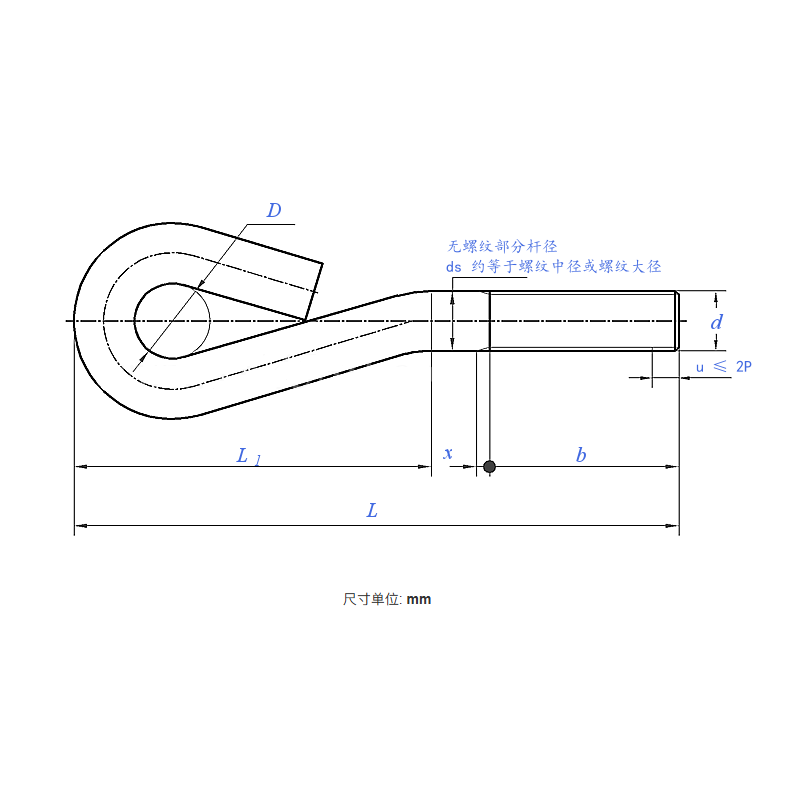
Product Specifications
| Model / Specification | M8 - 72 |
| Material | Carbon Steel |
| Thread Size d |
M8 | M10 | M12 | M16 | M20 | M24 | M30 | M36 | M42 | M48 | M56 | M64 | M72×6 | |
| a | Nom. | 24 | 30 | 36 | 48 | 60 | 75 | 95 | 115 | 135 | 155 | 180 | 200 | 240 |
| Max. | 27 | 33 | 39 | 51 | 63 | 78 | 98 | 118 | 138 | 158 | 183 | 203 | 243 | |
| Min. | 21 | 27 | 33 | 45 | 57 | 72 | 92 | 112 | 132 | 152 | 177 | 197 | 237 | |
| c | Nom. | 45 | 55 | 65 | 85 | 105 | 125 | 155 | 190 | 220 | 250 | 290 | 335 | 370 |
| Max. | 50 | 60 | 70 | 90 | 110 | 130 | 160 | 195 | 225 | 255 | 295 | 340 | 375 | |
| Min. | 40 | 50 | 60 | 80 | 100 | 120 | 150 | 185 | 215 | 245 | 285 | 330 | 365 | |
| g | ≈ | 30 | 38 | 45 | 60 | 75 | 90 | 115 | 135 | 155 | 180 | 210 | 235 | 260 |
| b | Min. = Nom. | 20 | 25 | 30 | 40 | 50 | 60 | 75 | 90 | 105 | 120 | 140 | 160 | 180 |
| Max. | 22.5 | 28 | 33.5 | 44 | 55 | 66 | 82 | 98 | 114 | 130 | 151 | 172 | 192 | |
| Steel Wt. ≈ kg/1000 pcs | - | - | - | - | - | - | - | - | - | - | - | - | - | |
Type A Hooked Foundation Bolt – Product Introduction
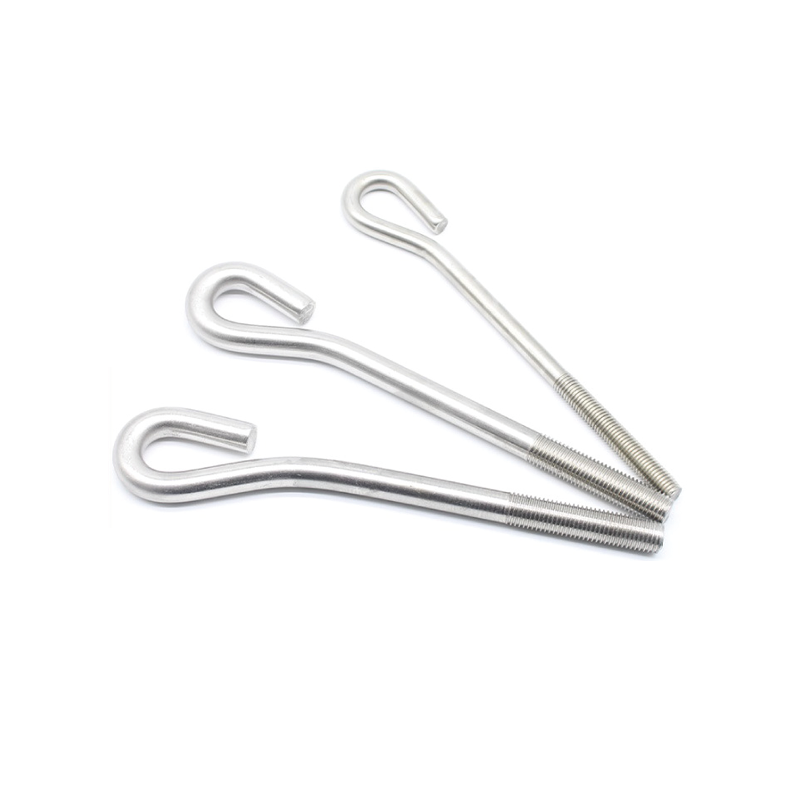
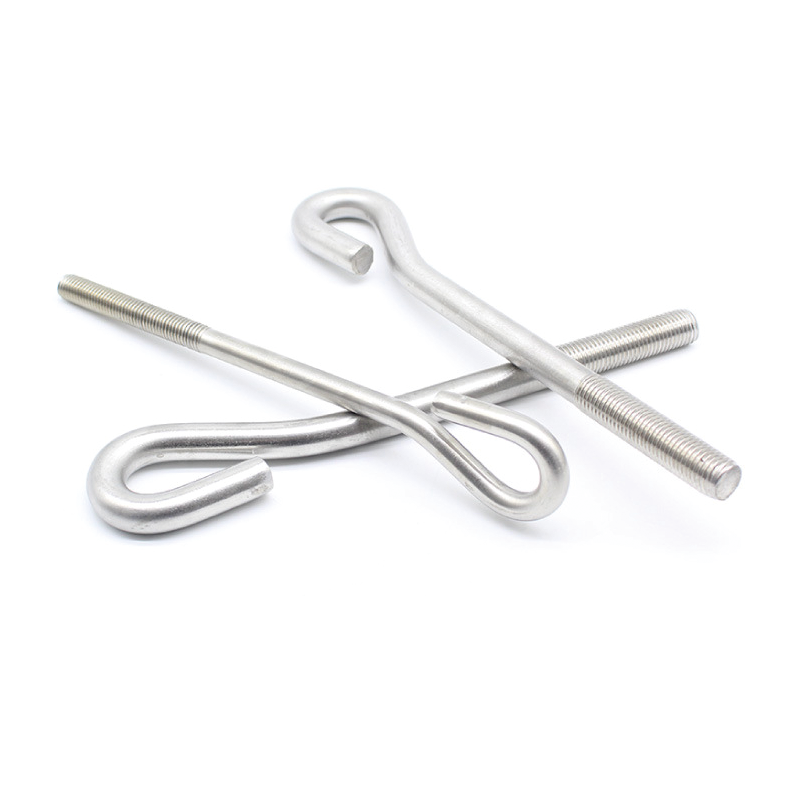
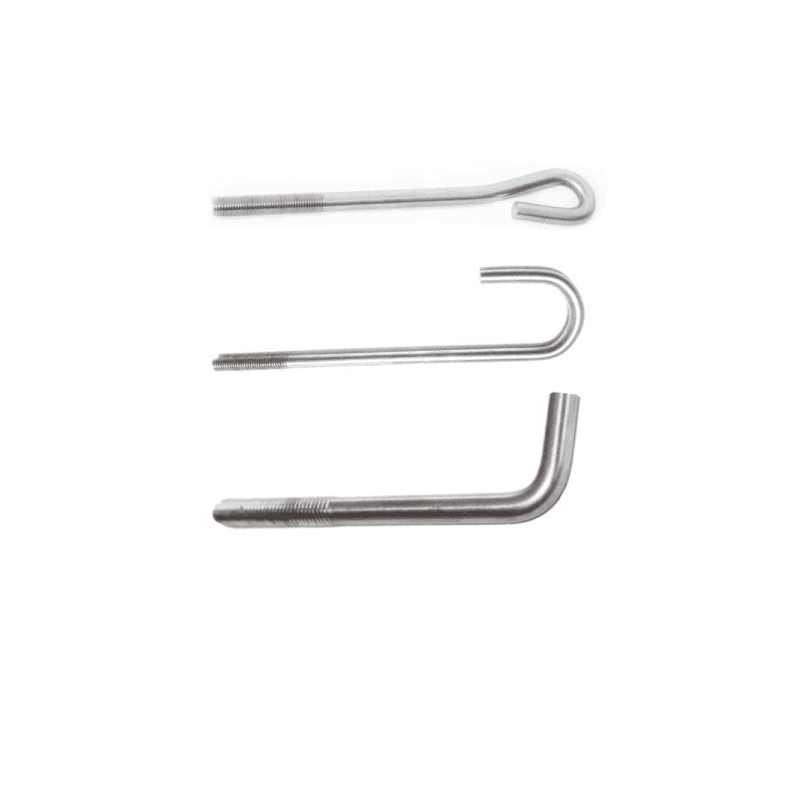
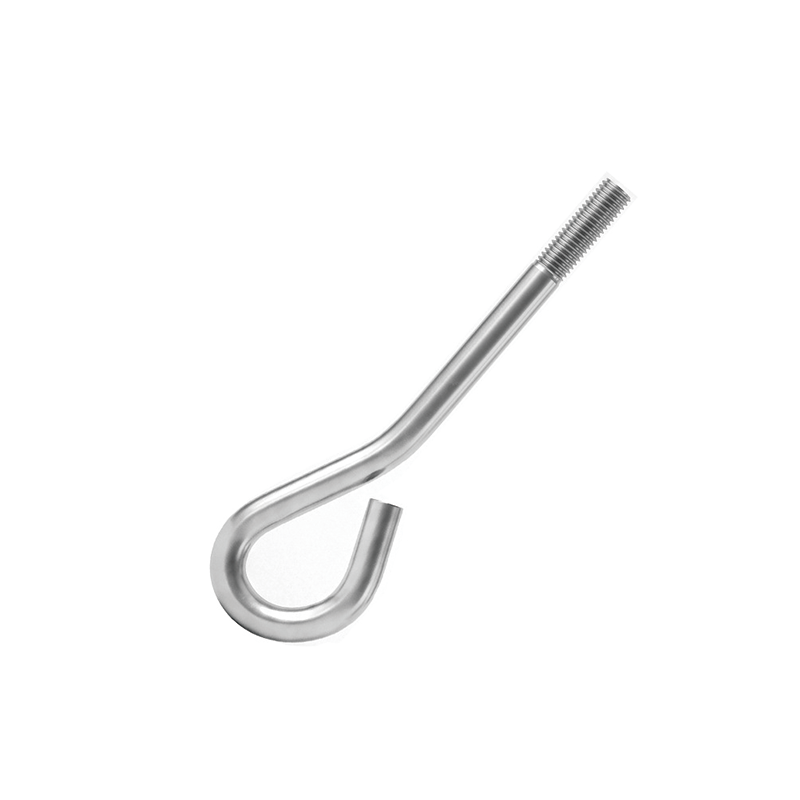
The Type A hooked foundation bolt (also known as the J-type embedded bolt) is a standard fastener specifically designed for anchoring into concrete foundations. Its rod end is formed into a J-type hook through a hot-bending process and fully complies with the national standard GB/T 799-2020. The product is manufactured from high-quality stainless steel 304/316L or high-strength alloy steel 40Cr/42CrMo. By precisely controlling the bend radius and the transition arc between the hook and the straight shank, it ensures the formation of an irreversible mechanical locking force after concrete pouring. This product is widely used for the permanent fixation of heavy machinery bases, steel structure column feet, power towers, and large outdoor facilities, and serves as a critical embedded connection component for ensuring structural safety and stability.
I. Product Features
J-type hook anchoring structure: The bottom is bent into a standard Type A (J-type) hook, with a smooth transition between the hook radius and the straight shank, meeting national standard dimensional requirements. This structure generates strong gripping force and pull-out resistance in concrete, effectively preventing the bolt from being pulled out of the foundation under tension.
Fully stainless, corrosion-resistant material: Made of 304 (06Cr19Ni10) or 316L stainless steel, offering excellent acid-alkali resistance, salt-spray resistance, and weather resistance. No additional coating is required for use in humid, coastal, and chemically corrosive environments, achieving lifetime maintenance-free performance.
High thread precision: The threaded section of the shank is formed by a rolling process, with full thread profiles and a smooth surface, reaching precision grade 6g or 6h. It mates smoothly with nuts and delivers stable, reliable locking torque.
Crack-free hook ends: During hot-bending, the heating temperature and bending speed are strictly controlled, leaving no visible cracks on the outer side of the hook. The internal microstructure is dense, ensuring the tensile strength at the hook is no less than 90% of the base material.
Full-thread / half-thread options: Depending on embedment depth and exposed length requirements, two forms can be customized — full-thread or half-thread (threaded top + plain bottom shank) — flexibly adapting to equipment base plates of different thicknesses.
Wide size range: Common diameters cover M12 to M100, with lengths from 300mm up to 3000mm, meeting the varying needs from small equipment to ultra-large heavy-industrial foundations.
II. Product Advantages
Pull-out capacity far exceeds straight-shank bolts: The anchoring force of the J-type hook in concrete is more than 50% higher than that of a straight plain round bolt of the same diameter. The hook orientation can be flexibly adjusted according to the force direction, ensuring absolute safety of the foundation connection.
Lifetime maintenance-free, significant total-cost advantage: Stainless steel fundamentally eliminates the rusting problem of ordinary carbon-steel bolts after their zinc coating flakes off. Throughout the equipment’s full life cycle, no oiling, rust prevention, or replacement is needed — especially suitable for concealed works that are difficult to inspect, greatly reducing long-term operation and maintenance costs.
Easy construction, precise positioning: During embedding, simply drill holes in the formwork and pass the bolt through — no additional welded fixtures are needed. The hook end can be paired with additional transverse rebar threaded through the hook to further enhance anchoring stability, significantly shortening on-site construction time.
High strength combined with high toughness: After solution heat treatment or quenching and tempering, the tensile strength can reach above 700 MPa (stainless steel) or above 1000 MPa (alloy steel), while maintaining excellent elongation and impact toughness, effectively absorbing dynamic vibration loads generated during equipment operation.
Flexible non-standard customization with reliable lead time: In addition to standard GB/T 799 specifications, we support customization per customer drawings — special hook angles, non-standard total lengths, shaped hook heads, and various mixed-material combinations — providing one-stop supply service from raw material procurement to finished-product shipment.
Traceable quality control: Each batch is accompanied by a material inspection report, mechanical property test report, and dimensional inspection records, meeting the strict factory-audit and traceability requirements of engineering projects.
III. Application Areas
The Type A hooked foundation bolt is dedicated to scenarios requiring high-strength, permanent concrete foundation anchoring, specifically including:
Heavy machinery equipment bases: Concrete foundation fixation for large air compressors, centrifugal fans, water pump units, diesel generator sets, crushers, and mining machinery.
Steel structure building column feet: Connection anchoring between steel column base plates of single- and multi-story steel-structure plants and concrete pile caps, bearing column-base bending moments and uplift forces.
Power and communication towers: Foundation anchor connections for high-voltage transmission line angle towers, terminal towers, communication signal towers, microwave towers, and broadcast-television transmission towers.
Transportation and municipal facilities: Foundation embedding for highway streetlight poles, high-mast lights, traffic signal poles, large outdoor billboards, bus shelters, and overpass columns.
Petrochemical and marine engineering: Corrosion-resistant anchoring connections for refinery reaction towers, tank foundations, offshore platform deck equipment, and coastal trestle bridges.
Large amusement facilities and landscape architecture: Concrete foundation fixation for Ferris wheels, roller-coaster supports, large sculptures, and tall landscape structures.