Wohe Research · Article revision V1
Hydrogen embrittlement in high-strength fasteners: why materials, processing and environment need joint assessment
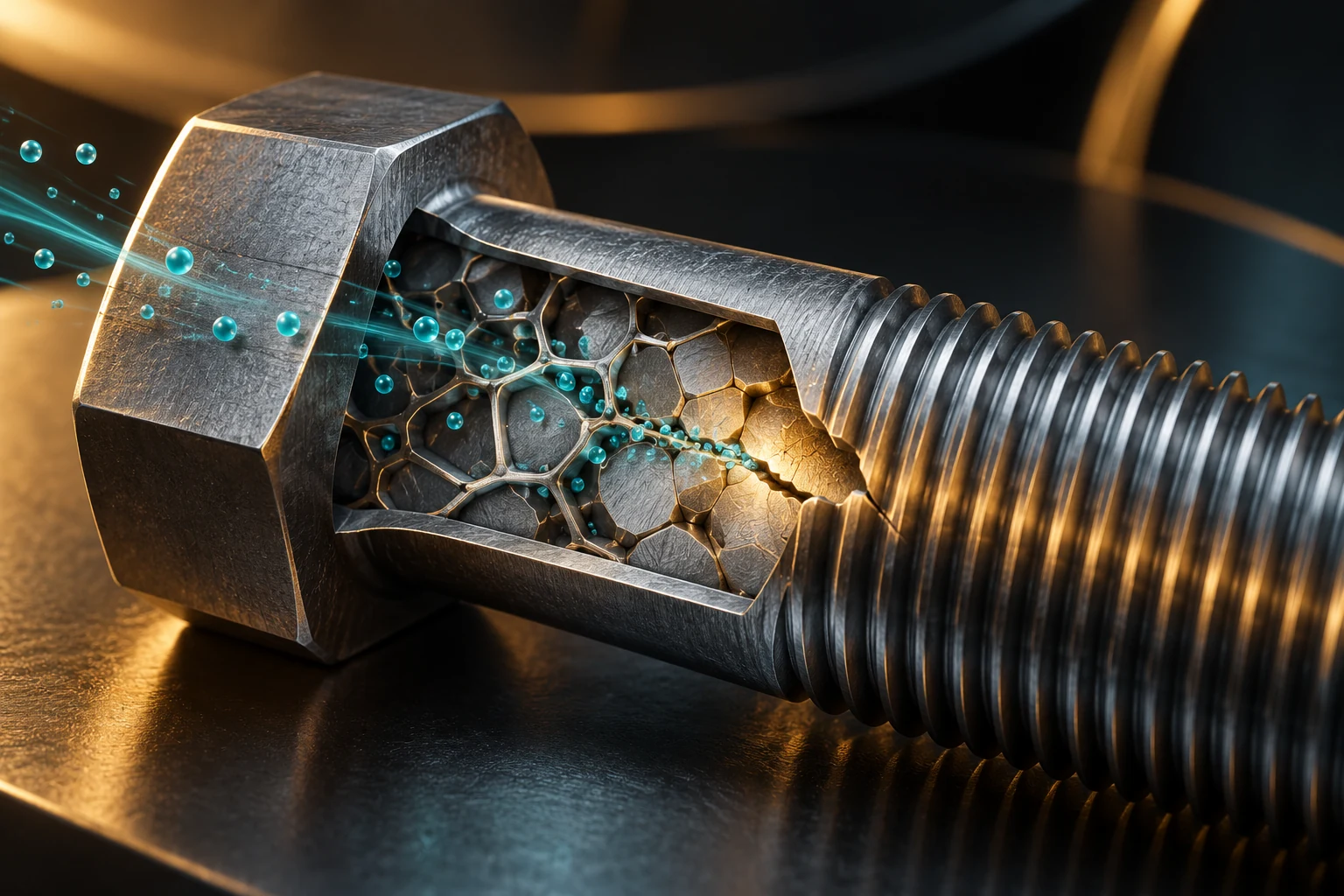
At a glance
Wohe Research interprets a 2025 paper on hydrogen embrittlement in high-strength steel, discussing the additional validation needed to translate material tests into fastener applications and directions for traceable research documentation.
Research question
How can material research inform a fastener hydrogen-embrittlement assessment with clearly defined limits?
Guidance & practice
Research observation / proposed research topic
This article interprets publicly available literature as of 2026-10-16. Wohe's research proposals are suggested directions; they do not represent approved projects, completed tests or developed products.
Research into high-strength fastener reliability must consider interactions among material, processing condition, load and environment. Hydrogen embrittlement requires careful interpretation: a material grade or the name of a treatment alone cannot support a complete assessment.
Starting from published material research, Hebei Wohe Fastener Manufacturing Co., Ltd. discusses its implications for technical assessment of fasteners. This is a research observation, not a certification of hydrogen-embrittlement resistance or a conclusion on a specific product's suitability.
What does a recent material study suggest?
In 2025, researchers examined the relationship between plastic deformation and hydrogen-charging conditions in ferritic high-strength steel containing TiC nanoprecipitates. Plastic deformation increased hydrogen uptake, but under that experimental arrangement, greater uptake did not directly correspond to a lower fracture strain. Research source: effect of plastic deformation on hydrogen embrittlement in ferritic high-strength steel
The study concerns a particular material and test conditions and cannot directly serve as an assessment of ordinary bolts. It suggests that a single measured indicator should not be simplistically equated with the ultimate failure risk.
What validation is missing between material specimens and fasteners?
Material specimens and actual fasteners differ in product geometry, processing and service conditions. These differences need to be defined when translating research findings into engineering applications.
| Assessment level | Questions worth checking |
|---|---|
| Material | Is the research material the same as the actual product material? |
| Processing condition | Are the forming and heat-treatment conditions comparable? |
| Surface condition | How are pretreatment and coating/plating conditions defined? |
| Load | Can the test loading method represent the intended application? |
| Environment | How are hydrogen exposure, duration and temperature specified? |
| Assessment | Which indicators identify damage and failure? |
These are questions for research design, not proof that a particular material is already suitable.
Wohe's proposed research direction
Manufacturers could consider establishing traceable specimen records linking material batch, processing condition, surface treatment and inspection results, and discuss dedicated validation with appropriately capable organizations.
A suggested starting point is to reduce the number of variables: for example, keep the product specification and material source fixed while comparing different confirmed treatment routes.
Research records should retain the full conditions, rather than only a “pass” conclusion. If abnormalities arise, specimen identity, treatment history and test condition should be traceable.
Which promotional claims should hydrogen-embrittlement research avoid?
Claims such as “hydrogen embrittlement can never occur” or “one treatment completely eliminates hydrogen embrittlement” lack clear limits and can exceed the evidence.
More technically meaningful statements should explain:
- Which product and material condition were assessed.
- Which method, load and environmental conditions were used.
- What scope the results cover.
- Which service situations remain unvalidated.
Looking ahead: from isolated reports to reliability documentation with defined conditions
One direction of interest to Wohe is presenting the applicable conditions more clearly in product reliability documentation.
In future, customer documentation might link material, treatment, testing and intended service conditions to make selection discussions more specific. This requires improvements in validation methods, data quality and responsibility boundaries together.
The engineering value of hydrogen-embrittlement research lies in progressively explaining influencing factors, identifying the applicable scope and supporting product assessment with appropriate evidence.
Methods, conditions and evidence
Public literature interpretation and engineering-question analysis are used to propose future validation directions. No Wohe in-house tests have been conducted or reported. The cited findings apply to the conditions of the original papers and cannot be directly extrapolated into product conclusions.
Findings
This page presents research observations and proposed topics. It does not mean that Wohe has approved a project, completed tests, deployed a system or developed a product. Actual engineering applicability still requires independent validation.
Scope and limitations
This article does not establish joint safety, product certification or suitability for a particular application. The research proposals do not mean that projects have been approved or validation completed. Findings from individual publications must not be used directly to set on-site torque, lubrication, reuse counts or disposition of critical joints. Actual applications should be assessed by appropriate technical personnel against the design, applicable specifications and confirmed inspection conditions.
Evidence and sources
Based on research-observation manuscripts supplied by the website owner, with all original literature links retained in the body. The manuscripts state a literature-search cutoff of 2026-10-16. For this publication, relevant publication details and publicly accessible abstracts or indexed excerpts were editorially checked; this was not a full-text review of every paper, and no Wohe on-site tests were conducted. The cited research findings belong to the original paper authors; the future proposals in this article are suggested directions.
Source document ↗https://www.nature.com/articles/s41529-025-00592-9Check the issuing organization for the full document and its latest status.
Article revision V1
First publication of research observations and proposed topics based on manuscripts supplied by the owner, using AI-assisted translation and conceptual illustrations.
You are reading the published revision. Later drafts are reviewed before they replace this page.