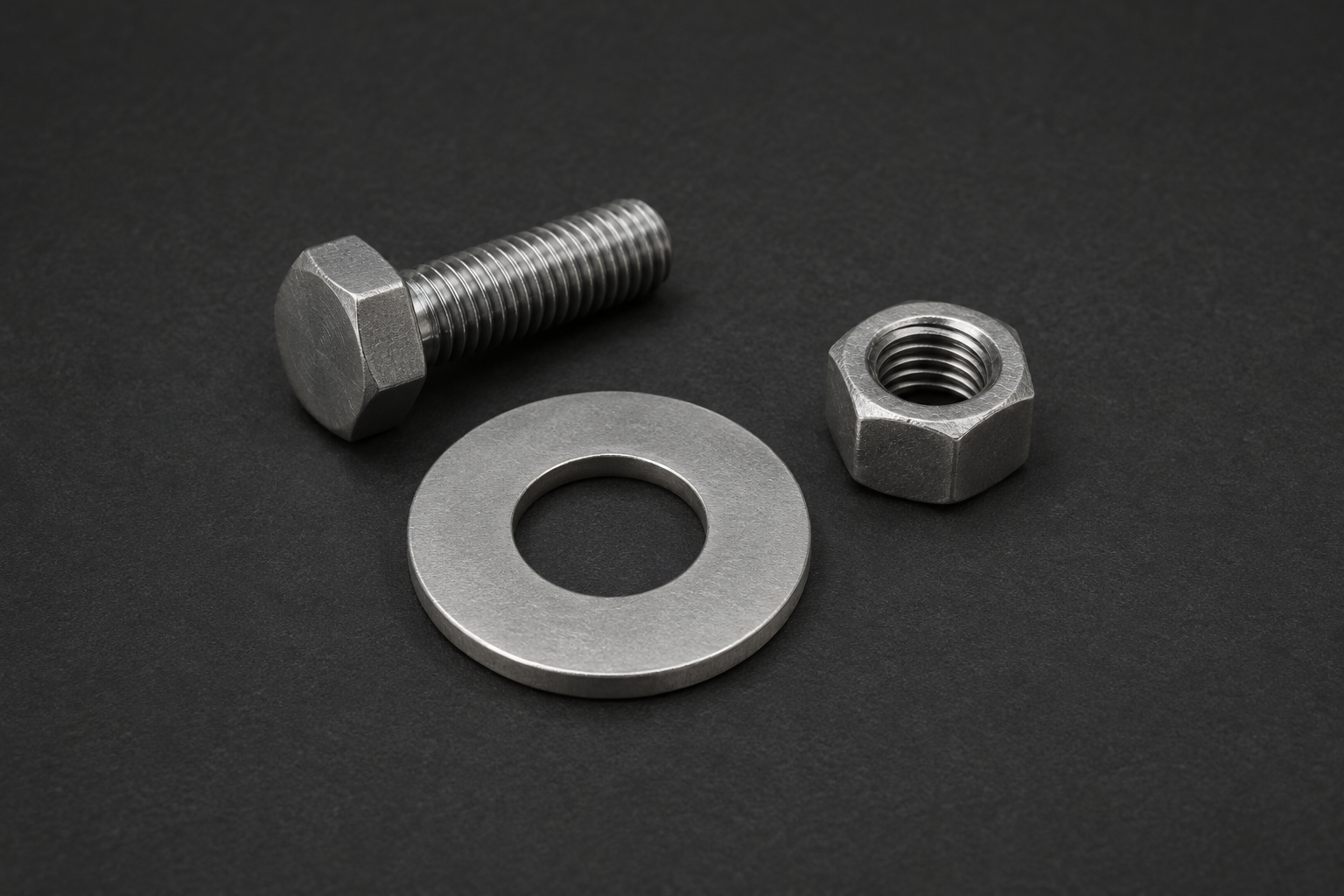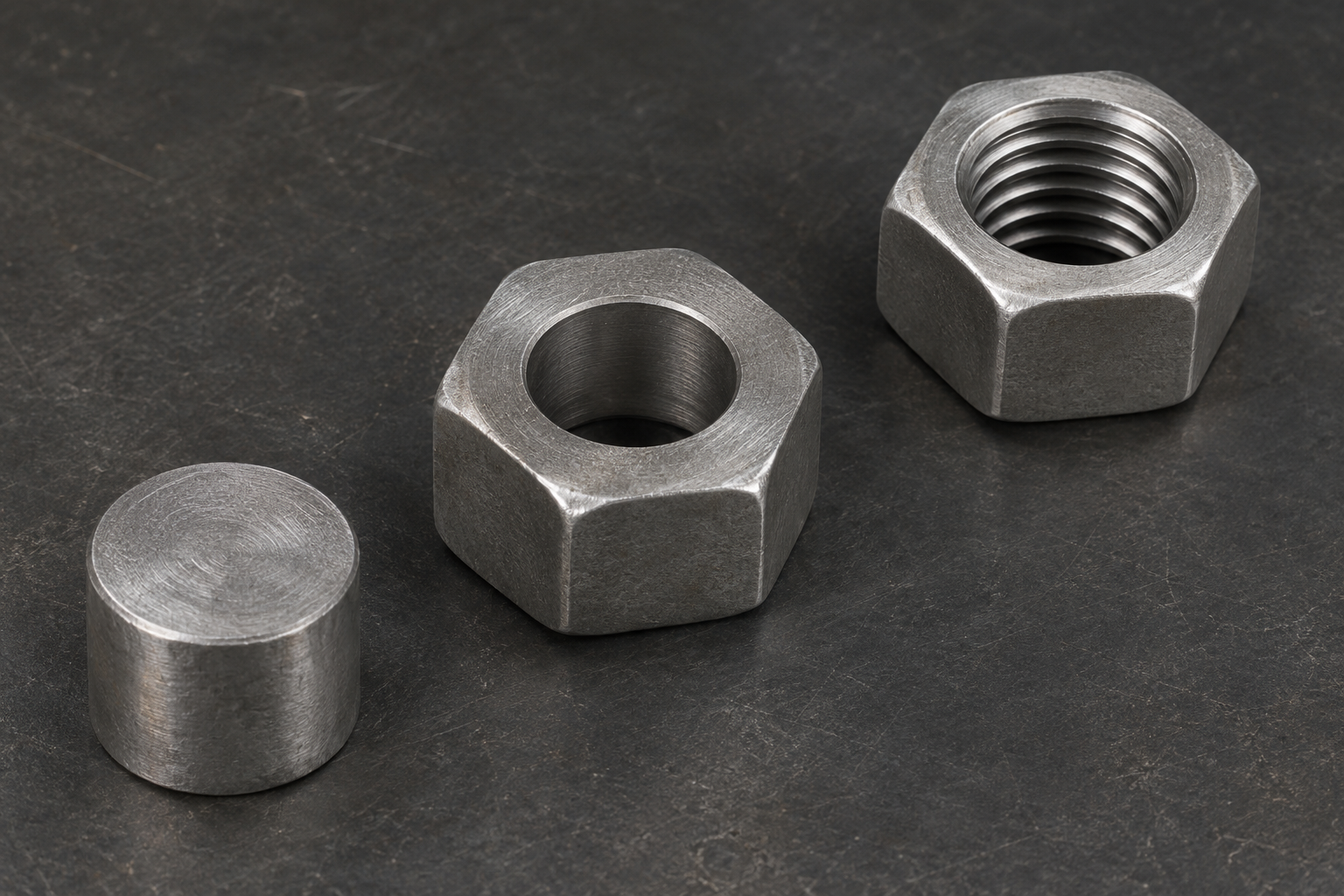
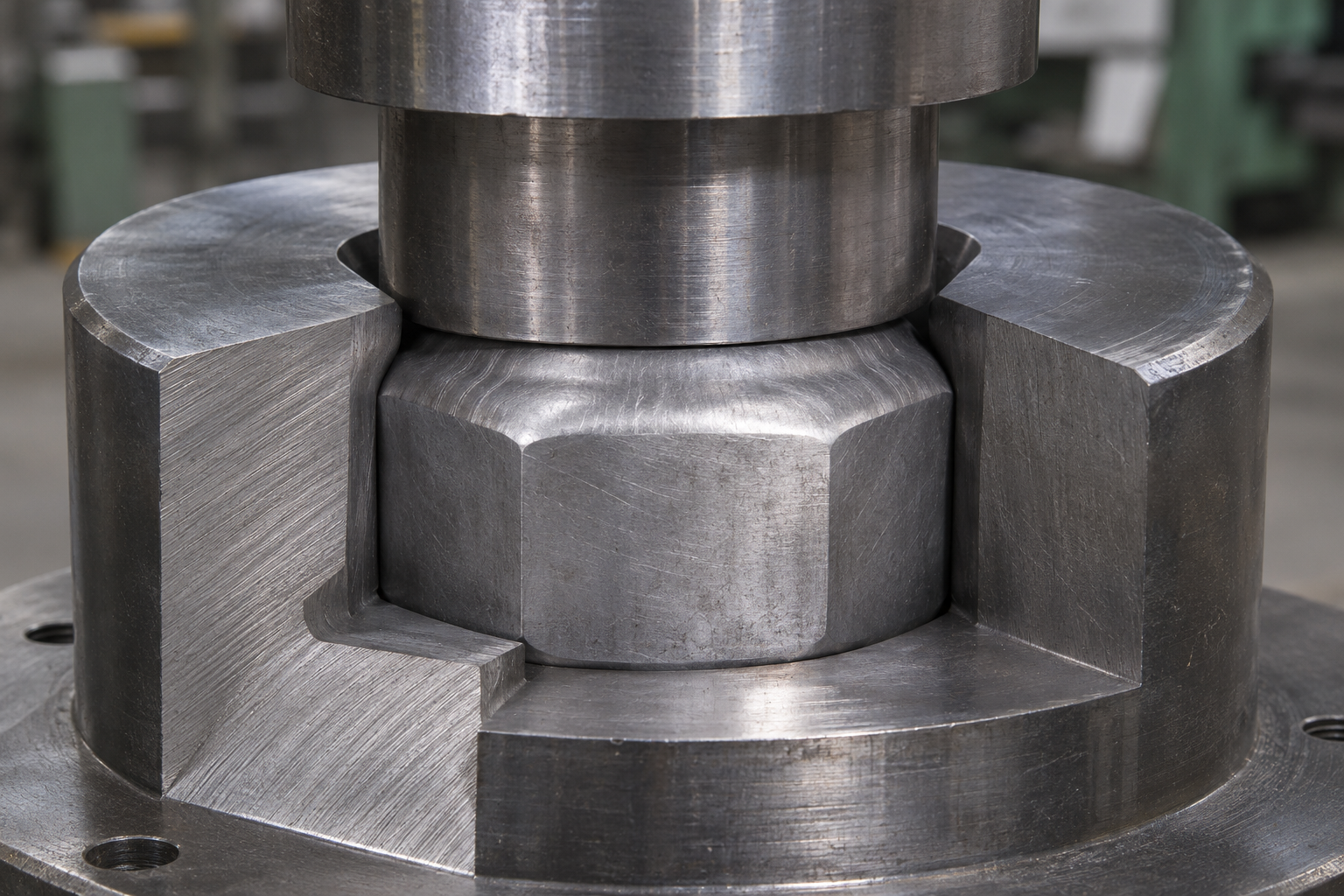
A steel slug enters the dies. It leaves with six wrench flats and a through hole, but it is still a blank. The internal thread comes later. On a typical steel hex nut route, stock is cut to length, cold formed and pierced in several stations, tapped, heat treated or surface treated as specified, and inspected before delivery. Here, “cold forming” covers upsetting, extrusion and piercing of a solid blank. The exact operations and their sequence vary with the product. [1]
Why cold form nuts in volume
Machining a hexagon from round stock and drilling the centre turns part of the steel into chips. In cold forming, the punch shortens the slug and the die directs metal outward, including towards the future bore wall. That saves material when the forming and machining allowances are well controlled. Piercing can still eject a slug, and cut tapping makes chips. After setup, several stations can work on different blanks in the same machine cycle. A steady volume spreads the cost of dies and setup. Short runs and frequent changeovers change that calculation. [1] [2]
One simulation of a long hex flange nut illustrates why station load matters. Closed-die flange upsetting peaked at 278.30 kN in station four. Piercing the web in station six peaked at 17.47 kN. The former drives much more steel into a constrained cavity. These are results for the study’s own geometry, material and tools, not general press settings for hex nuts. [8]
How the blank takes shape
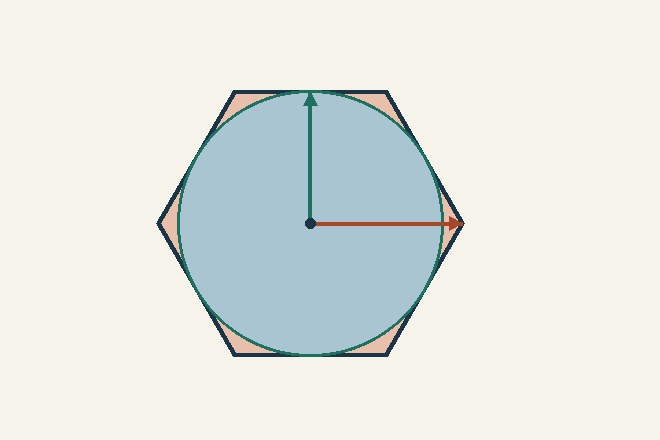
Cut-off volume depends on both diameter and length. For an ideal cylinder at fixed length, a 1% increase in wire diameter raises volume by 2.01%. A drift in blank mass is a reason to check both inputs. A production allowance also accounts for the piercing slug and subsequent machining. The punch shortens the blank axially and the die controls its outward spread. In an ideal regular hexagon, the distance from centre to corner is about 15.5% greater than the perpendicular distance to a flat. The circle can touch the flats while the corners remain empty. Actual filling also depends on blank mass, preform and friction. [2]
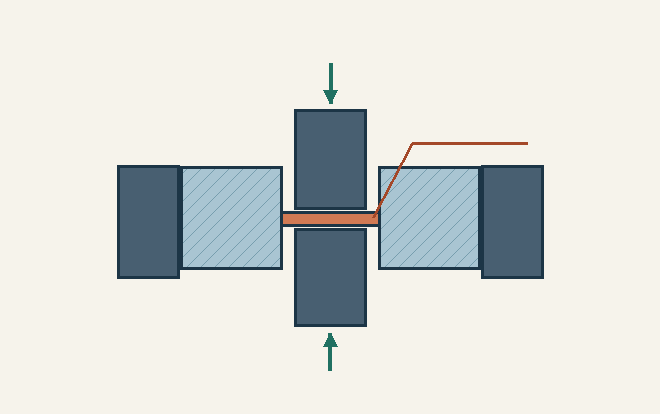
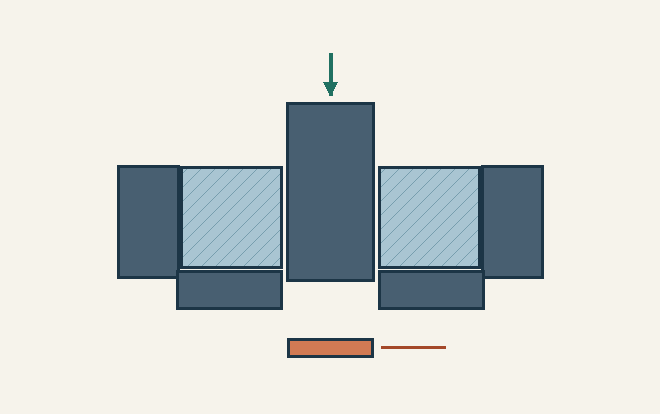
One published route faces the cut blank, forms a bevelled round, preforms the hexagon and forms a recess from each end. A thin web remains between the recesses. The rim is supported when the punch shears the web and ejects it as a slug. In that patent, piercing and final sizing share a station. The example takes the width across flats from 19.1 mm to 18.8 mm. Neither value prescribes an order dimension. [3]
The resulting bore is prepared for tapping. A cutting tap removes material to generate a helical thread. An oversized hole can leave too little material for the profile, while an undersized hole increases the cutting load. A forming tap displaces metal instead, so the pilot-hole dimensions must suit that tool and material. [4]
Upset the blank
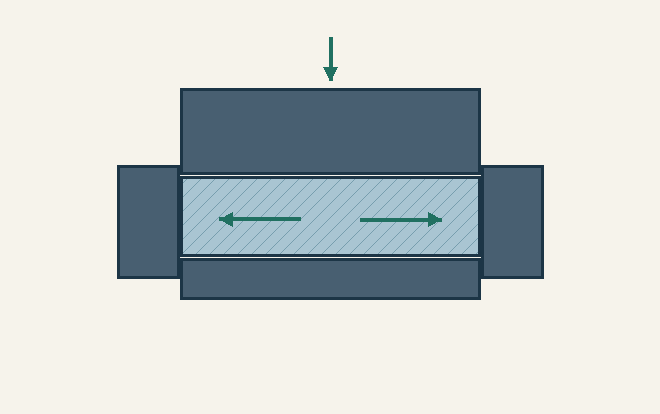
Punch / Die / The blank spreads sideways. The punch shortens the blank and the die constrains the profile.
Preform both ends
Web. The two recesses are still separated by a thin web.
Pierce through
Support / Ejected slug. The tooling supports the rim while the slug exits. Dark shapes are tools, blue is the workpiece, and orange marks the web and slug. These are simplified axial sections.
Which nuts suit this route
Regular steel hex nuts are good candidates when the steel can sustain the deformation, the tools and machine have sufficient capacity, and volume is steady. With a larger section, an abrupt change of section or a steel that is difficult to form cold, reassess tool load and cracking risk. Hot forging can improve formability. Machining may be practical for small runs or difficult features, and a forged blank can be machined locally. Thread diameter alone does not settle the route. [1]
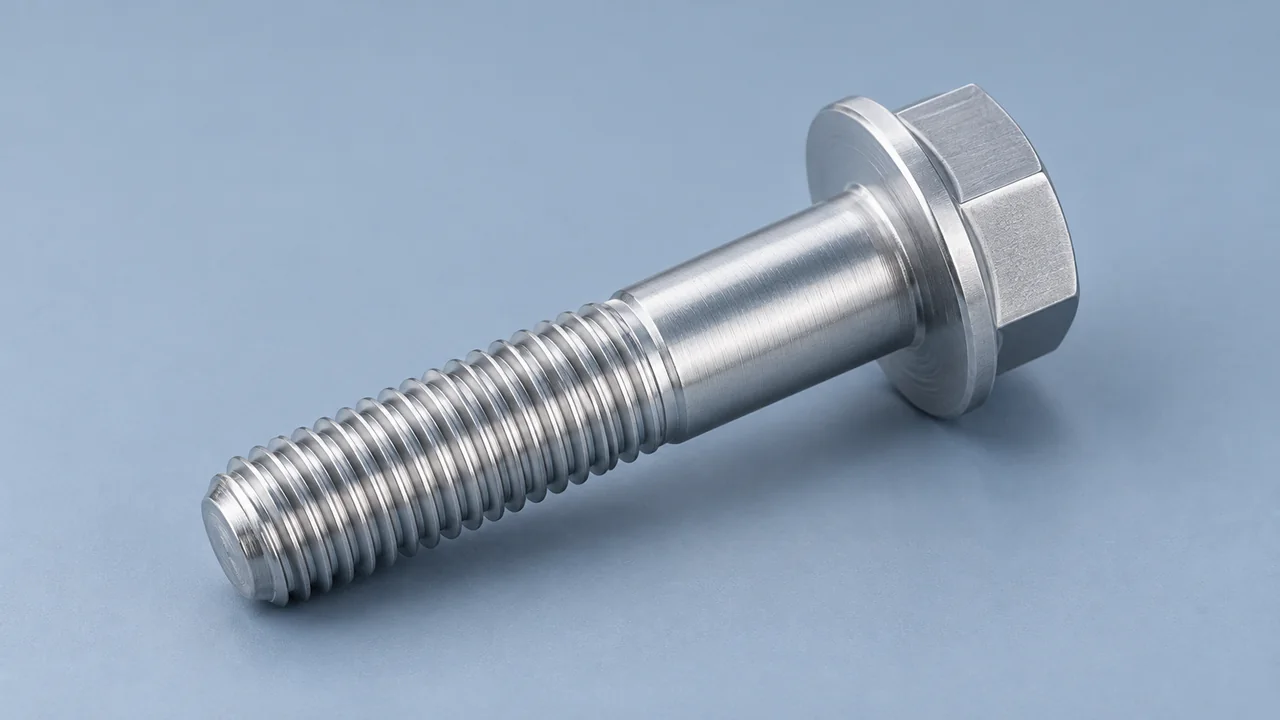
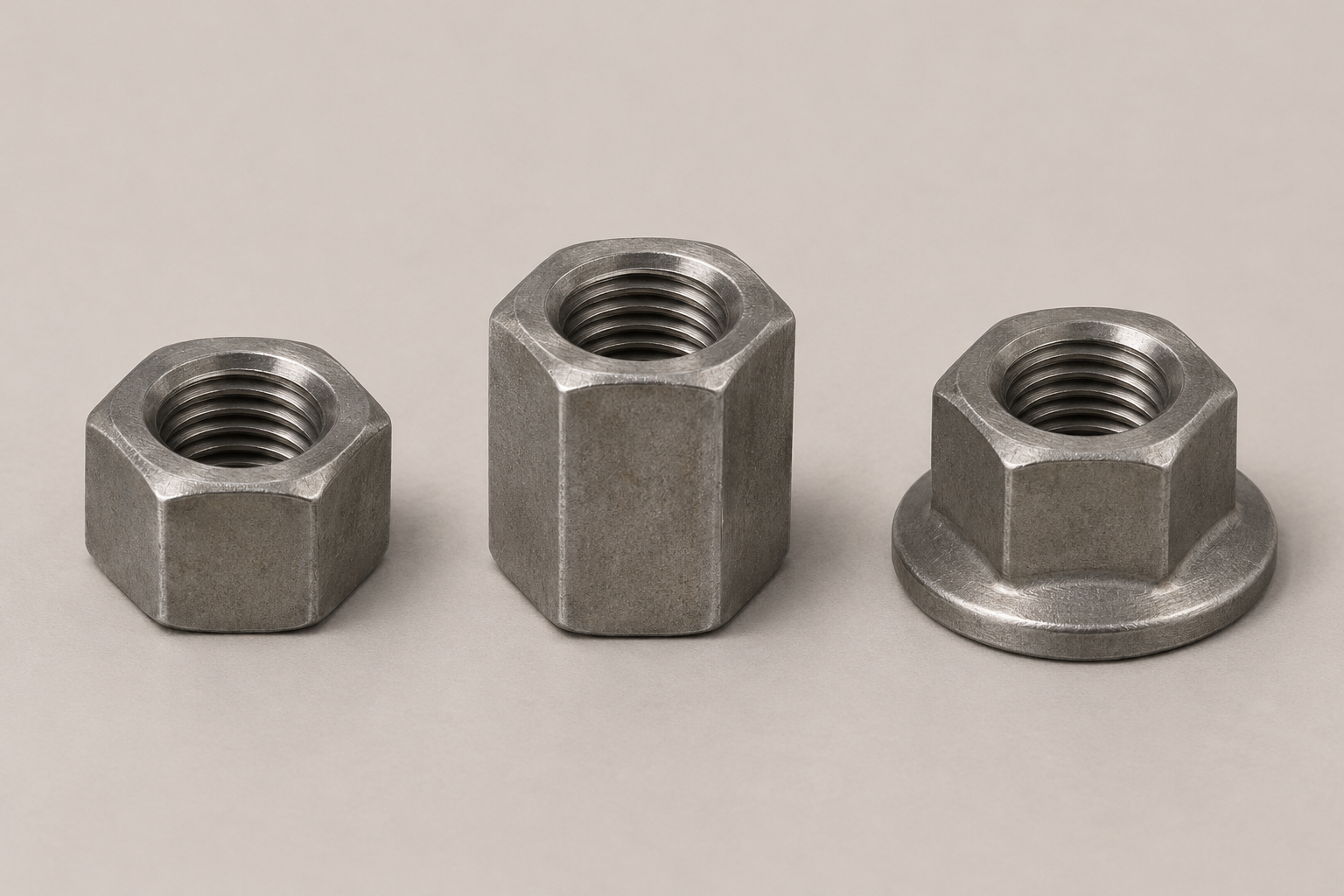
Regular, high and flange hex nuts illustrate three shapes that can be cold formed under suitable conditions. A long bore and a flange pose different problems: depth and location for the bore, and filling for the flange. Splitting them across tools can distribute the load. A sheet-metal U-nut uses blanking and bending for its spring clip instead. [1] [5] [8]
What changes in the steel
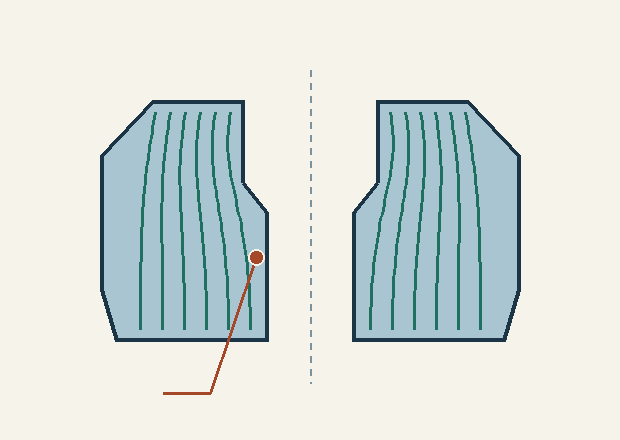
As a slug shortens and material flows into the corners or around a recess, the grains and inclusions reorient in the direction of deformation. Regions that deform more tend to work harden. This raises resistance to further deformation and makes the steel’s delivery condition important as well as its grade. [6] [7]
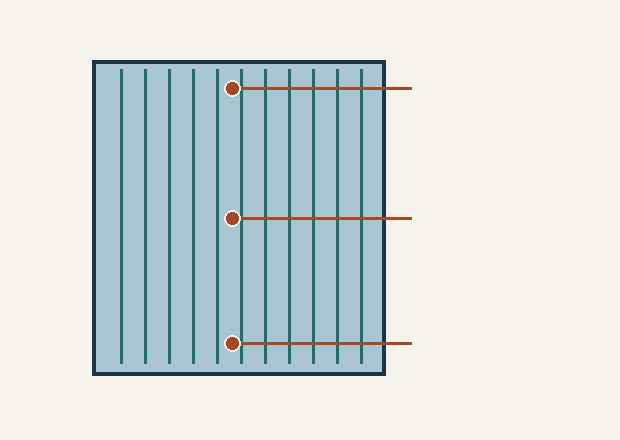
Yang and Liu measured an AISI 1010 low-carbon steel regulating nut. Mean cross-section hardness rose from 158.6 HV in the sheared billet to 207.6 HV after five stages, about 31%. Near the bore wall the final-stage local mean was about 240 HV. Even before forming, the sheared billet measured about 142 HV at mid-section and about 173 HV and 194 HV near the ends. These are readings from that particular specimen. Identify the part state and measurement location when comparing hardness, and verify the finished state if the process includes heat treatment. [7] [9]
Grain flow and hardness
Sheared billet
≈173 / 142 / 194 HV · Section average: 158.6 HV
After five forming stages
Near the bore wall · Local average: ≈240 HV · Section average: 207.6 HV
What shows up in the finished nut
The width across flats can pass while corners are underfilled. An off-centre pilot hole can also carry its position error into tapping. Compare pierced blanks and tapped parts from the same batch to see whether to trace the issue back to blanking, fill or hole location, or to check the tapping fixture and tool. [2] [8]
Take an illustrative 16.0 mm hexagon across flats with an 8.4 mm plain bore. The centred case leaves 3.8 mm each side, measured normal to the flats. Move the bore 0.8 mm towards one flat and the distances become 4.6 mm and 3.0 mm without changing the bore diameter or the width across flats. That is a geometry example, not a tolerance or a thread dimension.
Check shape, surface, thread and mechanical properties separately. A wrench engages the flats, a thread gauge checks the applicable dimensional limits, and a proof-load test assesses behaviour under the load prescribed for the applicable size and property class. A trial fit answers only whether those two items screw together. Looking at the blank and the finished nut together helps locate the operation that introduced a deviation and pick the check that will detect it. [9]
Same hexagon and bore diameter, different bore position
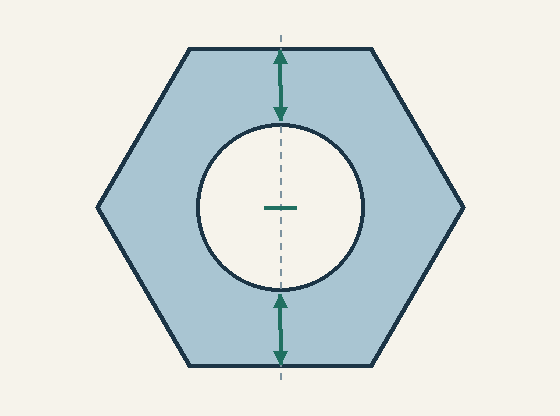
Centred bore
3.8 / 3.8 mm
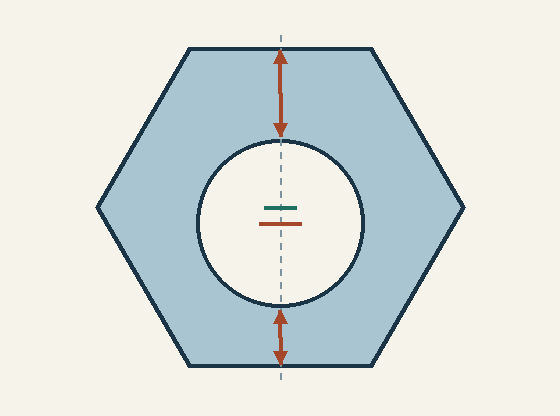
Bore offset by 0.8 mm
4.6 / 3.0 mm
Technical references
- Würth Industrie Service · Manufacturing screws and nuts
- Hsia et al. · Fabrication improvement of cold forging hexagonal nuts
- US4299000A · Method for the production of threaded nuts by cold forming
- Sandvik Coromant · Solid Round Tools, Session 9
- ARaymond · Speed Nut catalogue
- ISO 4954-1:2024
- Yang & Liu · Multi-stage cold forming of relief valve regulating nuts
- Hsia & Shih · Tool wear in cold forging long hex flange nuts
- GB/T 6170-2015 · ISO 6157-2:1995 · ISO 1502:1996 · GB/T 3098.2-2025 · ISO 898-2:2022